
The Tool Desk
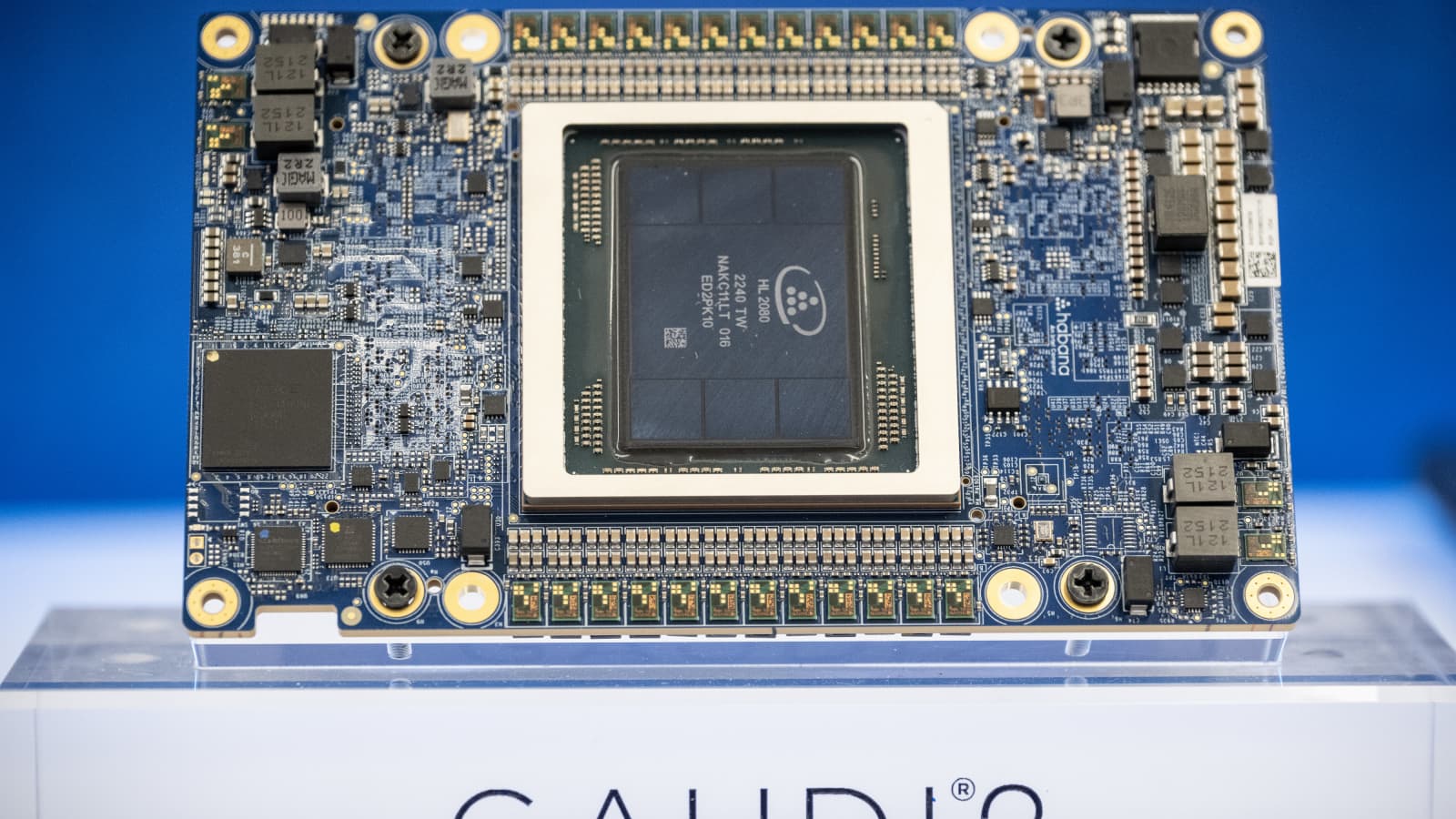
Outbyte Driver Updater FREEFix the driver behind crashes, sound loss and screen glitchesFind Drivers →Outbyte PC Repair FREERepair Windows errors before they cause bigger problemsFix Now →Intel’s latest AI accelerator, the Gaudi 3, is positioned as a strong contender against Nvidia’s well-regarded H100, suggesting a heated competition in the AI hardware market. Gaudi 3’s introduction marks a significant step by Intel to capture a share of the market dominated by Nvidia.
Intel’s Gaudi 3 AI accelerator showcases impressive advancements over its predecessor and Nvidia’s current offerings, potentially reshaping the competitive landscape. Gaudi 3, fabricated using TSMC’s 5nm process, mirrors the sophisticated fabrication process used by Nvidia for its H100, which employs a slightly refined 4N process from the same manufacturer. This places both chips at a similar starting point in terms of manufacturing precision and potential performance capabilities.
| # | Preview | Product | Price | |
|---|---|---|---|---|
| 1 |

|
MINISFORUM MS-02 Ultra Workstation Mini PC, Intel Core Ultra 9 285HX (24C/24T, up to 5.5GHz), PCIe... | $1,659.00 | Buy on Amazon |
| 2 |

|
GMKtec EVO-X2 AI Mini PC Ryzen Al Max+ 395 Superchip 128GB LPDDR5X 2TB SSD | $3,649.99 | Buy on Amazon |
Gaudi 3 stands out with its 128GB HBM3e memory, which exceeds the H100’s 80GB HBM3, offering a significant edge in handling larger datasets and more complex AI models, particularly beneficial for AI training workloads. Additionally, Gaudi 3 boasts a four-fold increase in BFloat16 performance over its predecessor, a feature that might give it an advantage in specific AI tasks that benefit from this type of computation.
Intel has also focused on enhancing the networking capabilities of Gaudi 3, doubling the bandwidth compared to its previous generation, which is essential for distributed AI applications and large-scale deployments. Although the H100 holds a slight edge in peak network bandwidth, Gaudi 3’s improvements signify Intel’s commitment to robust communication capabilities.
Shopping ad
- High-Performance AI Processor:The MS-02 Ultra features an Intel Core Ultra 9 285HX (24C/24T, up to 5.5 GHz, 13 TOPS NPU), delivering fast and efficient performance for AI inference, algorithm development, and media workloads. A PCIe x16 expansion slot supports desktop-class GPU upgrades for advanced model training and accelerated computing tasks. It's ideal for creators, engineers, and teams handling intensive parallel workloads.
- 4 × M.2 PCIe 4.0 + 4 × DDR5 SODIMM slots:Four DDR5 SODIMM slots support up to 256 GB of memory, while ECC helps maintain data integrity in mission-critical environments. Four PCIe 4.0 M.2 slots support up to 24 TB of storage, supporting RAID 0/1/5/10, combining high-speed performance with data protection. It allows for the creation of independent scratch disks, media libraries, and project drives, providing high-throughput for production workflows.
- PCIe & USB 4.0 v2: Up to three PCIe slots can be equipped, including a dual-slot x16 GPU. The main slot supports PCIe 5.0, meeting the needs of high-bandwidth creative and computing workloads. USB 4.0 v2 (80Gbps) supports high-bandwidth external storage and displays.
- Ultra-fast Networking: Wi-Fi 7 further enhances wireless performance with next-generation speeds and low-latency stability. Intelligent bandwidth switching optimizes throughput in different network environments, ensuring optimal performance for enterprise or local networks. Dual 25GbE ports (providing up to approximately 3.125 GB/s bandwidth, about 25 times faster than traditional 1GbE), enabling seamless large-scale file transfers and parallel computing. 10GbE and 2.5GbE ports, with support for Intel vPro technology, ensure enterprise-grade remote management and deployment flexibility.
- Server-grade thermal architecture: Utilizing a dedicated CPU/GPU airflow design, equipped with a 6-pipe dual-fan cooler, it maintains stable performance even under sustained loads, delivering up to 140W Turbo power while maintaining a 100W TDP, and operating with noise levels as low as 36 dB. An integrated 350W power supply ensures stable and reliable output for demanding computing tasks and fully loaded extended configurations.
One of the most critical aspects of Gaudi 3 is its power efficiency, facilitated by the advanced 5nm process. This not only potentially reduces operating costs but also aligns with a growing demand for sustainable AI computing practices.
Despite these enhancements, the H100 remains formidable, boasting leading benchmarks in several areas and a mature ecosystem that includes extensive developer support through Nvidia’s CUDA platform. The challenge for Intel lies not only in matching the technical specifications of the H100 but also in cultivating a similarly strong ecosystem around Gaudi 3.
Intel’s strategy includes forming partnerships with major enterprises and fostering an open platform for AI that could encourage broader adoption of Gaudi 3. Companies like Bosch, IBM, and Google Cloud have been involved in various capacities, integrating or supporting Gaudi’s capabilities in their operations, which could help Intel gain ground.
Shopping ad
- EVOLUTION RYZEN AI MAX+ 395 MINI PC - GMKtec EVO-X2 is the next evolution in AI mini PC Ryzen Strix Halo series. Thanks to AMD Simultaneous Multithreading (SMT) the core-count is effectively doubled, to 32 threads. Ryzen AI Max+ 395 has 64 MB of L3 cache and can boost up to 5.1 GHz, depending on the workload. The Ryzen AI Max+ 395 is currently rated as the "most powerful x86 APU" on the market for AI computing.
- AI NPU with XDNA 2 ARCHITECTURE - Powered by 16 “Zen 5” CPU cores, 50+ peak AI TOPS XDNA 2 NPU and a truly massive integrated GPU driven by 40 AMD RDNA 3.5 CUs, the Ryzen AI MAX+ 395 is a transformative upgrade and delivers a significant performance boost over the competition. The Ryzen AI Max+ 395 excels in consumer AI workloads like the llama.cpp-powered application: LM Studio. Shaping up to be the must-have app for client LLM workloads, LM Studio allows users to locally run the latest language model without any technical knowledge required and unleash their creativity and productivity.
- AMD RADEON 8090S iGPU GAMING PC - The AMD Radeon RX 8060S offers all 40 CUs with up to 2.9 GHz graphics clock and uses the new RDNA 3.5 architecture. The powerful iGPU is positioned between an RTX 4060 and 4070 laptop GPU and therefore enables gaming in FHD at maximum details in most demanding games. The 8060S can also utilize the full 128GB pool, which is perfect for running LLMs such as Deepseek 70B Q8, which runs comfortably on this machine.
- EIGHT CHANNEL LPDDR5X - LPDDR5X is a new ground breaking memory small form factor installed on-board. With blazing speeds up to to 8000MT/s, it runs 1.5x faster than the DDR5 SODIMMs; 90% better performance over DDR5 SODIMMs in video conferencing and photo editing; 30% better performance in productivity apps; 12% better performance in digital content workloads.
- QUAD SCREEN 8K DISPLAY SUPPORT - EVO-X2 AI Mini PC support 4-screen 4K/8K output via HDMI 2.1 (8K@60Hz), DisplayPort 1.4 (4K@60Hz), and dual USB 4 40Gbps Transfer speed (supporting PD3.0/DP1.4/DATA). Ideal for gaming, video editing, and multitasking, it provides expansive and crisp multi-display support.
The AI accelerator market remains a dynamic arena with Nvidia currently leading. However, Intel’s Gaudi 3, with its focus on advanced memory, improved power efficiency, and enhanced networking, represents a significant challenge that could influence future trends in AI hardware development.
While Nvidia’s H100 has established a strong position, Intel’s Gaudi 3 is set to disrupt the market, offering features that promise competitive performance, efficiency, and potentially lower costs. The ultimate impact of Gaudi 3 will depend on its real-world application performance and how quickly developers adopt and optimize their AI solutions around it.
Quick Recap
Product prices and availability are accurate as of the date/time indicated and are subject to change. Any price and availability information displayed on Amazon at the time of purchase will apply.
Independent reader supportYour contribution helps us test, update, and keep practical guides available for everyone.
