
Acra database security suite
cossacklabs.com · checked 15 Oct 2026
Acra encrypts and controls sensitive data in SQL, NoSQL, web, and backend applications.
How it plugs in
Signal on Cloud Encryption Software7.7#1 of 23
Acra is a self-hosted database security suite for protecting selected fields and records. It offers field-level and searchable encryption, masking, tokenization, query rules, intrusion alerts, and signed audit logs. It runs on Linux, Docker, or Kubernetes-compatible images, connects with several databases and key-management services, and has free and paid editions.
Review
In a line
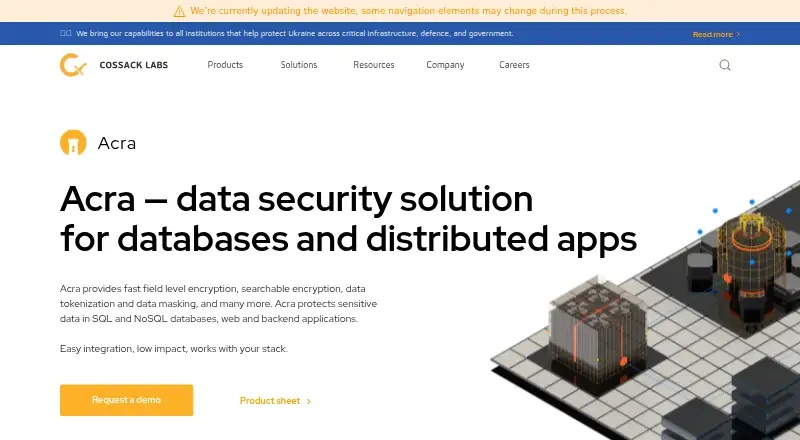
Acra is a database security suite for sensitive data in SQL and NoSQL databases, web applications, and backend systems.
Cossack Labs offers Community and Enterprise editions, plus a custom solution.
What it does
Acra encrypts chosen database cells or fields, including with AES-256-GCM cryptographic containers. It also supports searchable encryption, tokenization, and partial or full masking of values.
AcraCensor checks database queries against rules. The system can detect planted poison records or honeytokens, raise alarms, and stop decryption. Enterprise editions add cryptographically signed logs for access and security events.
Key utilities handle key generation, export, backup, rollback, and enterprise rotation without re-encrypting stored data.
How it connects
AcraServer supports PostgreSQL and MySQL wire protocols, including MySQL 5.7+, PostgreSQL 9.4+, and MariaDB 10.3. It also lists MongoDB, Redis, Cassandra, and TimescaleDB among its NoSQL and key-value integrations. MySQL is one of the supported database options.
You can deploy Acra as a transparent SQL proxy, an HTTP or gRPC encryption API, or client-side SDKs. AcraTranslator provides those HTTP and gRPC interfaces, with SDKs for Ruby, Python, Go, C++, Node.js, PHP, Swift/Objective-C, Java, and Kotlin.
For key storage and management, documented integrations include Amazon KMS, Google Cloud KMS, HashiCorp Vault, Keywhiz, and hardware security modules. Components require TLS 1.2 or newer.
Good fit
Acra suits teams that need to protect selected data fields across distributed applications while keeping control of their own infrastructure.
It fits prototypes and small projects through Community Edition, while Enterprise Edition targets large-scale and enterprise deployments. Linux packages, Docker images, Kubernetes-compatible images, and source builds support hybrid, self-hosted setups.
The service is cloud-agnostic and supported on Google Cloud Platform, AWS, and DigitalOcean.
Watch for
Server-side Acra components should not run on Windows. Windows clients can connect to Acra hosted on a Linux server, but Windows is also unsupported for source builds.
Community Edition does not support MySQL Protocol X and has limited platform, integration, and database support. It also allows one configuration policy.
Check edition needs, database protocols, and key-management requirements before deployment. Server builds require a supported stable Go compiler and Themis libraries.
Pricing
Acra uses a freemium model. Community Edition is free forever and includes core encryption and masking, a SQL request firewall, basic intrusion detection, and limited support for platforms, integrations, and databases.
Enterprise Edition starts at $10,000 a year. It adds all Acra features and controls, support tiers, DevOps/SRE tooling, policy management, and deployment assistance.
A bespoke solution is priced on request and can include custom masks and protocols, custom behavior, use-case features, and engineering or architecture support. A free evaluation playground for selected use cases runs Enterprise Edition.
Verdict
Choose Acra if your applications need encryption, masking, tokenization, or searchable protection while data stays in your infrastructure. Its proxy, API, and SDK choices cover several application designs, and its KMS links support external key storage.
Community Edition is a practical starting point for prototypes and smaller projects, but its protocol and support limits may rule it out for broader deployments. Enterprise pricing starts at $10,000 annually, so larger organizations should confirm requirements and support needs before committing.
Our take
Acra is a fit for organizations that need application-level control over sensitive database values and want to keep deployment in their own environment. It covers SQL and NoSQL stores, several key-management systems, and multiple integration styles. The free Community Edition can support early or small projects, while enterprise users pay at least $10,000 per year for the full feature set and support options. Avoid it if Windows hosting is required or if Community Edition’s database and policy limits do not meet your design.
- Field-level encryption, masking, tokenization, and searchable encryption
- Works with SQL and NoSQL databases
- Integrates with major cloud KMS products, Vault, Keywhiz, and HSMs
- Self-hosted through Linux packages, Docker, Kubernetes, or source builds
- Free Community Edition and free evaluation playground
- Server-side components do not support Windows hosting
- Community Edition lacks MySQL Protocol X support
- Community Edition has limited platforms, integrations, databases, and one policy
- Enterprise pricing starts at $10,000 annually
- Source builds require Go and Themis libraries
- Pick it ifTeams protecting sensitive fields across distributed applications; Organizations using Linux-based, self-hosted or hybrid deployments; Prototypes on Community Edition or enterprises needing full controls
- Skip it ifYou must host the server components on Windows; You need MySQL Protocol X in Community Edition; Your budget cannot support enterprise plans starting at $10,000 per year
Pricing
Community Edition is free forever. Bespoke solutions are priced case-by-case. A free Enterprise evaluation playground is available for selected use cases.
- Acra Community Editionfree forever · core encryption and masking · SQL request firewall · basic intrusion detection · single configuration policy · limited platform, integration and database supportFree
- Acra Enterprise Editionstarting at $10000 annually · all Acra features and controls · support tiers · DevOps/SRE tooling · policy management · deployment assistance$10,000/yr
- Acra bespoke solutioncase-by-case · custom masks and protocols · custom behavior · use-case features · engineering and architecture supportOn request
As cossacklabs.com lists them, checked 15 Oct 2026.
Questions
Does Acra have a free plan?
Yes. Community Edition is free forever and includes core encryption and masking, a SQL request firewall, basic intrusion detection, and limited platform, integration, and database support.
Which databases does Acra support?
AcraServer supports MySQL 5.7+, PostgreSQL 9.4+, and MariaDB 10.3 wire protocols. Listed NoSQL and key-value integrations include MongoDB, Redis, Cassandra, and TimescaleDB.
Can Acra run on Windows?
Server-side Acra components should run on Linux, not Windows. Windows clients can connect to Acra on a Linux server, but Windows source builds are unsupported.
What key-management services connect to Acra?
Documented integrations include Amazon KMS, Google Cloud KMS, HashiCorp Vault, Keywhiz, and hardware security modules.
How can applications connect to Acra?
Acra can act as a transparent SQL proxy, an HTTP or gRPC encryption API, or client-side SDKs. SDKs are available for Ruby, Python, Go, C++, Node.js, PHP, Swift/Objective-C, Java, and Kotlin.
What does Enterprise Edition cost?
Enterprise Edition starts at $10,000 a year, billed annually. It includes all Acra features and controls, support tiers, DevOps/SRE tooling, policy management, and deployment assistance.
Near it
All alternatives →- M
 MySQL#2 on this board
- TC
 Thales CipherTrust Data Security Platform#3 on this board
- CD
 Cosmian Data Protection Suite#4 on this board
- E
 Evervault#5 on this board
- C
 Cryptomator#6 on this board
- VDVirtru Data Security Platform#7 on this board
- PP
 PK Protect#8 on this board
- ILIronCore Labs SaaS Shield#9 on this board
- S
 Skyflow#10 on this board
- FD
 Fortanix Data Security Manager#11 on this board