Healthcare Workflow Automation Software
AKASA Platform: Healthcare Revenue Cycle AI Review
akasa.com · checked 16 Nov 2026
Generative AI platform for automating healthcare revenue cycle work.
How it plugs in
Signal on Healthcare Workflow Automation Software5.9#6 of 25
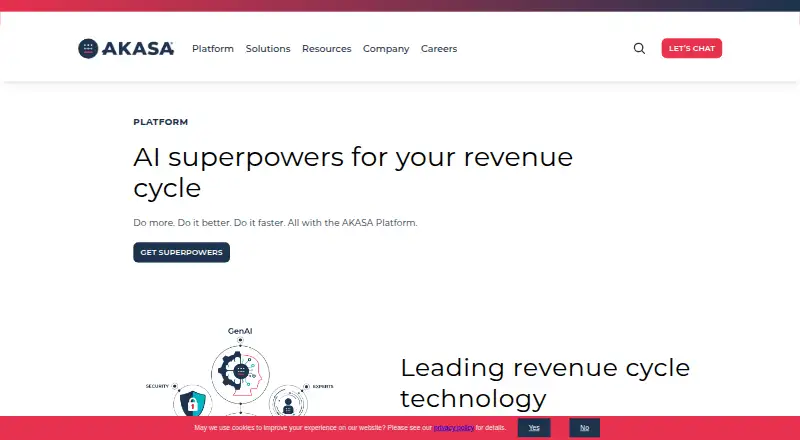
Generative AI from AKASA is aimed at revenue cycle operations in hospitals and health systems. The service helps automate workflows, coding, denials, status inquiries, reporting, and models customized with a health system’s data. Web and API access connect with EHRs through API and EDI standards, while secure data exchange avoids on-premise deployment. Platform pricing is quoted on request.
Review
In a line
AKASA Platform is a paid generative AI service for healthcare revenue cycle operations. Its tools target hospitals, health systems, and the teams handling billing-related work.
What it does
The platform can automate complete revenue cycle workflows or help staff finish individual tasks faster. Available tools cover prebill optimization, coding and clinical documentation improvement (CDI), authorization status, claim status, and AI Advisor functions. Denial management and coding support are included.
AKASA reports that its healthcare models draw on clinical and financial data, with more than 57 million clinical documents included to date. Health systems can also have models fine-tuned with their own data, according to AKASA.
The service combines AI with in-house revenue cycle specialists, whose average industry experience is more than 15 years.
How it connects
Electronic health records and other clinical repositories connect with AKASA through standards-based interfaces, including API and EDI. EDI is a structured way for systems to exchange business documents.
Users can reach the service through web or API endpoints and choose among secure data-exchange methods; AKASA says local installation is unnecessary. Configurable production reports and peer benchmarking are available, with regular guidance from a dedicated account manager.
AKASA characterizes its infrastructure as HIPAA-compliant and names HITRUST CSF, SOC 2, NIST-800-53, and CIS among its standards. It says ZeroTrust VPN, FIPS 140-2-compliant encryption for data at rest and in transit, access controls, continuous monitoring, and an incident-response policy are also part of its controls.
Good fit
Hospitals and health systems may consider AKASA when revenue cycle teams need to automate complex workflows or reduce repetitive work. It is aimed at organizations already using clinical data repositories and needing coding, denial, authorization, claim-status, or prebill support.
Watch for
Check that your EHR and other repositories can exchange data through the supported API or EDI standards.
Pricing is not posted publicly, so a buyer must request a quote. Confirm which workflows, data exchanges, reports, model tuning, and account support are included for your organization.
Pricing
The Prebill Optimization Suite uses a performance-based charge: there are no initial fees, and invoices follow measurable financial improvement.
Verdict
AKASA is a focused option for hospital and health-system revenue cycle departments seeking healthcare-trained AI with specialist support. Its workflow tools, custom-model option, reporting, and security controls may suit organizations prepared to connect sensitive clinical and financial data.
Organizations seeking self-hosted deployment or transparent list pricing should account for AKASA’s stated deployment and quote-based pricing model. Buyers should map their existing EHR connections and agree on how performance-based charges will be measured before signing.
Our take
Choose AKASA Platform if your organization is a hospital or health system with a revenue cycle team and you want AI-assisted automation tied to clinical and financial data. Its scope covers coding, denials, prebill work, authorizations, claims, reporting, and custom model tuning, with no on-premise installation. The trade-offs are a healthcare-only focus and pricing that requires a sales discussion. Prebill Optimization has a performance-based fee structure, so define the financial measures and connected systems before committing.
- Healthcare-specific models trained on more than 57 million clinical documents
- Supports coding, denial, prebill, authorization, and claim-status work
- Clinical repositories such as EHRs can connect through API and EDI standards
- No on-premise installation; multiple secure data-exchange options
- Configurable reports, peer benchmarks, and dedicated account guidance
- Pricing is available only on request
- Designed for hospitals, health systems, and revenue cycle teams
- Requires checking compatibility with your EHR and data-exchange standards
- Performance-based Prebill billing depends on measurable financial improvement
- Pick it ifHospitals and health systems automating revenue cycle workflows; Revenue cycle teams needing coding and denial support; Organizations seeking healthcare-specific AI with managed guidance
- Skip it ifYou require public price lists or a self-hosted installation; Your systems cannot use the supported API or EDI connections
Pricing
AKASA charges for the platform and quotes pricing on request. Prebill Optimization uses performance-based billing, with no upfront fees and invoices after measurable financial improvement.
Questions
Who uses AKASA Platform?
AKASA positions the platform for hospitals, health systems, and healthcare revenue cycle teams.
Which revenue cycle work can AKASA automate?
Listed tools cover prebill optimization, coding and CDI optimization, authorization status, claim status, AI Advisor, and denial management.
Can AKASA connect to an EHR?
Yes. EHRs and other clinical data repositories can connect through standards-based API and EDI interfaces.
Is local installation needed?
AKASA says its tools work without on-premise installation and support multiple secure data-exchange methods.
How does AKASA charge?
The paid platform is quoted on request. Prebill Optimization uses performance-based billing with no upfront fees.
Which security controls does AKASA identify?
AKASA describes HIPAA-compliant security and names HITRUST CSF, SOC 2, NIST-800-53, CIS, FIPS 140-2-compliant encryption, access controls, and 24/7 monitoring.
Can a health system tailor the models?
AKASA says health systems can create models fine-tuned with their own data.