
Amazon Timestream: Features, Integrations, and Pricing
aws.amazon.com · checked 15 Oct 2026
Managed AWS time-series databases for telemetry, monitoring, analytics, and large-scale ingestion.
How it plugs in
Signal on Columnar Databases5.9#18 of 27
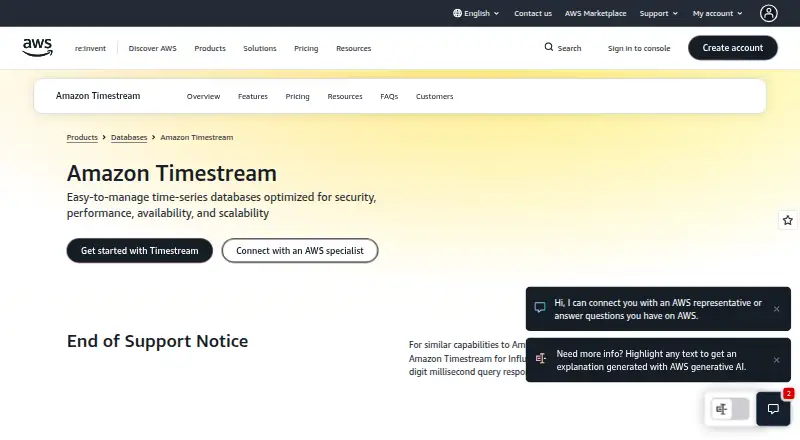
Amazon Timestream is a cloud service for storing and querying time-stamped data. Its LiveAnalytics engine scales ingestion and queries without server setup, while memory and magnetic storage tiers handle recent and older records. AWS also offers Timestream for InfluxDB clusters. It supports SQL, AWS tools, Grafana, and several ingestion paths, but LiveAnalytics is closed to new customers.
Review
In a line
Amazon Timestream is a managed database service for time-series data such as IoT telemetry, operational monitoring, and real-time analytics. It runs in the AWS cloud.
What it does
LiveAnalytics automatically adjusts ingestion and query capacity, so you do not provision database servers. It can combine recent memory-tier records with older magnetic-tier records in one SQL query.
Retention rules move data between those tiers and remove aging records. Tables can infer their structure from incoming dimensions and measures, and built-in functions cover aggregates, windows, interpolation, and complex arrays or rows.
Scheduled queries can create rollups in destination tables for dashboard use. AWS lists monitoring, alerting, IoT telemetry, predictive maintenance, and long-term telemetry retention as uses.
How it connects
Timestream has separate Write and Query APIs, REST endpoint discovery, AWS SDKs, and AWS CLI commands for Windows, macOS, and Linux. SDK documentation covers Java, Java 2, Go, Python, Node.js, and .NET. It also supports CloudFormation and Terraform database creation.
Data can arrive through AWS IoT Core, Kinesis, MSK, Managed Service for Apache Flink, Lambda, Telegraf, SDKs, the CLI, and the WriteRecords API. AWS provides a JDBC driver, Grafana plugin, and Telegraf connector; Grafana 10.4 or newer is required for the plugin.
LiveAnalytics connects with IAM, KMS, AWS Backup, SageMaker, QuickSight, Grafana, and JDBC. AWS says data is encrypted at rest by default, while IAM controls API permissions. The LiveAnalytics service is proprietary rather than open source.
Good fit
It suits teams that need a managed time-series database for incoming device measurements, operational signals, or fast analytics without managing servers.
Its independent scaling for ingestion, storage, and queries fits workloads that change in size. InfluxDB 3 Enterprise deployments can use clusters of up to 15 nodes, with nodes assigned to ingestion, querying, or compaction.
Watch for
AWS stopped accepting new LiveAnalytics customers on June 20, 2025. AWS describes LiveAnalytics as maintenance mode for existing customers and points new workloads toward Timestream for InfluxDB.
Check which engine you need: LiveAnalytics uses SQL, while the available query languages also include Flux and InfluxQL for InfluxDB. InfluxDB backups can run hourly through monthly or on a custom cron schedule, with 1–365 days of retention; on-demand backups can remain for up to 3,650 days.
LiveAnalytics magnetic storage has a 100-GB minimum per account in each Region. On-demand TCU use has a 30-second minimum, and provisioned TCUs have a one-hour minimum.
Pricing
There is no free tier. The on-demand listing says “free” but bills usage; LiveAnalytics charges separately for writes, memory storage, magnetic storage, and queries, with no upfront commitment.
The listed LiveAnalytics rates are $0.50 per million 1-KiB writes, $0.036 per GB-hour for memory storage, and $0.03 per GB-month for magnetic storage. The example query rate is $0.518 per TCU-hour.
A Timestream for InfluxDB single-AZ example totals $737.88 a month: $697.88 compute, $40 storage, and 3,000 IOPS, based on 730 hours and 400 GiB. Database Savings Plans require a one-year usage commitment measured in dollars per hour.
Verdict
Existing AWS customers already running LiveAnalytics can use its automatic scaling, tiered retention, SQL access, and broad AWS ingestion options. It is also a practical fit when Grafana, Lambda, IoT Core, or Kinesis are already part of the data path.
New buyers should start by evaluating Timestream for InfluxDB because LiveAnalytics no longer accepts new customers and is in maintenance mode. Budgeting needs care: there is no free tier, storage minimums apply, and charges vary by engine and usage.
Our take
Choose Amazon Timestream when your workloads involve timestamped telemetry and you want AWS to handle capacity, retention tiers, encryption, and connections to services such as IoT Core or Kinesis. Existing LiveAnalytics users have a mature path for SQL analytics and scheduled rollups. New projects should examine the InfluxDB option first because AWS has closed LiveAnalytics to new customers. This service is not a match if you require open-source software, a free tier, or pricing that can be known without estimating writes, storage, queries, or instance use.
- Automatic scaling for ingestion and queries
- SQL queries can span memory and magnetic storage
- Many AWS ingestion and analytics connections
- Retention rules move and delete aged data
- Separate InfluxDB option supports clusters up to 15 nodes
- LiveAnalytics is closed to new customers
- No free tier
- Magnetic storage has a 100-GB regional minimum
- Usage pricing varies by engine and workload
- LiveAnalytics is proprietary, not open source
- Pick it ifAWS teams storing IoT and operational time-series data; Existing LiveAnalytics customers; Workloads needing managed scaling and tiered retention
- Skip it ifYou are starting a new LiveAnalytics deployment; You need open-source software or a free tier; Your budget cannot absorb usage-based storage and query charges
Pricing
No free tier is offered. LiveAnalytics is usage-based, with separate write, memory-store, magnetic-store, and query charges; magnetic storage has a 100-GB regional minimum. InfluxDB pricing includes a listed $737.88/month single-AZ example, while savings plans require a one-year usage commitment.
- On-demandPay for writes, storage, queries, or database instance usage depending on the en · No minimum fees or upfront commitments for on-demand pricingOn request
- Amazon Timestream on-demandPay only for usage; charges depend on database engine and usage. · No minimum fees or upfront commitment; LiveAnalytics charges separately for writes, memory store, magnetic store, and queries.Free
- Timestream for InfluxDB single-AZ example730 hours plus 400-GiB storage · db.influx.2xlarge · $697.88 compute · $40 storage · 3,000 IOPS$738/mo
- Database Savings PlansCommit to a specific amount of usage measured in $/hour over a 1-year term. · Eligible usage; savings in exchange for a usage commitment.On request
- Timestream for LiveAnalytics on-demandusage-based · writes $0.50 per million 1-KiB writes · memory store $0.036/GB-hour · magnetic store $0.03/GB-month · queries by TCU-hour at $0.518 in the example · 100-GB magnetic-store minimum per account/RegionOn request
As aws.amazon.com lists them, checked 22 Sept 2026.
Questions
Is Amazon Timestream free?
No free tier is listed. An on-demand plan is labeled “free” but charges for usage, and LiveAnalytics bills writes, storage, and queries separately.
Can new customers sign up for LiveAnalytics?
No. AWS stopped accepting new LiveAnalytics customers on June 20, 2025, and describes it as maintenance mode for existing customers.
What data can Timestream store?
It is designed for time-series information such as IoT telemetry, operational monitoring signals, real-time analytics data, and long-term telemetry.
Which query languages are supported?
The facts list SQL, Flux, and InfluxQL. LiveAnalytics provides SQL querying.
Does Timestream work with Grafana?
Yes. A Timestream data-source plugin is available for local Grafana installations, and Grafana 10.4 or newer is required.
How does Timestream handle older data?
LiveAnalytics uses memory and magnetic storage tiers. Retention policies can move records between them and delete aged data.
Is Amazon Timestream open source?
LiveAnalytics is a proprietary AWS-managed service. The separate InfluxDB offering runs open-source InfluxDB engines but is delivered as a managed AWS service.
Near it
All alternatives →- AKApache Kudu#17 on this board
- MMotherDuck#19 on this board
- YDYellowbrick Data Warehouse#16 on this board
- SCSAP Customer Data Platform#20 on this board
- SStarRocks#15 on this board
- AR
 Amazon Redshift#21 on this board
- AD
 Apache Doris#14 on this board
- CCCouchbase Capella#22 on this board
- F
 Firebolt#13 on this board
- SMSAP Master Data Governance#23 on this board