Apache Jena Fuseki
jena.apache.org · checked 15 Oct 2026
An open-source SPARQL server for RDF data, running standalone or inside Java applications.
How it plugs in
Signal on RDF Databases7.6#3 of 26
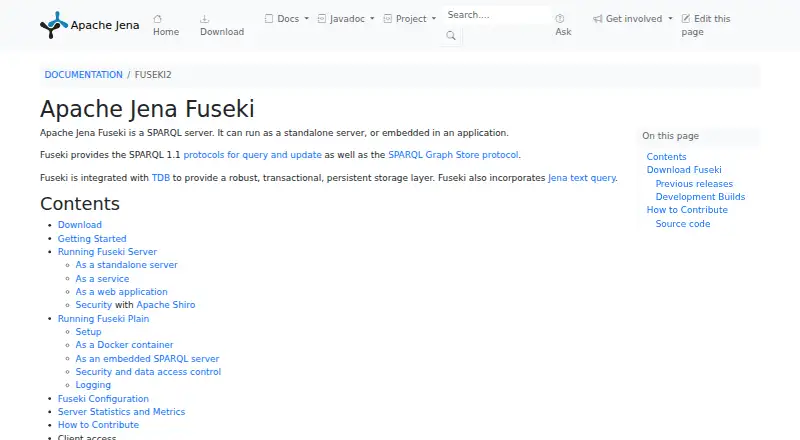
RDF data can be accessed through Fuseki's SPARQL 1.1 query and update endpoints, as well as its SPARQL Graph Store interface. It is available as a standalone or embedded server, operating-system service, web application, Docker setup, or self-hosted deployment. TDB adds transactional persistent storage, while Jena text query and GeoSPARQL modules extend its data features.
Review
In a line
Apache Jena Fuseki provides SPARQL services for RDF datasets. It can operate independently or as part of another application.
What it does
Clients can send Fuseki SPARQL 1.1 queries and updates, together with requests through the SPARQL Graph Store protocol. SPARQL is a language for finding and changing linked data.
Data may stay in memory, or Fuseki can use TDB for transactional, persistent storage. Jena text query support and GeoSPARQL modules are included.
How it connects
Fuseki is open source under the Apache License, Version 2.0. You can download a ZIP containing the server and web interface, use Maven artifacts, or deploy a WAR file.
It supports Turtle, TriG, N-Triples, N-Quads and JSON-LD RDF formats. A public HTTP administration protocol handles tasks such as server information, dataset management, backups, statistics and metrics.
You can deploy Fuseki as a standalone server, operating-system service, Apache Tomcat or Jetty web application, Docker setup, or embedded Java server. Databases in Docker require mounted volumes if they must survive container removal.
Good fit
Fuseki suits semantic-web and linked-data applications that need SPARQL access. It can let a Java application provide SPARQL services while still reading and updating its datasets.
Server, dataset, endpoint and graph access controls are available, with native HTTPS for data in transit. Monitoring exposes JSON statistics and Prometheus metrics for database and Java runtime measurements.
Watch for
The default web application configuration limits administration to localhost but leaves SPARQL endpoints open, so review security settings before exposing a server. Graph-level access control currently works only with read-only datasets.
Jena 6 requires at least Java 21. The project plans to retire its Fuseki WAR and related web-application modules, which may affect a Tomcat or Jetty deployment choice.
Fuseki is self-hosted. You are responsible for running it, storing data and keeping Docker volumes outside containers when persistence is needed.
Pricing
Fuseki is free. It is released under the Apache License, Version 2.0, with a free self-hosted deployment.
The listed free option covers standalone, embedded, Docker or WAR use. No commercial support plan is listed.
Verdict
Choose Fuseki if you need an open-source SPARQL endpoint, want to host RDF data yourself, or need to embed a server in a Java application. Its protocol support, deployment modes and access controls cover several architectures.
Look elsewhere if you want a managed service or commercial support, or if your deployment depends on a WAR that may be retired.
Our take
Apache Jena Fuseki can suit teams building linked-data or semantic-web systems around RDF and SPARQL. It offers free, open-source self-hosting, embedded Java use, persistent TDB storage and several deployment paths. Security needs attention because the default web setup leaves query endpoints open. Java 21 is required for Jena 6, and planned retirement of WAR-related modules matters for some web deployments. Buyers wanting hosted operations or a commercial support contract should consider another product.
- Free and open source under the Apache License, Version 2.0
- Runs standalone, embedded, as a service, in Tomcat or Jetty, or with Docker
- Handles SPARQL 1.1 query and update requests
- TDB provides transactional persistent storage
- Offers access controls and native HTTPS
- Self-hosted, so operation and data storage are your responsibility
- Default configuration leaves SPARQL endpoints open
- Graph-level permissions currently work only for read-only datasets
- Jena 6 requires Java 21
- WAR-related modules are planned for retirement
- Pick it ifSelf-hosted RDF and linked-data applications; Java apps that need embedded SPARQL services; Teams seeking free open-source graph data software
- Skip it ifYou need a managed hosted service or commercial support; Your deployment depends on a long-term Fuseki WAR module
Pricing
Fuseki is free self-hosted software licensed under the Apache License, Version 2.0. Standalone, embedded, Docker and WAR options are listed; no commercial support plan is listed.
- Apache Jena FusekiApache License 2.0 · self-hosted serverFree
- Free and open sourceself-hosted deployment · standalone, embedded, Docker or WAR options · no commercial support plan listedFree
As jena.apache.org lists them, checked 1 Oct 2026.
Questions
What is Apache Jena Fuseki?
It is an Apache Jena server that provides SPARQL access to RDF data. Fuseki can run independently or within another application.
Which SPARQL protocols does Fuseki support?
The server implements SPARQL 1.1 query and update, along with the SPARQL Graph Store protocol.
Can Fuseki store data permanently?
Yes. Fuseki integrates with TDB for transactional persistent storage. Docker deployments need mounted volumes to keep databases after container removal.
How can Fuseki be deployed?
Options include a standalone server, operating-system service, embedded Java server, Tomcat or Jetty web application, Docker, and a WAR file.
Is Apache Jena Fuseki free?
Yes. It is free, open source and licensed under the Apache License, Version 2.0. The listed deployment is self-hosted.
What security controls are available?
Fuseki provides controls at server, dataset, endpoint and graph levels, plus native HTTPS. Graph-level controls currently apply only to read-only datasets.
What Java version does Jena 6 need?
Jena 6 requires at least Java 21.