
APISec Platform
apisec.ai · checked 15 Oct 2026
APISec Platform discovers APIs, models application behavior, and validates exploitable weaknesses with replayable proof.
How it plugs in
Signal on API Security Testing Software6.4#3 of 27
APISec Platform is an AI-based application security service for discovering APIs and testing exploitable weaknesses. It maps endpoints, authentication, roles, permissions, and business logic, then runs attacker-like tests and returns replayable evidence. Public-cloud, private, and on-premises deployments are supported, with a free plan and paid tiers starting at $690 per month.
Review
In a line
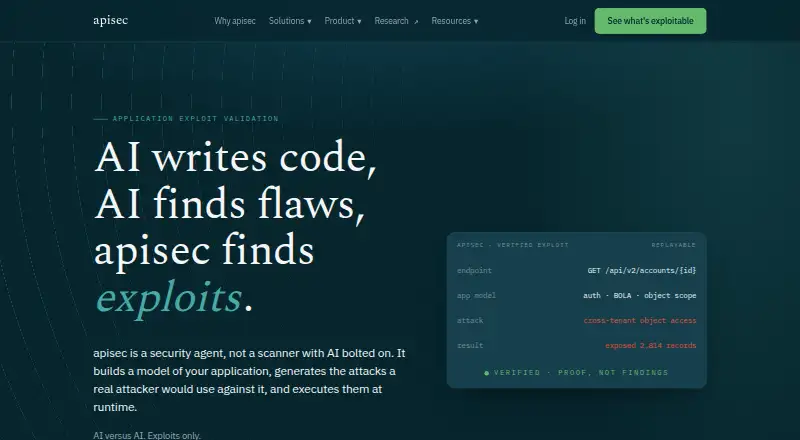
APISec Platform is an application security platform that discovers applications, learns how they behave, and checks whether API weaknesses can be exploited. It supplies proof that can be replayed, not just a list of possible issues.
What it does
The platform builds a live model of endpoints, parameters, authentication flows, roles, permissions, object ownership, and business rules. It does this without requiring existing documentation or developer interviews.
It generates many tests tailored to each API and checks business logic, data access, authorization, configuration, infrastructure, injection, token handling, and other security controls. Results show the request sequence, data reached, blast radius, replay details, and suggested resolution.
API registration accepts OpenAPI, Swagger, Postman, and RAML files from a URL or upload. The service can also flag sensitive data in API specifications, using built-in PII checks or your own patterns.
How it connects
APISec can find APIs in source code, gateways, ingress and authentication paths, web apps, Postman, SwaggerHub, Insomnia, CI/CD systems, agents, MCP servers, and LLM call sites. Its public API exposes nearly every product capability for custom automation.
Public APIs run against APISec's cloud. Private or on-premises APIs can run through APISec Kubernetes or Docker containers, including deployments in your AWS, Azure, or GCP environment. A lightweight Docker scanner receives tasks over SSL.
Connectors include Jira for validated vulnerability tickets and fix transitions, plus GitHub for vulnerability issues and playbook storage. Configuration also supports reporting, notifications, playbook backups, and single sign-on. Open-source Surface tools run locally, with nothing leaving the machine, and include GitHub Actions and a browser extension.
Good fit
APISec suits security and development teams that need recurring API checks, authorization and business-logic testing, and evidence they can replay. It fits public APIs as well as private services that must stay in a customer's environment.
Teams using CI/CD can automate registration and scans through API, Python, or shell workflows. Jira and GitHub connections help route findings and keep playbooks with development work.
Watch for
Pricing is based on 100-endpoint increments. Private and on-premises API testing has custom pricing, so confirm the quote for your deployment model.
The scanner uses Docker, while private deployments require APISec Kubernetes or Docker containers. Check that your environment supports this setup; hosted agents can validate private APIs.
APISec retains customer data and credentials for up to 365 days after termination unless earlier deletion is requested. Support promises an initial response within 24 hours, but not a resolution deadline.
Pricing
A Free plan costs $0 forever and includes public API testing, basic test simulations, dashboard access, and community support. A free trial is also available.
Standard costs $690 a month, billed at $690 per month per 100 endpoints, or $8,275 a year. It adds continuous automated validation, business-logic attacks, continuous API testing, team collaboration, and dedicated support.
Pro costs $2,750 a month, billed at $2,750 per month per 100 endpoints, or $33,075 a year. It adds CI/CD and ticketing integrations, custom attack simulations, advanced reporting and SLAs, white-glove onboarding, and premium support.
Bug Bounty uses custom pricing and includes certified expert reports, manual and ad-hoc deep dives, private and public API testing, and authentication support.
Verdict
Choose APISec if you need API discovery plus ongoing tests of authorization, authentication, input validation, or business rules, especially when replayable exploit evidence matters. The free tier offers a way to start with public APIs, while paid plans add endpoint capacity, collaboration, integrations, and support.
Look at API Security Testing Software for other testing tools. For broader product options, compare API Security Software.
Our take
APISec Platform makes sense for teams responsible for APIs across development and production, particularly where private deployment, automated scans, or proof of exploitability are required. Its free plan covers public API testing, but endpoint-based pricing and custom private-deployment quotes need budget planning. Docker or Kubernetes may be part of the rollout. Choose another tool if you only need a basic one-time scan, do not want continuous validation, or cannot support its deployment approach.
- Discovers APIs across code, gateways, apps, CI/CD, and LLM call sites
- Models roles, permissions, ownership, and business logic dynamically
- Returns replayable exploit evidence and remediation context
- Offers public cloud, private, on-premises, and customer-cloud deployment
- Free plan includes public API testing and dashboard access
- Pricing is charged per 100 endpoints
- Private and on-premises API testing has custom pricing
- Docker or Kubernetes is needed for private deployment
- Support response has no guaranteed resolution time
- Data and credentials may be retained for up to 365 days
- Pick it ifTeams running continuous API security and authorization checks; Organizations needing private deployment or replayable exploit proof; CI/CD teams connecting scans to Jira or GitHub
- Skip it ifYou only need a simple one-time API scan; Your environment cannot run Docker or Kubernetes for private testing; Endpoint-based or custom deployment pricing does not fit your budget
Pricing
Free is $0 forever for public API testing. Annual prices are $8,275 and $33,075. Bug Bounty and private or on-premises testing use custom pricing.
- Free$0 forever · Public API testing · Basic test simulations · Community support · Dashboard accessFree
- Standard$690/mo · per 100 endpoints or $8,275/yr · Continuous automated validation · Business-logic attacks · Continuous API testing · Team collaboration · Dedicated support$690/mo
- Pro$2,750/mo · per 100 endpoints or $33,075/yr · Standard features · CI/CD and ticketing integrations · Custom attack simulations · Advanced reporting and SLAs · White-glove onboarding · Premium support$2,750/mo
- Bug BountyCustom pricing · Certified expert reports · Manual and ad-hoc deep dives · Private and public API testing · Authentication supportOn request
As apisec.ai lists them, checked 15 Oct 2026.
Questions
Is there a free APISec plan?
Yes. Free costs $0 forever and includes public API testing, basic test simulations, dashboard access, and community support.
What does APISec test?
It tests business logic, data access, roles and permissions, configuration, infrastructure, injection, token handling, authentication, authorization, and input validation.
Can APISec test private APIs?
Yes. Private and on-premises APIs can use APISec Kubernetes or Docker containers. Hosted agents can validate private APIs.
Does APISec have a public API?
Yes. APISec says nearly every product capability is exposed through an API for custom automation and integrations.
Which API formats can I register?
You can register OpenAPI, Swagger, Postman, or RAML documents from a URL or uploaded file.
How does APISec connect with Jira and GitHub?
Jira can create tickets after validated findings and transition them when fixes are confirmed. GitHub can receive vulnerability issues and store or restore playbooks.
How long does APISec retain data?
Its privacy policy says customer data and credentials may be retained for up to 365 days after termination unless deletion is requested sooner.
Near it
All alternatives →- 4A42Crunch API Security Platform#2 on this board
- AAAutomatic API Attack Tool#4 on this board
- WWuppieFuzz#1 on this board
- PTPentest-Tools.com API Scanner#5 on this board
- SSchemathesis#6 on this board
- GCGraphQL-Cop#7 on this board
- VVulnAPI#8 on this board
- AA
 Akto API Security Platform#9 on this board
- AA
 ApyGuard API Security Scanner#10 on this board
- AAAquilaX API Security Scanner#11 on this board