
AppJail: FreeBSD Jail Management
appjail.readthedocs.io · checked 9 Oct 2026
Open-source FreeBSD framework for building and running isolated jails.
How it plugs in
Signal on Container Engines5.8#22 of 31
AppJail is a free, self-hosted framework for creating isolated environments with FreeBSD jails. Its feature set covers thin and thick jails, dependency handling, startup controls, storage, networking, resource limits, health checks, and automated builds. It can also place OCI-compatible containers and Linux distributions inside jails, with several setup requirements to review first.
Review
In a line
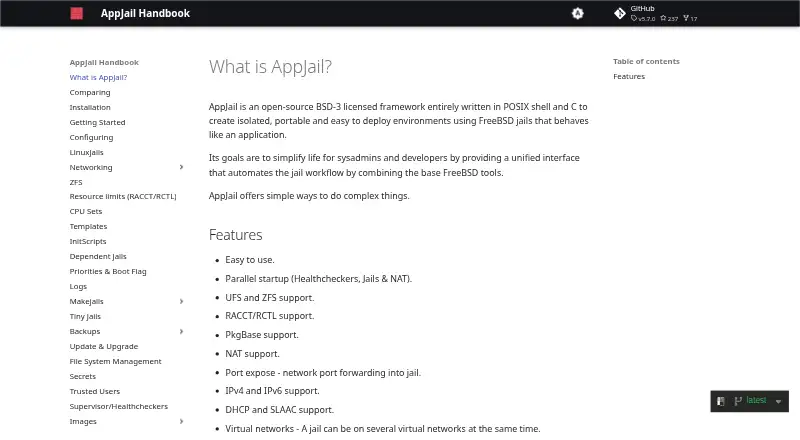
AppJail creates isolated, portable environments from FreeBSD jails as an open-source project. The framework uses the BSD-3 license and targets FreeBSD hosts.
What it does
AppJail manages thin and thick jails, dependencies, startup ordering, and parallel startup for healthcheckers, jails, and NAT. A healthchecker may monitor a jail, one of its services, or another target you specify.
Makejail files automate jail creation by producing both an InitScript and a BuildScript. AppJail also supports image building in both supported image formats.
Linux distributions can run inside jails for applications not available in the FreeBSD ports collection. This method uses debootstrap.
How it connects
As a self-hosted project, AppJail can be obtained from source, the sysutils/appjail-devel port, or the sysutils/appjail package. It is written in POSIX shell and C, with its code released as open source.
UFS and ZFS are available for storage. Networking includes NAT, port forwarding, IPv4 and IPv6, virtual networks, bridges, VNET, DHCP, and SLAAC. RACCT/RCTL resource limits are also supported.
OCI-compatible container images can be deployed into FreeBSD jails. The OCI command depends on Buildah and jq.
Good fit
AppJail is aimed at system administrators and developers seeking repeatable jail workflows on FreeBSD. It is useful for isolated services, portable environments, automated jail builds, and applications that need Linux userspace inside a jail.
The documented controls cover storage, networking, startup behavior, health checks, secrets, and resource limits.
Watch for
AppJail does not provide rootless mode. For unprivileged users, the handbook points to access through a configured privilege tool such as doas, sudo, or FreeBSD's mdo.
TinyJails are experimental. ZFS is needed for raw-image jail backups. OCI deployment needs Buildah and jq, while Linux jails need debootstrap.
Secrets stored in memory use a 32 MiB default filesystem, so larger needs require an increase or disk encryption for larger data.
Pricing
AppJail is free, with a free plan and no free trial. It is self-hosted rather than a hosted service.
Verdict
Choose AppJail if your systems run FreeBSD and you want jail management with scripted builds, detailed networking, and optional OCI or Linux workloads. Its open-source license and package, port, and source installation options suit teams managing their own hosts.
A different option is preferable when you need rootless operation, a hosted product, or a setup less tied to FreeBSD. Check the experimental status of TinyJails, the ZFS backup requirement, and the extra tools needed for OCI and Linux support before adopting it.
Our take
AppJail makes the most sense for teams already operating FreeBSD servers and comfortable managing software themselves. It covers everyday jail administration along with automated builds, network isolation, health checks, and resource controls. The ability to run OCI images or Linux distributions can broaden its use, but those paths add dependencies. There is no rootless mode, and some functions have clear constraints, including ZFS for raw-image backups and a small default memory area for secrets. Free pricing helps experimentation, while the self-hosted model leaves installation and maintenance with the user.
- Available at no cost with the BSD-3 license and open-source code
- Supports thin and thick jails, dependency handling, and startup sequencing
- Provides UFS, ZFS, networking, and RACCT/RCTL limits
- Makejail files streamline repeatable jail creation
- Can deploy OCI images and Linux distributions in jails
- Runs on FreeBSD hosts rather than as a hosted service
- No rootless mode
- TinyJails are experimental
- ZFS is required for raw-image backups
- OCI and Linux jail modes need extra tools
- Pick it ifFreeBSD administrators building isolated services; Developers automating repeatable jail environments; Teams needing OCI or Linux workloads inside FreeBSD jails
- Skip it ifYou require rootless containers or a hosted platform; You cannot use FreeBSD, ZFS, Buildah, jq, or debootstrap where needed
Pricing
AppJail is free through its free plan. There is no trial period, and you run it on your own FreeBSD systems.
Questions
What is AppJail?
AppJail is a BSD-3 licensed, open-source framework for making isolated, portable environments with FreeBSD jails.
Which operating system does AppJail support?
FreeBSD is the host operating system supported by AppJail.
How can AppJail be installed?
You can install AppJail from source, using the sysutils/appjail-devel port, or using the sysutils/appjail package.
Can AppJail run OCI containers?
Yes. OCI-compatible container images can run in FreeBSD jails through AppJail, using an OCI command that requires Buildah and jq.
Does AppJail support Linux applications?
Linux distributions can run in jails for isolated applications unavailable in the FreeBSD ports collection. This requires debootstrap.
Does AppJail have rootless mode?
No. The handbook recommends using a configured privilege tool such as doas, sudo, or FreeBSD's mdo for unprivileged users.
What should I know about AppJail secrets?
Encrypted secrets can be stored on disk. For unencrypted secrets, AppJail documents a read-only, non-swap-backed in-memory filesystem that defaults to 32 MiB.
Is AppJail free?
Yes. AppJail has a free plan and no free trial.