
Arelle: Free Open-Source XBRL Validation Software
arelle.org · checked 15 Oct 2026
Open-source software for validating, inspecting, and processing XBRL financial-reporting data.
How it plugs in
Signal on Regulatory Reporting Software7.7#1 of 24
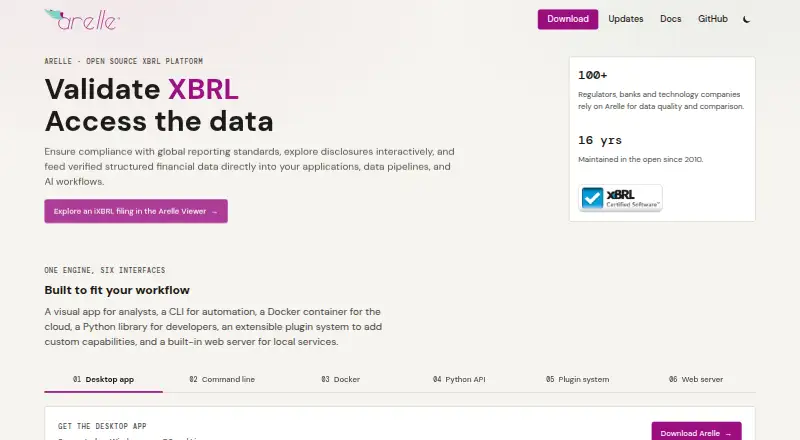
Arelle is a free, open-source XBRL processor for regulators, auditors, filers, and software teams. It validates filings, inspects disclosures, and sends results to applications or data pipelines. You can run it on Windows, macOS, Linux, Docker, or your own servers, using a desktop app, command line, Python API, or web service.
Review
In a line
Arelle is an open-source platform that validates and processes XBRL, the structured format used for business and financial reports. The project uses the Apache License 2.0.
What it does
Arelle checks XBRL filings and related data against reporting rules, lets you inspect disclosures, and makes results available to other applications and data pipelines.
It supports XBRL 2.1, XBRL Dimensions, Inline XBRL, xBRL-JSON, xBRL-CSV, taxonomy packages, and report packages. Its listed filing-rule coverage includes ESMA ESEF, SEC EDGAR, US FERC, Japan EDINET, South Africa CIPC, Denmark DBA, Netherlands SBR and KvK, UK HMRC, and Ireland ROS.
The package also includes an SEC EDGAR Renderer and local viewer for Windows, macOS, and Linux, for previewing how XBRL filings appear on the SEC website.
How it connects
You can use Arelle as a desktop program, command-line tool, Python API, Docker image, or web service. Its web service exposes REST validation endpoints and can work with applications including Excel, Java, and Oracle. A supported Python API centers on the arelle.api module and Session object.
The command line accepts instances, schemas, linkbases, inline XBRL documents, testcase files, and testcase indexes. Docker provides latest and slim image variants for local checks or an HTTP service. Python installation uses pip install arelle-release; Python 3.10 or newer is required for version 2.42.0.
A plugin system can add validation rules, data extraction, and interface features. Community plugins come with desktop builds and the full Docker image; Python package and source installations need those plugins configured separately.
Good fit
Arelle is intended for regulators, software providers, auditors, and filers seeking a standards-based method to check structured business data. It works for on-premises deployments and for teams that need results exposed to software or data workflows.
It is a practical match when you need several entry points, such as a desktop tool for review, a command line for repeatable jobs, or an API and Docker service for integration.
Watch for
The built-in web server has no login or access controls. It can read arbitrary file paths and load local Python plugins, so the documentation limits it to trusted callers and networks, not public internet or multi-tenant use.
The Python API may take extra learning for newcomers to XBRL. One reported use case required selecting the instance document explicitly and encountered a ModelManager formulaOptions error, while command-line loading handled a ZIP automatically. An open enhancement issue also reports problems converting iXBRL files inside report-package archives when taxonomy paths are remapped.
Support is directed to GitHub issues, the Arelle Google Group, and [email protected]. Problems inside third-party products should go to those product developers.
Pricing
Arelle is free, with no paid plan and no free trial. The open-source download includes desktop, command-line, Docker, Python API, plugins, and a local web server for Windows, macOS, and Linux.
The project publishes an arelleproject/arelle Docker image and supports on-premises use. Bundled dependencies may have separate license notices.
Verdict
Choose Arelle if your work involves XBRL validation and you want software that can run locally, in containers, or through APIs without a purchase price. Its broad format and filing-rule coverage, plugin model, and multiple interfaces fit technical reporting workflows.
Do not expose its built-in web server to untrusted networks unless you add your own protections. Teams new to XBRL should also allow time to learn the Python API and check whether their archive-conversion workflow is supported. For broader product comparisons, review alternatives such as REGnosys or Altova Regulatory Solutions.
Our take
Arelle is a sensible choice for organizations that need free, standards-based XBRL validation on their own machines or servers. It covers major XBRL formats and several national filing programs, while offering desktop, command-line, Docker, Python, and REST options. The trade-off is responsibility: web access controls are absent, plugin setup differs by installation method, and some API and archive tasks can be difficult for newcomers. Pick it when you can manage that setup and need an adaptable processor rather than a hosted filing-submission service.
- Free open-source software distributed under Apache License 2.0
- Desktop, command line, Docker, Python API, and web service options
- Supports major XBRL formats and multiple filing programs
- Plugin system can add rules, extraction, and interface features
- Runs on Windows, macOS, Linux, and on-premises systems
- Built-in web server has no authentication or authorization
- Python API can be difficult for XBRL newcomers
- Some report-package archive conversions can fail
- Plugins need separate setup for Python and source installs
- It does not submit filings to regulators
- Pick it ifRegulators, auditors, filers, and software providers handling XBRL; Teams building local or API-based validation workflows; Organizations needing free on-premises deployment
- Skip it ifYou need a hosted service with built-in access controls; You need direct regulator submission rather than validation; Your workflow depends on unsupported archive conversion
Pricing
Arelle has a free open-source plan covering desktop, command-line, Docker, Python API, plugins, and local web server support. There is no trial because the software is already free.
- ArelleFree open-source download · Desktop, command line, Docker, Python API, plugins, local web server · Windows, macOS, LinuxFree
As arelle.org lists them, checked 15 Oct 2026.
Questions
Is Arelle free?
Yes. You can download and use Arelle at no cost; it has no separate paid tier or trial period.
Which systems can run Arelle?
Official desktop builds support Windows, macOS, and Linux. It also runs through Docker, Python, a command line, and a web service.
What XBRL formats does it support?
Its conformance list includes XBRL 2.1, Inline XBRL 1.0 and 1.1, xBRL-CSV, xBRL-JSON, taxonomy packages, and report packages.
Can Arelle connect to other software?
Yes. The web service can integrate with applications including Excel, Java, and Oracle, and a supported Python API is available.
Is the web server safe for public access?
No. It has no authentication or authorization, can read arbitrary filesystem paths, and can load local Python plugins. Documentation limits it to trusted callers and networks.
Can I add custom validation rules?
Yes. Plugins can add validation rules, data extraction, and user-interface enhancements. Python and source installations require plugins to be added and configured separately.
Near it
All alternatives →- R
 REGREP#2 on this board
- AR
 Altova Regulatory Solutions#3 on this board
- RREGnosys#4 on this board
- SC
 Semansys Compliance Platform#5 on this board
- ERElite Reporting Platform#6 on this board
- SPS&P Global Cappitech Regulatory Reporting#7 on this board
- DX
 Diligence XBRL Suite#8 on this board
- A
 AutoRek#9 on this board
- RReg360#10 on this board
- CSCoreFiling Seahorse#11 on this board