
AssetTiger: Asset Tracking and Management
assettiger.com · checked 15 Oct 2026
Cloud asset tracking for inventory, custody, maintenance, depreciation, contracts and audits.
How it plugs in
Signal on Asset Tracking Software6.6#4 of 52
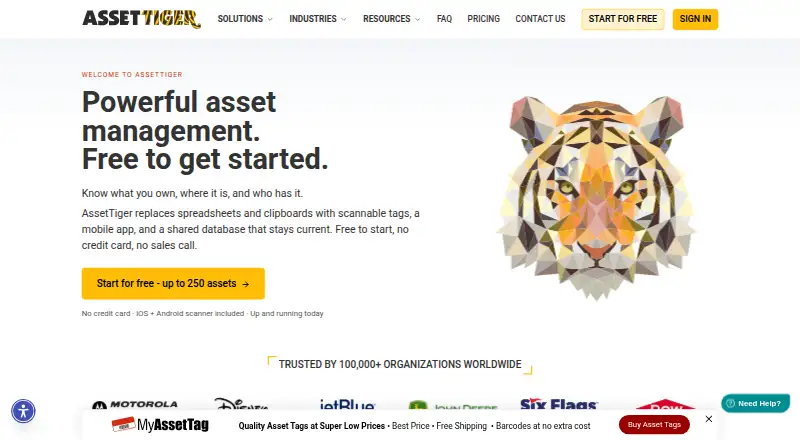
AssetTiger is a hosted asset-management service for tracking physical items and inventory. It supports barcode and QR scanning on iOS and Android, custody history, maintenance schedules, depreciation methods, contracts, audits and reports. A public REST API connects with business and IT service systems. Plans range from a 30-day trial and free inventory option to paid tiers based on asset count.
Review
In a line
AssetTiger is a cloud service for managing physical assets, inventory, maintenance, depreciation, contracts and audits. It runs through the web, iOS and Android apps, with an API for connected systems.
What it does
You can create and print barcode or QR labels, then scan them with a phone or tablet without dedicated scanner hardware. Assets can be assigned to people, departments or locations, with timestamped check-in and check-out records, due dates and overdue alerts.
Recurring maintenance schedules, email reminders and per-asset history help track service work. Depreciation supports straight-line, declining-balance and sum-of-years-digits methods. Contracts, warranties and insurance policies can be tied to assets with expiration alerts.
AssetTiger offers more than 80 report types, including maintenance, reconciliation, depreciation and checkout reports. Reports can be exported as CSV or PDF. Locations can appear on Google Maps, and GPS coordinates can be captured during handoffs.
How it connects
The public REST API provides access to 14 resource groups using JSON and bearer-token sign-in. Paid plans include a separate sandbox for testing, interactive Swagger documentation and an OpenAPI schema. Requests are limited per organization per minute; exceeding the limit returns HTTP 429.
The API can connect with ERP products such as SAP, Oracle and NetSuite, plus IT service platforms including ServiceNow and Jira Service Management.
AssetTiger is a fully hosted commercial service. There is no server installation or self-hosting option, and it does not publish an open-source license. Its mobile apps support offline scanning and sync after reconnection.
Good fit
AssetTiger suits organizations that need shared records for equipment, inventory and custody. The maker names schools, IT teams, healthcare organizations, government agencies, nonprofits, construction and manufacturing as intended users.
A single login can manage multiple organizations with separate data, users and settings. More than 120 permission settings control viewing, editing, checkout, reporting and exporting. Two-factor authentication, Google single sign-on and an immutable activity log are listed security controls.
Watch for
Check the asset limits and user terms of each plan before choosing one. The 30-day trial allows up to 250 assets, two users, five custom fields and 25 emails per day.
API traffic is rate-limited, and the service is cloud-hosted rather than self-managed. The privacy policy says account data is automatically deleted within 30 days after cancellation. Trial accounts receive standard email support; paid plans include priority support.
Pricing
AssetTiger has a free inventory option and a 30-day free trial. Inventory Free is included with an account and allows up to two inventory items. The trial supports up to 250 assets, two users, five custom fields and 25 emails per day.
Paid asset plans are Basic at $20 a month ($220/year annually) for 500 assets; Core at $40 a month ($440/year annually) for 2,500; Advanced at $75 a month ($825/year annually) for 10,000; Pro at $140 a month ($1,540/year annually) for 50,000; and Enterprise at $275 a month ($3,025/year annually) for 250,000. These plans include unlimited users.
Inventory Paid costs $15 a month ($14/mo; $165/yr) as an add-on to any subscription and allows unlimited inventory items.
Verdict
Choose AssetTiger if you need phone-based barcode or QR scanning, custody records, maintenance reminders and depreciation in one hosted system. Its API and sandbox are useful when asset data must share space with ERP or IT service software.
Look elsewhere if self-hosting, open-source code or a different data-retention arrangement is required. Also check the plan’s asset ceiling, trial limits and API request allowance before moving a large inventory.
Our take
AssetTiger provides an online system for tracking equipment, maintenance and depreciation. Phone scanning, offline sync, location capture and configurable permissions cover day-to-day control, while the API can link records to business systems. The free inventory option and trial lower the entry barrier, but larger inventories quickly move to paid tiers. Buyers should confirm asset limits, API throttling and the 30-day deletion window after cancellation. It is not suited to teams that require self-hosted software or an open-source license.
- Barcode and QR scanning works on iOS and Android devices.
- Offline scans sync when a mobile device reconnects.
- More than 80 reports export to CSV or PDF.
- Public API includes a sandbox and Swagger documentation.
- Plans provide more than 120 permission settings.
- The service has no self-hosting option or open-source license.
- API requests are rate-limited per organization per minute.
- Trial limits include 250 assets, two users and 25 emails daily.
- Account data is deleted within 30 days after cancellation.
- Pick it ifSchools, IT teams and nonprofits tracking shared equipment; Organizations needing maintenance, custody and depreciation records; Teams integrating assets with ERP or IT service software
- Skip it ifYou need to run the software on your own servers.; You require open-source code or different data-retention terms.; Your inventory may exceed the selected plan's asset limit.
Pricing
A free inventory option covers up to two items, and a 30-day trial covers up to 250 assets. Unlimited inventory is a $15-a-month add-on, also available at $165 per year.
- Inventory FreeIncluded with your account · Up to 2 inventory itemsFree
- Free trial30 days · up to 250 assets · up to 2 users · 5 custom fields · 25 emails/dayFree
- Inventory Paid$15/mo · $14/mo · Add-on to any plan $165/yr · Unlimited inventory items · Add-on to any subscription$15/mo
- Inventory add-on$165/year annually · unlimited inventory items · add-on to any plan$15/mo
- Basic$220/year annually · 500 assets · unlimited users$20/mo
- Core$440/year annually · 2,500 assets · unlimited users$40/mo
- Advanced$825/year annually · 10,000 assets · unlimited users$75/mo
- Pro$1,540/year annually · 50,000 assets · unlimited users$140/mo
As assettiger.com lists them, checked 3 Oct 2026.
Questions
Does AssetTiger have a free plan?
Yes. Inventory Free is included with an account and supports up to two inventory items. There is also a 30-day trial with limits on assets, users, custom fields and daily emails.
Can phones scan AssetTiger barcodes and QR codes?
Yes. iOS and Android devices can scan barcode and QR labels without dedicated scanner hardware. Offline scans sync after the device reconnects.
What systems can connect through the API?
The REST API can connect with ERP systems such as SAP, Oracle and NetSuite, plus ServiceNow and Jira Service Management.
Is AssetTiger self-hosted or open source?
No. It is described as a fully hosted commercial service, with no server installation or self-hosting option and no published open-source license.
How much do paid AssetTiger plans cost?
Basic is $20 a month, Core $40, Advanced $75, Pro $140 and Enterprise $275. Annual prices are listed separately, from $220/year to $3,025/year.
What happens to data after cancellation?
The privacy policy says account data is automatically deleted within 30 days after cancellation.