ATA API Governance
ata.dev · checked 15 Oct 2026
API governance platform for tracking ownership, rules, schemas, versions, testing and dependencies across teams.
How it plugs in
Signal on API Governance Software6.7#2 of 25
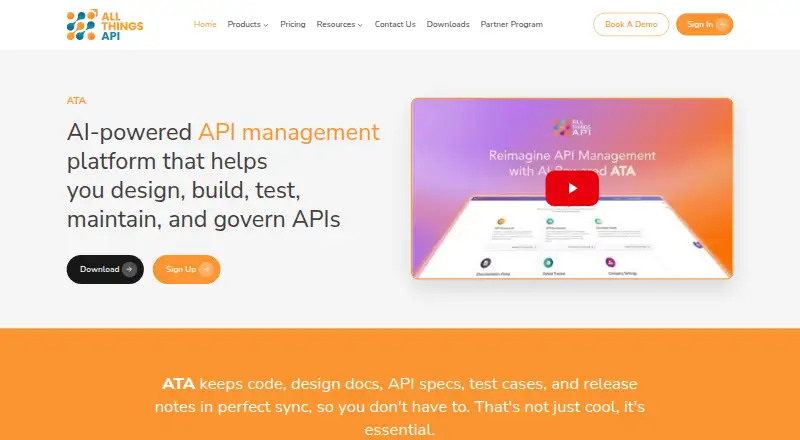
ATA API Governance centralizes API inventories, ownership, specifications, schemas, policies, versions and dependencies. It supports OpenAPI rule checks, approval workflows, testing, monitoring, documentation and an AI question assistant. The service runs on the web, desktop, Linux, command line, agents and a Chrome extension. A free plan is available, with paid plans billed per user each month annually.
Review
In a line
ATA API Governance is a platform for designing, testing, documenting, maintaining and governing APIs. It brings API ownership, specifications, compliance information, lifecycle status and dependencies into one place.
What it does
Its inventory shows APIs across teams and applications, including endpoints, methods, versions, exposure types, owning teams and deployment environments. Lifecycle tracking runs from draft to deprecated and supports multiple versions. Approval workflows control which consumers can use particular APIs.
Teams can create OpenAPI rules for authentication, naming, methods, headers and security. Reusable schemas are managed centrally, with warnings when an API differs. A dashboard reports versions, schema status, usage, security protocols, possible PII exposure and ownership.
ATA also provides ad-hoc, chained, security, performance, robustness and vulnerability testing. Scheduled monitoring checks for slow responses, timeouts and failures. Its documentation portal supports Markdown, HTML and visual editing, versioned publishing, API links, access controls and public or private sharing. Ask AI answers questions about projects, rules, schemas, versions and governance policies.
How it connects
ATA offers a web platform, Windows and Mac desktop clients, Linux downloads, an npm command-line package, local and server agents, and the ATA Bridge Chrome extension. Local and server agents can run private-network API and monitoring tests inside customer network environments.
The CLI can run tests and workflows from a terminal or continuous integration process. ATA says Developer Studio uses third-party integrations to source and deploy applications, and its homepage describes Jira issue creation with real-time synchronization. The product is not open source and is built around OpenAPI APIs.
Good fit
ATA suits teams that need a shared API catalog, role-based access, design reviews, lifecycle controls and policy checks. It can help teams see ownership and dependency impacts before changes, keep schemas aligned, test APIs, monitor them on a schedule and publish controlled documentation.
It may also fit organizations that need browser-flow recording through ATA Bridge, private-network test execution, or an AI assistant for questions about governance information.
Watch for
Check endpoint allowances carefully. The free plan includes 30 governance endpoints, while Basic includes 100, Startup includes 500 and Enterprise uses a custom count. The free plan also lists 500 total endpoints, which is separate from its governance-endpoint limit.
ATA's terms say the site and related services are not designed for HIPAA, FISMA or GLBA compliance obligations. The privacy policy lists OpenAI in the United States and AWS in Northern Virginia as subprocessors, current as of July 21, 2025.
Pricing
ATA has a free plan and a free trial. Free includes three users, 500 endpoints, API testing, basic UI automation, two scheduled monitoring runs, seven days of monitoring history and 30 governance endpoints.
Basic costs $10.58 per user/month, billed annually. It includes 10 users, 800 endpoints, five scheduled monitoring runs, 15 days of history, 25,000 mock calls per user/month and 100 governance endpoints. Startup costs $35.60 per user/month, billed annually, with 200 users, 7,500 endpoints, 60 monitoring runs, 60 days of history, 100,000 mock calls per user/month and 500 governance endpoints.
Enterprise pricing is on request, with custom users, endpoints, monitoring, history, testing, documentation, SSO and support. A dedicated server is listed at $10,000/month. Paid plans offer Basic, Premium and Priority Support options.
Verdict
Choose ATA if your team needs one place to catalog APIs, assign ownership, enforce OpenAPI rules, manage schemas and versions, and trace dependencies. Its testing, monitoring, documentation tools and private-network agents cover more of the API lifecycle than governance records alone.
Start with the free tier if 30 governance endpoints and its usage limits fit. Move to Basic or Startup when you need more governed APIs, users, monitoring runs or history. Buyers with HIPAA, FISMA or GLBA requirements should verify alternatives because ATA's terms exclude those compliance purposes.
Our take
ATA API Governance is a practical choice for teams standardizing API ownership, lifecycle stages, OpenAPI rules and schema use across many projects. Its inventory, dependency tree, approvals, testing, monitoring and documentation features address both governance and day-to-day API work. The free option gives teams a way to begin, but only 30 governance endpoints are included. Paid tiers add capacity and monitoring, while Enterprise is negotiated. Organizations with HIPAA, FISMA or GLBA obligations should look elsewhere or obtain specific assurances, since ATA says its services are not designed for those requirements.
- Central inventory records ownership, versions, schemas and deployment status.
- Custom OpenAPI rules provide real-time violation feedback.
- Dependency trees show owners, consumers, projects and services.
- Testing, monitoring and documentation tools cover the API lifecycle.
- Runs through web, desktop, Linux, CLI, agents and Chrome extension.
- Free plan allows 30 governance endpoints.
- HIPAA, FISMA and GLBA compliance is excluded by the terms.
- OpenAI and AWS are listed as subprocessors.
- Enterprise pricing and dedicated server costs require a request or large budget.
- Pick it ifTeams governing OpenAPI services across multiple owners and environments; Organizations needing API testing, monitoring and controlled documentation; Groups that can use role-based approvals and dependency mapping
- Skip it ifYou need a service designed for HIPAA, FISMA or GLBA compliance.; You require open-source governance software.; Your API estate exceeds the free plan's governance-endpoint allowance.
Pricing
A free plan and free trial are available. Enterprise pricing is on request, with a dedicated server listed at $10,000/month.
- FreeUI automation basics · API testing · 3 users · 500 endpoints · 2 scheduled monitoring runs · 7-day monitoring history · 30 governance endpointsFree
- Basicper user/month, billed annually · 10 users · 800 endpoints · 5 scheduled monitoring runs · 15-day monitoring history · 25,000 mock calls/user/month · 100 governance endpoints$10.58
- Startupper user/month, billed annually · 200 users · 7,500 endpoints · 60 scheduled monitoring runs · 60-day monitoring history · 100,000 mock calls/user/month · 500 governance endpoints$35.60
- EnterpriseCustom users, endpoints, monitoring, history, testing, documentation, SSO and support · dedicated server listed at $10,000/monthOn request
As ata.dev lists them, checked 15 Oct 2026.
Questions
Does ATA API Governance have a free plan?
Yes. The free plan includes three users, 500 endpoints, API testing, basic UI automation, two scheduled monitoring runs, seven days of monitoring history and 30 governance endpoints.
What API format does ATA govern?
Its governance policies and schema controls are built around OpenAPI specifications.
Can ATA run tests inside a private network?
Yes. Local and server agents route private API and monitoring tests through customer network environments.
Which platforms does ATA support?
ATA offers web access, Windows and Mac desktop clients, Linux downloads, an npm CLI package, local and server agents, and a Chrome extension.
Does ATA integrate with Jira?
The homepage describes Jira issue creation with real-time synchronization. Developer Studio also uses third-party integrations to source and deploy applications.
Is ATA open source?
No. The facts identify ATA as not open source.
Does ATA meet HIPAA requirements?
ATA's terms state that its site and related services are not designed for HIPAA, FISMA or GLBA compliance obligations.
What support comes with paid plans?
Paid plans list Basic, Premium and Priority Support options.