
AudD: Music Recognition API, Features and Pricing
audd.io · checked 15 Oct 2026
Music-recognition API for clips, files, streams, videos and microphone audio.
How it plugs in
Signal on Music Identification Apps6.0#8 of 23
AudD identifies music through an API, web tools, an extension, Android and self-hosted options. It returns track details and provider links, monitors streams, and handles long enterprise files with timestamps. A free trial provides 300 requests, while paid plans start at $5. Enterprise customers can choose on-premise deployment and private data terms.
Review
In a line
AudD provides music recognition for software. It matches songs in audio clips, uploaded files, URLs, videos, microphone recordings and live streams.
What it does
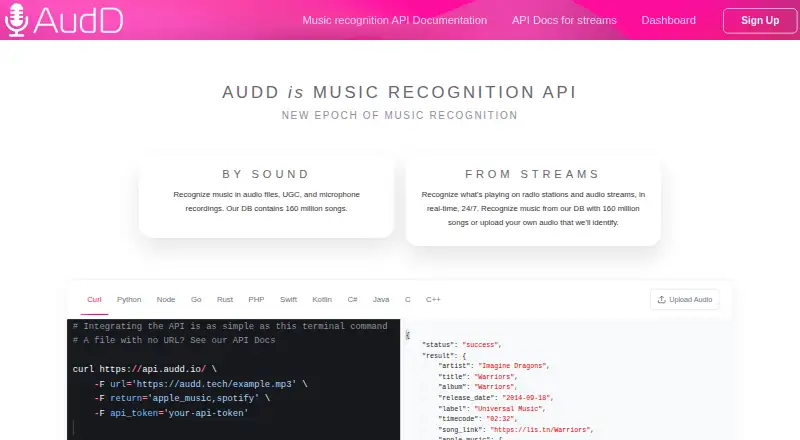
Submit a URL or upload a file to the standard API; it examines the opening roughly 12 seconds and reports its leading match. Returned details may cover artist, title, album, label, release date, timecode and song links.
For unlimited-length audio or video, the enterprise endpoint can identify multiple tracks and mark their timestamps. AudD also watches radio stations and streams continuously, delivering findings through webhooks or long polling.
AudD uses its own neural-network fingerprinting approach for recognition. The company says its catalog holds 160 million songs. Accounts with special access can add private tracks for matching against a custom catalog.
How it connects
AudD runs on Android, the web, an extension, an API and self-hosted deployments. Its standard endpoint accepts short clips up to 10 MB; larger media belongs on the enterprise endpoint.
Developers can use official SDKs for Python, Node.js/TypeScript, Go, Rust, PHP, Swift, Kotlin, C#/.NET, Java, C and C++. An MCP server lets AI agents search documentation, inspect usage and make API calls.
On request, recognition responses may carry identifiers or links for Apple Music, Spotify, Deezer, Napster and MusicBrainz. Stream recognition can identify Twitch, YouTube and other stream URLs, and AudD provides a Twitch extension plus an embeddable widget.
The public SDK repositories and OpenAPI specification use the MIT license, but the hosted recognition service is proprietary. API calls require an account token in the api_token parameter.
Good fit
AudD suits apps that need to identify songs from short recordings, media files, microphone input or online streams. It also fits monitoring jobs that need repeated checks and timestamped results.
Developers can use documented endpoint parameters, response schemas, curl examples and language-specific examples. Enterprise users can keep audio inside their own environment with on-premise deployment.
Watch for
Each standard request covers roughly 12 seconds and clips no larger than 10 MB. Longer or larger media requires the enterprise endpoint.
All API requests need an account token. The standard endpoint has no documented rate limit; the enterprise endpoint has a default concurrent-request limit that AudD can raise.
According to AudD, processing fingerprints audio and then discards the audio, retaining the fingerprints. Enterprise customers can sign a data-processing agreement or deploy on premises. Separate pricing applies to on-premise licensing and the database.
Pricing
AudD is paid, with a free trial of 300 requests total for 14 days and no credit card. Recognition stops at 300 requests. A stream-monitoring trial is available by asking AudD.
Pay-as-you-go file recognition is $5 monthly for 1,000 requests, with the first 300 included. The $5 Indie plan covers 1,000 requests each month; additional requests cost $5 per 1,000, and its listed tier reaches 90,000 monthly requests.
Stream plans cost $25 per stream per month for uploaded music or an own catalog, and $45 per stream per month for the AudD database. Own-catalog setup and storage fees are quoted separately.
Startup costs $450 a month for 100,000 requests, with extras at $4.50 per 1,000. Pro costs $850 a month for 200,000 requests, with extras at $4.25 per 1,000. A 500,000-request volume plan costs $1,800 a month. Custom pricing is quoted individually.
Verdict
Choose AudD if your product needs song matching through an API, stream monitoring, metadata or links to music providers. The SDK range and MCP server cover many development setups, while the enterprise endpoint handles long media.
Check the 12-second and 10 MB standard limits before building around short requests. Teams with strict data boundaries should review the processing terms and on-premise option. Budget users can start with 300 free requests, but ongoing use is paid and higher-volume plans rise quickly.
Our take
AudD is a practical choice for software that must recognize songs across clips, files, video, microphone audio or streams. Its short-request API, long-file enterprise endpoint, provider links and broad SDK list cover different implementation needs. The free 300-request trial lowers the entry cost, but there is no ongoing free plan. Verify whether the standard size and duration limits fit your workflow. Enterprise buyers should examine concurrent-request limits, custom catalog access, data-processing terms and the separate cost of on-premise licensing.
- Recognizes music from files, URLs, videos, microphones and streams
- Returns track metadata, timestamps and optional provider links
- SDKs cover many common programming languages
- A signup trial includes 300 recognition requests with no credit card
- On-premise option keeps audio inside an enterprise environment
- Each standard request covers roughly 12 seconds and up to 10 MB
- No permanent free plan
- Enterprise and on-premise options have separate pricing
- API use requires an account token
- Higher-volume plans cost hundreds or thousands per month
- Pick it ifApps that need song identification through an API; Teams monitoring radio or online streams; Enterprise projects needing on-premise audio processing
- Skip it ifYou need unlimited free recognition; Your files exceed standard limits without an enterprise plan; You cannot use token-authenticated API requests
Pricing
A 300-request, 14-day trial is free.
- Free trial300 requests total · usable for 14 days · no credit card · recognition stops at 300Free
- File recognition pay-as-you-go$5 per 1,000 requests; first 300 requests free · Pay-as-you-go · 1,000 requests$5/mo
- Indie$5 per month · 1,000 requests/month · extra requests $5.00 per 1,000 · up to 90,000 requests/month listed tier$5/mo
- Live stream recognition (uploaded music)$25 per stream per month · Per stream · Your uploaded music catalog$25/mo
- Stream monitoring with own catalog$25 per stream per month · Uses uploaded catalog · catalog setup and storage fees quoted separately$25/mo
- Live stream recognition (AudD music database)$45 per stream per month · Per stream · AudD music database$45/mo
- Stream monitoring with AudD database$45 per stream per month · 24/7 stream recognition · billed by maximum simultaneous stream capacity$45/mo
- Startup$450 per month · 100,000 requests/month · extra requests $4.50 per 1,000$450/mo
As audd.io lists them, checked 15 Oct 2026.
Questions
Is AudD free?
AudD offers 300 free requests for 14 days without a credit card. After that, its listed plans are paid.
What can AudD identify?
It identifies music in clips, uploaded files, URLs, videos, microphone recordings, radio stations and live streams.
How long can a standard request be?
A standard call examines about 12 seconds and allows clips up to 10 MB; longer or larger media goes through the enterprise endpoint.
Which details can results include?
Responses can contain artist, title, album, label, release date, timecode, song links, ISRC, UPC and other provider metadata.
Does AudD offer self-hosting?
Yes. AudD offers separately priced on-premise licensing, and enterprise customers can deploy the recognition technology inside their own environment.
Which languages have official SDKs?
Official SDK documentation covers Python, Node.js/TypeScript, Go, Rust, PHP, Swift, Kotlin, C#/.NET, Java, C and C++.