
AWS CloudFormation: Features, Fit, and Pricing
aws.amazon.com · checked 20 Oct 2026
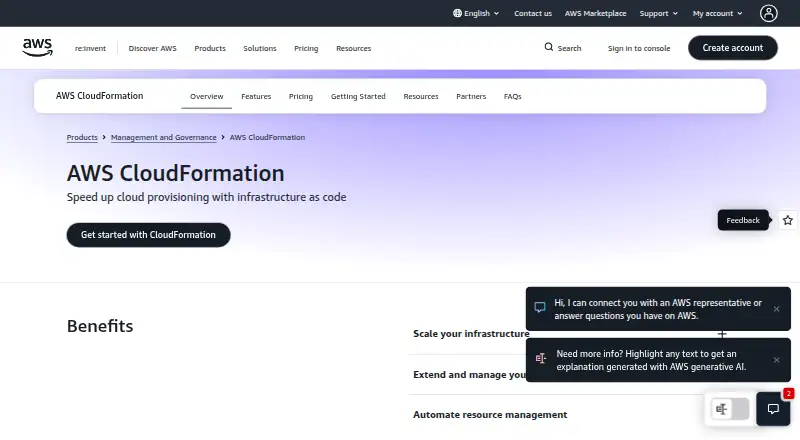
Reusable templates let AWS CloudFormation provision and manage AWS resources.
How it plugs in
Signal on Infrastructure as Code Tools6.7#4 of 31
With YAML or JSON templates, AWS CloudFormation manages related resources together as stacks. Change Sets let teams inspect planned updates, Drift Detection identifies changes made outside the service, and StackSets deploy a shared template across accounts and Regions. CloudFormation has no separate charge for AWS::* and Alexa::* resource providers, although provisioned AWS resources carry standard charges. It connects with AWS tools including the console, API, CLI, SDKs, CDK, SAM, and CodePipeline.
Review
In a line
AWS CloudFormation uses declarative templates to define AWS resources, provision them, and manage them. Related resources are grouped into stacks, which users can create, update, or delete together.
What it does
Templates written in YAML or JSON describe resources and their settings. The same template can create consistent stacks across environments or regions. If a deployment encounters an error, CloudFormation can restore it to the last known good state.
Before running an update, users can review its proposed changes, including potential resource deletions or replacements, with Change Sets. Drift Detection records changes made to resources outside CloudFormation. StackSets deploy a shared template to create common resources in multiple AWS accounts and Regions.
How it connects
Users can work with CloudFormation in the AWS Management Console or through its API, AWS CLI, and SDKs. During pipeline runs, CodePipeline can create, update, replace, or delete CloudFormation stacks and Change Sets. Stacks can also be updated using templates kept in remote Git repositories.
AWS CDK lets developers define cloud environments in TypeScript, Python, Java, or .NET, then provisions them through CloudFormation. AWS SAM offers concise YAML for functions, APIs, databases, and event source mappings; deployment transforms that syntax into CloudFormation. The Registry includes third-party resources and modules, with examples such as MongoDB, Datadog, Atlassian Opsgenie, JFrog, and Splunk.
The CloudFormation CLI toolkit lets developers build custom resource providers and modules, and its library carries an Apache 2.0 license. AWS documentation also covers CloudFormation Hooks and Guard, an open-source policy-as-code tool.
Good fit
CloudFormation suits teams that want repeatable AWS infrastructure deployments from templates. AWS describes use cases that include CI/CD automation for infrastructure templates, as well as stacks for one EC2 instance or complex multi-Region applications.
Watch for
CloudFormation targets AWS rather than other cloud platforms. AWS does not add a CloudFormation fee for AWS::* and Alexa::* resource providers, but the resources provisioned are billed at standard rates. Third-party provider and custom hook operations may add costs.
AWS documents IAM as a way to manage access and CloudTrail as a way to log API calls. Data is encrypted at rest, while service communications use encrypted channels; AWS recommends TLS 1.3 and requires TLS 1.2.
Pricing
The CloudFormation service has no minimum fees or upfront commitments. Provisioned AWS resources are charged at their regular rates.
Third-party provider and custom hook operations are billed per second once operation time exceeds 30 seconds. The Free Tier covers the first 1,000 operations, with no additional charge for the first 30 seconds of each operation.
Verdict
For AWS-focused work, templates, previews, and stack-based resource management can support repeatable deployments. Teams can use the console, API, command-line tools, SDKs, and integrations with CDK, SAM, and CodePipeline. Check the cost of AWS resources and third-party operations before adopting it. CloudFormation does not manage infrastructure across clouds beyond AWS.
Our take
CloudFormation gives AWS teams a consistent way to define and update resources. Its templates, stack previews, rollback, and multi-account deployment features support common infrastructure workflows without a separate service charge. The primary costs are provisioned AWS resources and any third-party provider or hook operations. Teams needing a multi-cloud tool should look elsewhere.
- No separate CloudFormation charge for AWS::* and Alexa::* resource providers.
- Templates can support consistent stacks across regions and environments.
- Change Sets show potential resource replacement or deletion before execution.
- StackSets deploy a shared template across accounts and Regions.
- Integrates with AWS CDK, SAM, and CodePipeline.
- Supports AWS, not other cloud platforms.
- Provisioned AWS resources carry standard charges.
- Third-party provider and custom hook operations may incur charges.
- Pick it ifTeams managing AWS resources with reusable templates; AWS users automating infrastructure template deployment in CI/CD
- Skip it ifYou need one infrastructure tool for multiple cloud platforms; You expect provisioned AWS resources to be included in the CloudFormation service cost
Pricing
There is no separate CloudFormation charge for AWS::* and Alexa::* resource providers; provisioned AWS resources are billed at standard rates. The Free Tier includes the first 1,000 third-party provider and custom hook operations and the first 30 seconds of each operation. Additional operation time may be billed per second.
- AWS CloudFormationFree service for CloudFormation itself; underlying AWS resources are billed at their own rates. Third-party provider and custom hook operations may incur charges; first 1,000 operations are included in the Free Tier, and the first 30 seconds of each operation have no additional charge.Free
- CloudFormation serviceNo additional CloudFormation charge for AWS::* and Alexa::* resource types; pay for provisioned AWS resources · No minimum fees · No upfront commitmentsFree
- Third-party resource providersper second above 30 seconds of handler-operation duration · First 30 seconds per operation free · Free tier includes hook and third-party provider operationsFree
As aws.amazon.com lists them, checked 30 Sept 2026.
Questions
Does AWS CloudFormation cost money?
CloudFormation has no separate charge for AWS::* and Alexa::* resource providers. AWS resources it provisions are billed at standard rates.
What template formats does CloudFormation use?
Templates can be written in YAML or JSON to describe AWS resources and their configuration.
Can CloudFormation deploy to multiple AWS accounts?
Yes. StackSets deploy a shared template to provide common AWS resources across multiple accounts and Regions.
Can I preview a CloudFormation update?
Yes. Change Sets let you inspect proposed updates before execution, including potential resource replacement or deletion.
Does CloudFormation work with CodePipeline?
Yes. CodePipeline can create, update, replace, or delete CloudFormation stacks and Change Sets during pipeline runs.
Can CloudFormation manage resources outside AWS?
Its supported cloud platform is AWS, though the Registry includes third-party resources and modules.