Menu Bar Customization Software
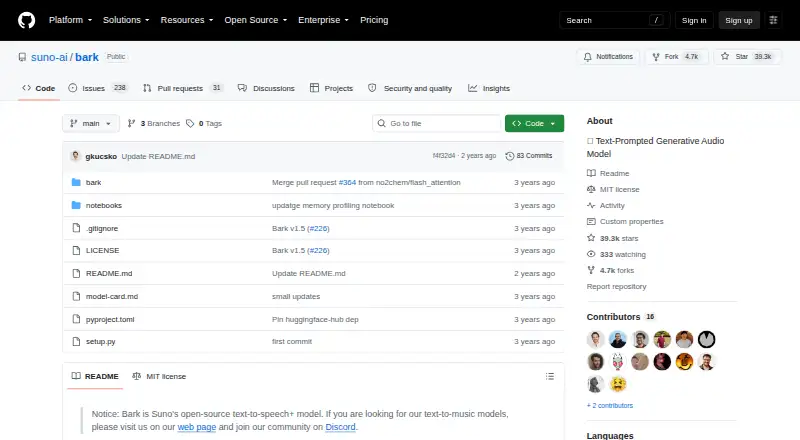
Bark: Text-to-Audio Model
github.com · checked 10 Oct 2026
Suno’s transformer-based Bark model creates audio from text, including speech, music, and other sounds.
How it plugs in
Signal on Menu Bar Customization Software7.0#2 of 25
Suno’s free, open-source Bark model generates speech in 13 languages, as well as music, sound effects, background noise, and nonverbal sounds. It includes more than 100 speaker presets and can create random voices, but not clone a custom voice. Speech generation works well with about 13 seconds of spoken text; output is typically around 13 to 14 seconds. The full model needs about 12 GB of GPU memory.
Review
In a line
Bark is an open-source model from Suno that generates audio from text. It can produce speech, music, sound effects, and other sounds.
What it does
Bark generates speech in 13 languages, alongside music, background noise, sound effects, and nonverbal audio like laughter, sighs, or crying. Its voice options include over 100 presets and randomly generated voices.
The project describes typical speech output as about 13 to 14 seconds. It can be used from Python or the command line.
How it connects
The Hugging Face Transformers library supports Bark, and Hugging Face handles model downloads and storage. The project provides installation instructions through Python tools and its GitHub repository.
Bark’s code carries the MIT license; the project says pretrained models may be used commercially. Audio exports in WAV format. The project points users to Discord for community discussion and shared prompts.
Good fit
Bark may suit people who want to generate short speech or other audio from text and are comfortable setting up a model themselves. It can also be used for commercial work under its stated license terms.
For other voice-generation options, browse text-to-speech software or game voice generators.
Watch for
Bark was developed for research and demonstrations, and generated audio may differ unexpectedly from the prompt. It does not clone custom voices, and typical speech output is brief.
Running the full model takes around 12 GB of GPU memory; smaller versions are described as fitting within 8 GB. The release also has a classifier meant to detect audio generated by Bark.
Pricing
Bark is free and open source. The pretrained models are available for commercial use.
Verdict
Bark is a free, open-source option for producing short speech or varied audio from text if you can handle setup and hardware requirements. Its range of languages and sound types can serve needs beyond spoken narration. Look elsewhere if you need a custom cloned voice, long speech output, or predictable results from every prompt.
Our take
Bark may suit people who want to make short speech, music, or sound effects from text with a free model they can set up themselves. Its open-source license and commercial-use permission allow uses beyond personal experiments. But short output, no custom voice cloning, hardware demands, and the possibility of unexpected results are practical limits. If your work depends on a specific voice or consistent prompt-following, Bark may not be a good fit.
- Free and open source under the MIT license.
- Pretrained models are available for commercial use.
- Generates speech, music, sound effects, and nonverbal sounds.
- Supports 13 languages and more than 100 speaker presets.
- Works through Hugging Face Transformers and exports WAV audio.
- Typical spoken output is about 13 to 14 seconds.
- Does not support custom voice cloning.
- The full model needs around 12 GB of GPU memory.
- Generated audio may differ unexpectedly from prompts.
- Pick it ifPeople who want free, short text-to-audio generation.; Users comfortable installing and running an open-source model.
- Skip it ifYou need cloned custom voices or long spoken output.; You need results to follow every prompt predictably.
Pricing
Bark is free and open source, and its pretrained models are available for commercial use. Buyers should account for the hardware needed to run it themselves.
Questions
Is Bark free?
Yes. Bark is free and open source.
Can Bark be used commercially?
Yes. The project makes pretrained models available for commercial use under its MIT-licensed release.
Can Bark clone a voice?
No. Bark provides speaker presets and random voices, but it cannot clone a custom voice.
How long is a typical Bark speech output?
The project says generation works well with about 13 seconds of spoken text and describes typical output as roughly 13 to 14 seconds.
What hardware does Bark need?
The full model needs around 12 GB of GPU memory. Smaller models are described as fitting 8 GB.
What audio formats does Bark export?
WAV.
How can I use Bark with other software?
Bark is supported through Hugging Face Transformers, which it also uses to download and store models.