
BitPay Crypto Payments and Wallet Review
bitpay.com · checked 15 Oct 2026
Crypto payment tools for merchants, payouts, and a self-custody wallet.
How it plugs in
Signal on Payment Processing Software7.7#1 of 71
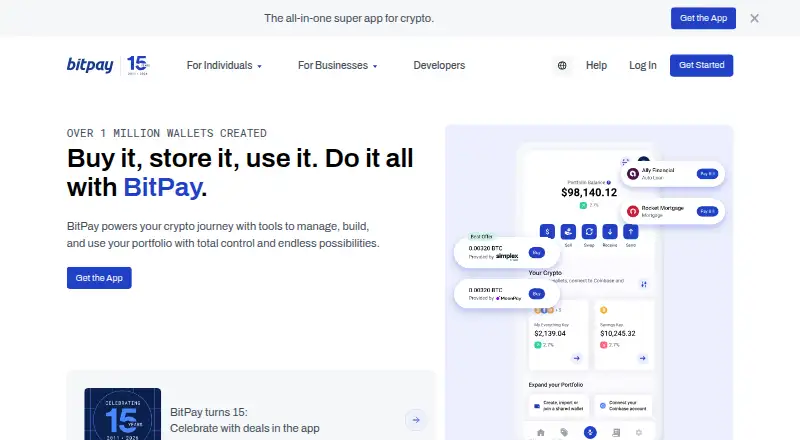
BitPay helps businesses accept cryptocurrency online, in stores, and through emailed invoices. It can settle payments in local currency, cryptocurrency, or both, and supports payouts, recurring billing, and payment links. Its wallet handles crypto storage and transactions on several devices. Integrations cover major ecommerce platforms, while developers can use REST APIs and SDKs.
Review
In a line
BitPay is a cryptocurrency payment service for businesses and a self-custody wallet for consumers. It was founded in 2011 and is based in Atlanta, Georgia.
What it does
Merchants can accept crypto online, in stores, or through email billing. Online checkout can use hosted checkout, payment buttons, invoices, or ecommerce integrations. In-store checkout uses QR codes on iOS and Android devices.
Email billing creates one-time or recurring invoices. BitPay also supports payment links, recurring billing, and payouts for payroll, vendors, affiliates, and other business payments.
Customer payments can be converted to local currency for bank settlement on the next business day. A merchant can settle in fiat, cryptocurrency, or a mix. The service supports more than 100 cryptocurrencies, including Bitcoin, Ethereum, Solana, and supported stablecoins.
The BitPay Wallet lets people hold, send, receive, buy, swap, sell, and spend crypto. It also supports gift-card purchases from more than 250 brands and cryptocurrency bill payments, including credit-card and mortgage bills, where available.
How it connects
BitPay lists plugins and integrations for Shopify, WooCommerce, Magento, and BigCommerce, plus other ecommerce platforms. Checkout can connect with wallets such as Coinbase, Exodus, MetaMask, Phantom, Trust Wallet, and WalletConnect.
Developers can use BitPay REST APIs and SDKs. The API covers invoices, refunds, bills, exchange rates, and ledgers. Official libraries include Java, Node, PHP, C#, and Python, with packages distributed through Composer, Maven, NuGet, and npm.
The wallet is open source, and public wallet and client components include MIT-licensed code. BitPay provides webhooks, integration guides, SDK references, and a changelog. Its apps run on Android, iOS, Mac, Windows, and Linux; the Android app requires Android 11 or newer.
Good fit
BitPay suits merchants that want cryptocurrency checkout across web, retail, and emailed invoices, with settlement choices in fiat or crypto. It also fits businesses needing crypto-funded payouts or recurring billing.
Consumers who want a self-custody wallet for storing and using crypto may find the wallet useful. The user keeps control of the wallet keys on their own devices.
Watch for
US merchant accounts require business verification, and BitPay's compliance process includes know-your-customer and anti-money-laundering checks. Fiat deposits are available only in supported countries.
Payouts are API-only, with no dashboard. They run in batches twice daily and require six confirmations before processing. Bill Pay is currently limited to US residents, and other bill-payment features have geographic restrictions.
Check device requirements before installing: BitPay requires Android 11 or newer and recommends current iOS, Android, or Apple-silicon Mac devices.
Pricing
BitPay has a free wallet download and no free trial. Merchant pricing can be quote-based: under $500,000 monthly transaction volume, $500,000–$999,999, and at least $1,000,000 are all listed as price on request.
Crypto acceptance is listed at $225 a month for volume below $500,000, $1.53 a month for $500,000–$999,999, and $125 a month for at least $1,000,000. These are billed per transaction; higher fees may apply to high-risk industries.
BitPay merchant processing is price on request and has unlimited monthly transactions. Its fee is based on cumulative monthly volume: 2% + 25¢* below $500,000 USD, 1.5% + 25¢* from $500,000 to $999,999 USD, and 1% + 25¢* at $1,000,000 USD or more.
Verdict
Choose BitPay if your business needs several crypto payment channels, local-currency settlement, or developer access through APIs and libraries. The wallet is a separate option for people who want self-custody and crypto spending tools.
Look elsewhere if you need a payout dashboard, operate outside supported settlement countries, or require Bill Pay outside the US. Confirm the quoted or transaction-based charges for your volume and industry before signing up.
Our take
BitPay is a practical option for merchants adding cryptocurrency payments without limiting themselves to one checkout format. Its settlement choices, ecommerce plugins, and developer libraries cover different ways to collect money, while the wallet gives consumers direct control of their keys. The main cautions are quote-based merchant plans, unusual transaction-based prices, compliance checks, and API-only payouts. US-only Bill Pay also narrows the consumer feature set. Businesses should verify country support, device requirements, and the fee structure for their monthly volume before choosing it.
- Accept payments online, in stores, or through emailed invoices
- Settle in fiat, cryptocurrency, or a combination
- Plugins for Shopify, WooCommerce, Magento, and BigCommerce
- REST APIs, SDKs, and official language libraries
- Open-source, self-custody wallet for several devices
- Payouts are API-only with no dashboard
- Bill Pay is currently limited to US residents
- Merchant pricing is often listed as price on request
- Android wallet app requires Android 11 or newer
- US merchants must complete verification and compliance checks
- Pick it ifMerchants adding crypto checkout and payout options; Consumers wanting a self-custody crypto wallet; Developers needing REST APIs and SDK libraries
- Skip it ifYou need a visual dashboard for managing payouts; You need Bill Pay outside the United States; You cannot meet the listed verification or device requirements
Pricing
The wallet is free. Merchant plans may require a quote, while crypto acceptance lists monthly amounts billed per transaction. Merchant processing uses volume-based percentage fees plus 25¢* per transaction.
- Under $500,000 monthly transaction volumeLess than $500,000 USD monthly transaction amountOn request
- $500,000–$999,999 monthly transaction volume$500,000–$999,999 USD monthly transaction amountOn request
- At least $1,000,000 monthly transaction volumeAt least $1,000,000 USD monthly transaction amountOn request
- BitPay Walletfree wallet download · mobile and desktop walletFree
- Crypto acceptance — $500,000–$999,999 monthly volumeper transaction · monthly transaction volume $500,000–$999,999$1.53/mo
- Crypto acceptance — $1,000,000+ monthly volumeper transaction · monthly transaction volume of at least $1,000,000$125/mo
- Crypto acceptance — under $500,000 monthly volumeper transaction · monthly transaction volume below $500,000 · higher fees may apply to high-risk industries$225/mo
- BitPay merchant processingUnlimited monthly transactions · fee based on cumulative monthly volume: < $500,000 USD: 2% + 25¢* · $500,000 - $999,999 USD: 1.5% + 25¢* · ≥ $1,000,000 USD: 1% + 25¢*On request
As bitpay.com lists them, checked 20 Sept 2026.
Questions
Does BitPay offer a free plan?
Yes. The BitPay Wallet is free to download. BitPay does not list a free trial.
How can a business accept payments?
BitPay supports online checkout, in-store QR payments, and one-time or recurring invoices sent by email.
Which ecommerce platforms integrate with BitPay?
Listed integrations include Shopify, WooCommerce, Magento, and BigCommerce, along with other ecommerce platforms.
Can BitPay settle payments in regular currency?
Yes. Merchants can settle in fiat, cryptocurrency, or a combination. Fiat can be deposited to bank accounts in supported countries.
Is the BitPay wallet self-custody?
Yes. BitPay describes the wallet as self-custody, with users responsible for controlling their cryptocurrency keys on their devices.
Are BitPay payouts available in a dashboard?
No. Payouts are API-only, batch twice daily, and require six confirmations before processing.
Who can use BitPay Bill Pay?
BitPay says Bill Pay is currently available only to US residents. Other bill-payment features may also have geographic restrictions.