
Bool AI App Builder Review: Features, Connections and Pricing
bool.com · checked 15 Oct 2026
AI app builder that turns plain-language prompts into hosted web apps with data, sign-in and deployment.
How it plugs in
Signal on AI App Builders6.6#6 of 39
Bool uses chat prompts to create full-stack web apps built with Next.js. Each app gets a database, file storage, authentication and a shareable hosted address. You can edit with collaborators, restore checkpoints and connect tools such as Linear, Notion and GitHub. A free plan is available, while paid plans add private projects, custom domains and larger limits.
Review
In a line
Bool is an AI app builder for making and publishing web apps from plain-language requests. It creates a hosted app with its own database and storage.
What it does
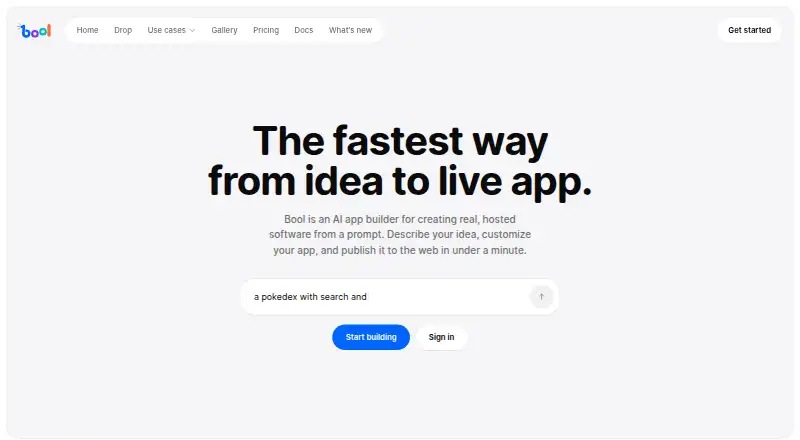
Describe an app, refine it through chat, preview the result and publish it to a bool.so address. Bool generates a real Next.js application, database and live preview.
Each app includes file storage, email/password or Google sign-in, password resets and separate data for each user. Data changes can appear live for other viewers, and every change is saved as a restorable checkpoint.
Published apps can be shared publicly, with a workspace, or only with invited people. Bool can also add server-side AI features for visitors without requiring you to provide a model-provider key.
How it connects
Connectors can link services such as Linear, Notion and GitHub so Bool's chat agent can use their data. An MCP connector lets ChatGPT, Claude, Cursor and other compatible AI clients build and deploy projects.
For technical access, Bool offers a bearer-token HTTP API, a command-line tool for local development and deployment, and a JavaScript SDK with client and entity operations. New apps can expose typed actions to AI agents through WebMCP.
Bool-hosted deployment is described in its documentation; no self-hosting option is provided. The service is available through web, iOS, Linux and an API, while it does not provide mobile apps.
Good fit
Bool suits people making personal tools, prototypes, internal software, private websites and organizing apps. It is useful when you want a working web app, database and hosting from a conversational workflow.
Teams can invite collaborators by email, restore earlier checkpoints and control sharing. Paid plans support private projects and custom domains.
Watch for
Generated code may be inaccurate, incomplete or insecure, so Bool says it should be reviewed and tested before production use. Bool does not guarantee uptime, speed, capacity or storage durability, and outages can include maintenance or model-provider downtime.
Free workspaces have a five-credit rolling 24-hour limit. Existing apps stay live and shareable after credits run out, but changes pause until credits return or are added. Private visibility requires a paid plan.
Bool is not open source and its terms say the service software belongs to Bool. Credits are generally non-refundable and cannot be transferred. Prompts and relevant project context are sent to third-party AI providers, although Bool says it does not train models on them.
Pricing
Bool has a free plan and paid plans from $20/month. Free includes 30 credits per month with a five-credit rolling daily limit, five deployed Bools, five bool.so subdomains, collaborators, public projects, databases and 10MB Drop projects.
Plus costs $20/month and includes 100 credits per month, unlimited Bools and subdomains, private projects, custom domains, no Bool badge and larger Drop limits. Pro is also $20/month, with 100 credits, unlimited Bools and subdomains, public and private projects, custom domains, no badge, larger file limits, up to 10 workspace members and pooled workspace credits.
Team costs $30/user/month with 150 pooled credits per seat, a shared workspace, roles, permissions, workspace sharing, managed domains and centralized billing. Business costs $100/month with 500 pooled credits, unlimited members, roles, permissions, workspace-level sharing, managed domains and centralized billing. There is no free trial.
Verdict
Choose Bool if you want to turn a written idea into a hosted web app that already has data storage, sign-in and publishing. It also fits teams that need shared editing, checkpoints and controlled visibility.
Check the credit rules and plan differences before committing, especially if you need private sharing, custom domains or frequent revisions. Developers can use the API, CLI or SDK, but generated code still needs review. Skip it if you require open-source software or self-hosting.
Our take
Bool is a practical choice for quickly creating web apps from conversational instructions, with hosting, databases, files, authentication and publishing included. Its connectors and AI-client support broaden how projects can be built, while checkpoints and workspace controls help with collaboration. The main trade-offs are credit limits, paid-only private visibility, no self-hosting or open-source release, and the need to check generated code before production. Buyers should compare the similarly priced Plus and Pro plans closely and review the higher-cost workspace options before choosing.
- Plain-language prompts create hosted full-stack web apps
- Each app includes a database, file storage and sign-in
- Connectors support Linear, Notion, GitHub and other tools
- API, CLI, SDK and MCP access are available
- Free plan includes deployed apps and public projects
- Free workspaces pause changes after the credit limit
- Private visibility requires a paid plan
- No self-hosting option or open-source license
- Generated code may be inaccurate, incomplete or insecure
- Credits are generally non-refundable and non-transferable
- Pick it ifPeople building personal tools, prototypes and internal web apps; Teams needing shared editing and controlled app visibility; Developers who want API, CLI, SDK or MCP access
- Skip it ifYou need open-source software or deployment on your own infrastructure; You require guaranteed uptime, capacity or storage durability; Your work cannot send prompts and project context to outside AI providers
Pricing
Credit limits govern how much building you can do; paid tiers add private projects, custom domains, larger limits and workspace features.
- Plus$20/ month · 100 credits/month · unlimited Bools and subdomains · private projects · custom domains · remove Bool badge · larger Drop limits$20/mo
- Team$30/ user / month · 150 pooled credits per seat/month · shared workspace · roles and permissions · workspace sharing · managed domains · centralized billing$30/mo
- Free$0/ month · 30 credits/month with 5-credit rolling daily limit · 5 deployed Bools · 5 bool.so subdomains · collaborators · 10MB Drop projects · public projects · databasesFree
- Pro$20/ month · 100 credits per month · unlimited bools and bool.so subdomains · public and private projects · custom domains · remove Bool badge · larger Drop file limits · up to 10 workspace members · pooled workspace credits$20/mo
- Business$100/ month · 500 pooled credits per month · unlimited workspace members · roles and permissions · workspace-level project sharing · workspace-managed domains · centralized billing$100/mo
As bool.com lists them, checked 15 Oct 2026.
Questions
Does Bool make mobile apps?
No. Bool creates web apps. Its listed platforms are web, iOS, Linux and an API, but it does not provide mobile apps.
What does each Bool app include?
Each app gets a database, file storage, hosting, authentication and a shareable address. Bool also provides live preview and spreadsheet-style data editing.
Can I connect Bool to other services?
Yes. Bool documents connectors for Linear, Notion, GitHub and other tools. Its chat agent can use connected data.
Can ChatGPT or Claude build Bool apps?
Yes. Bool offers an MCP connector and server for ChatGPT, Claude, Cursor and other compatible AI clients to build and deploy projects.
What happens when free credits run out?
Existing apps remain live and shareable, but changes pause until credits replenish or you add credits. The free workspace has a five-credit rolling 24-hour limit.
Is Bool open source or self-hostable?
No open-source license or self-hosting option is provided. The documentation describes deployment hosted by Bool.