Boundary software review
developer.hashicorp.com · checked 15 Oct 2026
Identity-based access to servers, databases, applications and cloud infrastructure without direct network access.
How it plugs in
Signal on SSH Server Software6.7#2 of 34
Boundary controls access to infrastructure through authenticated, identity-based sessions instead of direct network entry. It supports role-based permissions, just-in-time access, credential brokering and auditing for TCP, SSH, RDP, HTTPS, RDS, Kubernetes and database targets. HCP Boundary is hosted, while Enterprise is self-managed.
Review
In a line
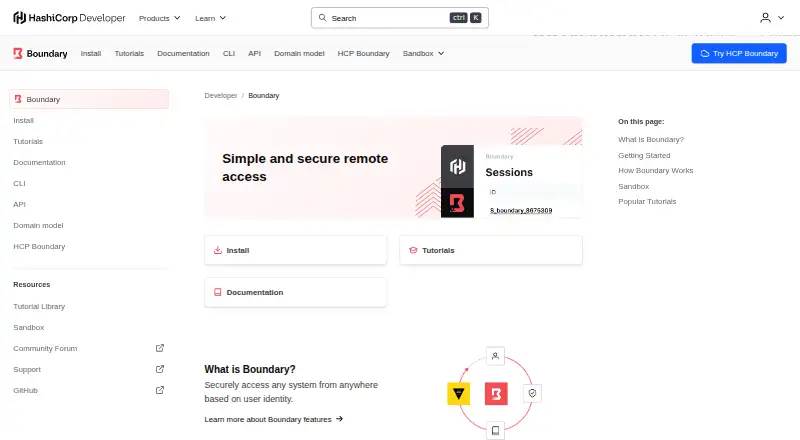
Boundary is a hybrid access service for reaching servers, databases, applications and other infrastructure without exposing the underlying network directly.
It centralizes permissions and creates authenticated sessions for people connecting to cloud or on-premises targets.
What it does
Boundary grants role-based, least-privilege access that can be approved just when needed. Users can connect to TCP, SSH, RDP, HTTPS, RDS, Kubernetes and database targets through familiar clients such as SSH, PuTTY, Remote Desktop, database tools and web browsers.
It can broker stored credentials or inject them into a session so the user does not see the secret. Vault can provide short-lived credentials and act as an identity provider or external key-management root.
Audit logs, session logs and administrator termination support oversight. HCP audit-log streaming and session recording are available, with recording and playback in the Plus edition.
How it connects
Boundary accepts password, OpenID Connect and LDAP authentication. OIDC connections include providers such as Okta, Auth0 and Microsoft Entra ID, and an OIDC provider can enforce multi-factor authentication.
It provides a REST API, command-line tool, SDKs and a Terraform provider for management and automation. Dynamic host catalogs can discover changing targets in AWS, Azure and Google Cloud; AWS catalogs can use IAM AssumeRole.
HCP Boundary hosts the control plane and can use customer-run workers. Boundary Enterprise is self-managed. Installers cover Linux, macOS and Windows, and desktop clients are available for macOS, Windows and Debian Linux.
Good fit
Boundary suits organizations that need identity-aware, auditable access to mixed cloud and on-premises infrastructure. It is useful when teams want centralized permissions, just-in-time authorization and credential handling across many target types.
Its PAM features combine access control, credential brokering and injection, session auditing, administrator termination and recording. The Client Agent can route eligible DNS connections through Boundary without users entering resource IDs or proxy ports.
Watch for
Production deployments require PostgreSQL with pgcrypto and citext modules, controller-worker network connectivity and listener-specific load balancing. Check these requirements before choosing a self-managed setup.
Boundary Community Edition is deprecated, archived and read-only as of October 2026, with no further releases, fixes or security patches planned. The repository uses Business Source License 1.1 and changes to MPL 2.0 four years after publication.
HCP Plus adds session recording, while Enterprise pricing is quote-based. Confirm which edition supplies the controls and support your organization needs.
Pricing
Boundary has a free access option and a free trial. Boundary Community Edition is free but archived, with no future releases, fixes or security patches planned.
HCP Boundary Standard is free for the first 1–5 users monthly, then costs $23.95833/user/month with Silver Support or $25.00000/user/month with Gold Support for 6–20 users. It includes Community features, Vault dynamic credential injection and audit-log streaming.
HCP Boundary Plus is free for the first 1–5 users monthly, then costs $47.91667/user/month with Silver Support or $50.00000/user/month with Gold Support for 6–20 users. It adds session recording and the standard HashiCorp Cloud SLA. Boundary Enterprise is price on request and self-managed.
Verdict
Choose Boundary if you need centralized, identity-based access to varied infrastructure and want permissions, credentials and session records managed in one system. Its API, Terraform support and dynamic discovery help teams automate changing environments.
HCP is the simpler route when you want HashiCorp to host the control plane. Enterprise fits organizations that require self-management and commercial support. Avoid relying on Community Edition for new production work because it is archived and unsupported.
Our take
Boundary is a fit for organizations that need controlled access to servers, databases and cloud resources without giving users direct network entry. It covers common remote and database protocols, supports major identity providers, and can work with Vault for temporary credentials. HCP reduces control-plane operations, while Enterprise keeps deployment self-managed. Buyers should account for PostgreSQL and networking requirements, confirm which plan includes recording or log streaming, and avoid Community Edition for new deployments because it no longer receives fixes or security patches.
- Identity-based, least-privilege access without direct network exposure
- Supports TCP, SSH, RDP, HTTPS, RDS, Kubernetes and databases
- Vault credential brokering and injection
- REST API, CLI, SDKs and Terraform automation
- Audit logs, streaming and session controls
- Community Edition is archived and receives no fixes or security patches
- Production self-hosting requires PostgreSQL and network setup
- Session recording is available in the Plus edition
- Enterprise pricing is available only on request
- Pick it ifInfrastructure teams needing centralized, audited access; Mixed cloud and on-premises environments; Organizations using Vault or Terraform
- Skip it ifYou need a supported open-source community edition; You want a fully self-managed product without PostgreSQL requirements; You require session recording on a lower plan
Pricing
The first 1–5 HCP Standard or Plus users are free monthly. Paid per-user rates apply for 6–20 users, with different Silver and Gold Support prices. Enterprise pricing is by request; Community Edition is free but archived.
- Boundary Community EditionSource-available CE; repository archived October 8, 2026 · no further releases, fixes, or security patches plannedFree
- HCP Boundary Plusfirst 1–5 users monthly; then $47.91667/user/month with Silver Support or $50.00000/user/month with Gold Support (6–20 users) · Standard features · session recording · standard HashiCorp Cloud SLAFree
- HCP Boundary Standardfirst 1–5 users monthly; then $23.95833/user/month with Silver Support or $25.00000/user/month with Gold Support (6–20 users) · Boundary Community features · Vault dynamic credential injection · audit-log streaming · standard HashiCorp Cloud SLAFree
- Boundary EnterpriseSelf-managed deployment · full feature parity with HCP Boundary · commercial supportOn request
As github.com lists them, checked 15 Oct 2026.
Questions
Is Boundary free?
Yes. HCP Boundary Standard and Plus are free for the first 1–5 users monthly. Community Edition is also free, but it is archived and no longer receives releases, fixes or security patches.
Does Boundary support single sign-on?
Yes. Boundary supports OpenID Connect and LDAP. OIDC examples include Okta, Auth0 and Microsoft Entra ID, and an OIDC provider can enforce multi-factor authentication.
Which systems can Boundary reach?
It supports TCP, SSH, RDP, HTTPS, RDS, Kubernetes and database targets. Users can connect with SSH clients, PuTTY, Remote Desktop, database clients and web browsers.
Can Boundary manage credentials?
Yes. It can broker centrally stored credentials or inject them into sessions. HashiCorp Vault can provide short-lived dynamic credentials and other key-management functions.
Is Boundary open source?
No. The repository uses Business Source License 1.1, with each version changing to MPL 2.0 four years after publication. Community Edition is deprecated and archived.
What is the difference between HCP and Enterprise?
HCP Boundary is managed by HashiCorp and can use customer-run workers. Boundary Enterprise is self-managed, has full feature parity with HCP Boundary and includes commercial support.