
ChartStead conference programming software review
chartstead.com · checked 10 Oct 2026
Open-source conference programming from proposals to a published agenda.
How it plugs in
Signal on Event Scheduling Software5.1#31 of 34
ChartStead organizes conference proposals, reviews, speakers, schedules, and public programs in one workflow. It runs on the web and offers an API. ChartStead is available at no cost as MIT-licensed open-source software. Teams running their own instance take care of deployment, access, updates, backups, delivery setup, and ongoing support.
Review
In a line
ChartStead manages conference programming and speakers, starting with a call for proposals and ending with a public agenda. It runs on the web and through an API.
What it does
Organizers can collect proposals through public forms, review them by track, and mark them approve, maybe, or deny. The workflow also covers internal decisions, speaker preparation, messages, and agenda publication.
The speaker portal supports onboarding tasks, bios, headshots, and logistics. Scheduling tools cover rooms, tracks, session placement, and warnings about conflicts.
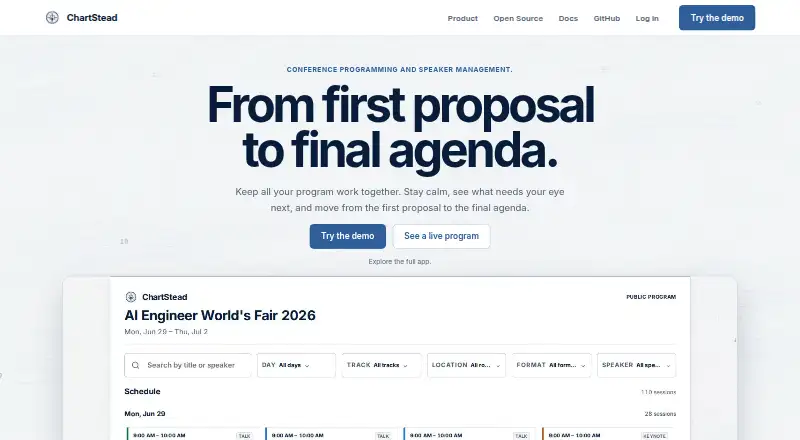
Course Check examines talks at acceptance and performs another review before publication. Named schedule conflicts remain displayed until they are resolved. The public program offers an embeddable, mobile-friendly schedule and speaker gallery.
How it connects
ChartStead provides a scoped HTTP API, meaning access can be limited to the needed areas. Agents and automation can use MCP through those same keys.
Users reach the production site through Better Auth, with Google or magic-link sign-in. The MIT License permits using, studying, modifying, and sharing ChartStead as long as the license notice stays with it.
With self-hosting, your team handles deployment and access, software updates, backups and recovery, delivery setup, and operational support. A separate demo uses sample event data and does not require an account.
Good fit
ChartStead suits conference organizers who need one place for proposal intake, track-based review, speaker coordination, room scheduling, and a public program.
It is a fit when you want open-source software, web access, an API, or automation through MCP. Its session tracks, room scheduling, and speaker management cover the core programming work described here.
Watch for
ChartStead does not include ticketing, payments, advertising, or a broad event CRM. You will need other tools for those jobs.
Self-hosting adds operational work. Confirm who will manage access, updates, backups, delivery setup, recovery, and support before adopting it.
Pricing
ChartStead is free. The MIT terms allow sharing when the accompanying license notice is retained.
Verdict
Choose ChartStead if your main task is running a conference program from submissions through the published schedule, and you can take on self-hosting duties when needed.
Look elsewhere if your event depends on built-in ticket sales, payment handling, advertising, or a wider customer-management system. The free license and API access make it worth considering for organizers who value control and automation, but operational ownership remains part of the decision.
Our take
ChartStead is a focused option for conference programming rather than a complete event business system. It brings proposal forms, track review, speaker preparation, scheduling checks, and an embeddable public agenda into one flow. The free MIT-licensed code can suit organizations that want to run or adapt the software themselves. However, self-hosting means taking responsibility for deployment, security access, backups, updates, delivery, and support. Events needing ticketing, payments, advertising, or a broad CRM should plan to pair ChartStead with other products or choose a wider platform.
- MIT-licensed open-source software at no cost
- Covers proposals, review, speakers, rooms, tracks, and agenda publication
- The public program offers a mobile-friendly schedule and speaker gallery
- Scoped API and MCP support automation
- Course Check flags named schedule clashes
- No ticketing, payment, advertising, or broad event CRM features
- Teams hosting it themselves must manage deployment, backups, updates, and support
- Requires separate operational planning for delivery and recovery
- Pick it ifConference teams managing proposals through a public program; Organizers wanting open-source control and API access; Events using tracks, rooms, and speaker workflows
- Skip it ifYou need built-in ticket sales, payments, advertising, or a broad event CRM; No one can own self-hosting, backups, updates, and operational support
Pricing
ChartStead costs nothing to use and is released under the MIT License. Self-hosting still leaves deployment and ongoing operations to your team.
Questions
Is ChartStead free?
Yes. It is available free of charge as open-source software under the MIT License.
What does ChartStead manage?
It manages conference proposals, track review, speaker preparation, room and session scheduling, conflict checks, and a public agenda.
Does ChartStead have an API?
Yes. The documentation covers a scoped HTTP API and MCP access for agents and automation; both use the same keys.
How do users sign in?
Better Auth powers the production environment, offering Google or magic-link sign-in.
Can I try ChartStead without an account?
An isolated demo with sample event data is available without requiring account setup.
What does self-hosting require?
Teams operating their own deployment are responsible for deployment and access, updates, backups and recovery, delivery setup, and operational support.
What does ChartStead leave out?
Its scope omits ticketing, payments, advertising, and a broad event CRM.