ClamAV: Open-Source Antivirus Scanning Engine
clamav.net · checked 15 Oct 2026
Self-hosted, open-source scanning engine for email, web content and files.
How it plugs in
Signal on Antivirus software7.6#1 of 120
ClamAV detects viruses, trojans and other malware as a free open-source engine. It scans email, web content and files through a command-line tool, a multithreaded service and automatic database updates. Supported environments include GNU/Linux, FreeBSD, macOS and Windows, alongside Docker and other self-managed deployment choices.
Review
In a line
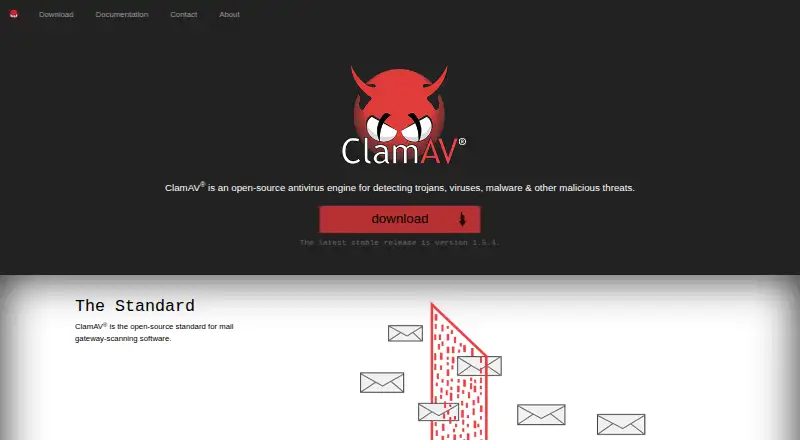
ClamAV is an open-source engine for finding viruses, trojans, malware and related threats. Its main emphasis is mail-gateway email scanning, not operation as a conventional endpoint-security suite.
What it does
The clamscan command scans files when you ask it to. The clamd service keeps virus signatures loaded for repeated scans, while FreshClam downloads and checks updated databases. The project says its official database is normally updated once or twice daily, with updates also described as occurring multiple times per day.
It handles standard mail, many archive types, executable files and documents such as Microsoft Office files, HTML, RTF, PDF, OneNote and HWP. A bytecode runtime lets trusted detection routines run inside the scanner.
On modern Linux systems, ClamOnAcc can scan files as they are accessed and can optionally block access until scanning finishes.
How it connects
ClamAV is GPL-2.0 open-source software. Its core engine is available as a shared library, and applications can communicate with clamd through its socket protocol. A Milter interface is available for Sendmail.
You can add custom signature files and supported YARA rules. Official installation choices include package managers, Linux DEB or RPM packages, a macOS package, a Windows installer or portable ZIP, Docker images, and source builds. Cisco publishes Alpine and Debian Docker images with versioned, stable and unstable tags.
Good fit
ClamAV suits administrators who need self-hosted antivirus scanning for mail gateways, web content or files. Endpoint scanning is also possible on the operating systems named by the project: GNU/Linux, FreeBSD, macOS and Windows.
It is a practical match for teams that want open-source code, command-line scanning, a long-running scanning service, automatic signature downloads and the ability to add their own signatures.
Watch for
ClamAV does not function as a conventional antivirus or endpoint-security suite, so check whether an engine-only design meets your security needs. The project does not guarantee that every version or variant of a supported file format can be unpacked or extracted.
The recommended minimum is 3 GiB of RAM, one 2.0 GHz CPU and 5 GiB of free disk space. Linux on-access scanning requires kernel 3.8 or newer and curl 7.45 or newer.
Release packages can be checked with GnuPG and the Cisco Talos public key. Security issues must be reported privately instead of through public GitHub issues.
Pricing
ClamAV is free, with no paid plan and no free trial. The listed plans are “ClamAV” and “ClamAV open-source software”; both are free of charge, GPL-licensed and self-hosted.
Verdict
Choose ClamAV when you need a free, self-hosted scanning engine that can plug into mail handling, scripts or applications through its tools and interfaces. Its broad file parsing, signed databases and Linux on-access option add flexibility.
Look elsewhere if you need a complete endpoint security product, guaranteed extraction of every file variant or a vendor-managed service. Confirm the hardware, operating-system and Linux kernel requirements before deployment.
Our take
ClamAV makes sense for organizations that can manage their own antivirus engine and want to scan mail, web content or files without a license fee. Its open-source license, multiple operating-system options, command-line utility, scanning service and update tool give administrators several deployment paths. The trade-off is responsibility: this is not a complete endpoint suite, format extraction is not guaranteed for every variant, and on-access scanning has Linux version requirements. Review your integration method, system capacity and operational support needs before choosing it.
- Free GPL-licensed open-source software
- Scans mail, archives, documents and executable formats
- Command-line scanner, multithreaded daemon and automatic updates
- Available on GNU/Linux, FreeBSD, macOS and Windows
- Supports Sendmail Milter, socket access and custom signatures
- Not a conventional antivirus or endpoint-security suite
- Extraction is not guaranteed for every supported format variant
- Recommended minimum is 3 GiB RAM and 5 GiB free disk
- Linux on-access scanning needs kernel 3.8+ and curl 7.45+
- Pick it ifSelf-hosted mail-gateway and file scanning; Administrators needing open-source antivirus tools; Linux users needing optional on-access scanning
- Skip it ifYou need a full endpoint security suite; You require guaranteed handling of every archive or file variant; You prefer a hosted service instead of self-managed software
Pricing
Both listed plans are free of charge, GPL-licensed and self-hosted. There is no paid tier or free trial.
- ClamAVOpen-source anti-virus engine under GPL; no paid plan or price statedFree
- ClamAV open-source softwarefree of charge · GPL-2.0 software · self-hostedFree
As clamav.net lists them, checked 7 Oct 2026.
Questions
Is ClamAV free?
Yes. The listed ClamAV plans are free of charge, with no paid plan stated. The software is licensed under GPL-2.0.
What does ClamAV scan?
It scans email, web content and files for viruses, trojans, malware and related threats. It supports many archives, executable formats and documents including Microsoft Office, HTML, RTF and PDF.
Which systems can run ClamAV?
The project lists GNU/Linux, FreeBSD, macOS and Windows. Official Docker images are available for Alpine Linux and Debian Linux.
Does ClamAV provide real-time scanning?
ClamOnAcc provides on-access scanning on modern Linux versions, with an option to block file access until scanning finishes. It requires kernel 3.8 or newer and curl 7.45 or newer.
Can applications connect to ClamAV?
Yes. The core engine is available as a shared library, and applications can use clamd through its socket protocol. A Milter interface is also available for Sendmail.
How often are virus definitions updated?
FreshClam periodically downloads and verifies signed databases. The official database is normally updated once or twice daily, with updates described as occurring multiple times per day.
Near it
All alternatives →- BT
 Bitdefender Total Security#2 on this board
- F
 FortiClient#3 on this board
- KAKaspersky Antivirus#4 on this board
- AO
 Avast One#5 on this board
- MDMicrosoft Defender for Business#6 on this board
- EH
 ESET HOME Security#7 on this board
- KPKaspersky Plus Internet Security#8 on this board
- BA
 Bitdefender Antivirus Plus#9 on this board
- MP
 Malwarebytes Premium#10 on this board
- FS
 F-Secure Total#11 on this board