
Clarity Billing Review
clarityschools.com · checked 8 Oct 2026
Online tuition and incidental-charge billing for private K-12 schools.
How it plugs in
Signal on Tuition Management Software5.0#16 of 26
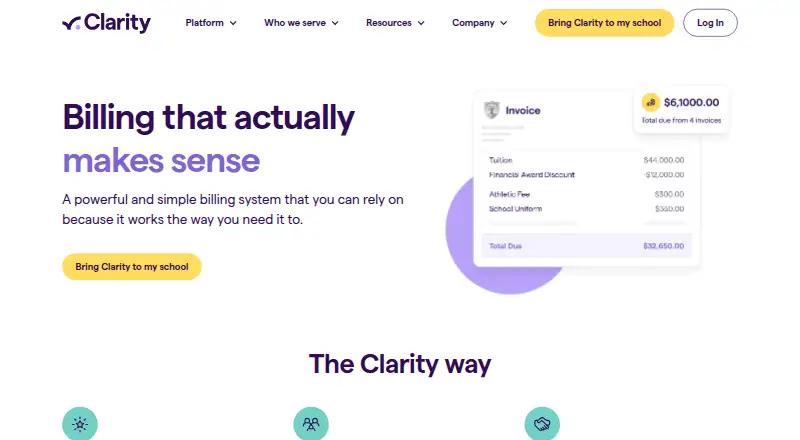
Clarity Billing helps K-12 private schools manage tuition and other family charges. The system creates invoices, issues reminders, supports payment-plan edits, and lets families use one account for aid, contracts, deposits, and invoices. Schools can charge for transportation, after-care, and similar items, while a dashboard combines billing, contract, and financial-aid figures.
Review
In a line
Clarity Billing is a web service for managing tuition and incidental charges at K-12 private schools. It covers school charges and family payments in one service.
What it does
The system generates family invoices and sends reminders automatically; staff can adjust a household’s payment plan with just a few clicks.
Signed contract information, including aid and other discounts, can drive invoice creation. A single family account supports aid applications, contract signing, deposit payments, and phone-based invoice management.
Its incidental-charge portal covers after-care, transportation, extracurricular activities, and similar expenses. Schools can define financial-aid discount rules for those charges.
Financial Aid, Contracts, and Billing data appear together in a real-time dashboard. The dashboard includes figures such as net tuition revenue, enrollment, and discount rates.
How it connects
Clarity Billing works alongside Clarity Financial Aid and Clarity Contracts. The billing workflow can use signed contract information to create invoices automatically.
The Billing page identifies no outside billing integration or public API. It runs on the web.
According to Clarity, data is protected by encryption during transmission and storage. School users also have to complete multi-factor authentication, an additional sign-in step. Household records remain private and separate, even when households share a student.
Good fit
K-12 private schools and business officers handling tuition, aid discounts, contracts, and incidental charges are the intended audience.
Schools seeking one family account for aid applications, contracts, deposits, and invoices may find it suitable. Automatic reminders and phone-based payments may help schools organize collections.
Watch for
Pricing is not published, so a school must request a quote. The service is offered through the web, and the page identifies no outside billing connections.
Schools control whether and when late fees are charged and retain the amounts collected. Clarity states that ACH payments carry no fee, referring to that bank-transfer method.
Clarity says a Truth in Lending Act disclosure is generated automatically when a parent is required to receive one. Each school is assigned a Client Success Manager, and the site lists separate email contacts for sales and family support.
Pricing
Clarity Billing is paid software. Buyers must request pricing because no public plan amounts are shown.
Verdict
Private schools needing tuition and incidental billing closely connected to financial-aid and contract records may want to consider Clarity Billing. Its family portal brings several payment tasks together, while the dashboard gives staff a shared view of key school figures.
Look elsewhere if you need a stated price, named outside billing integrations, or a platform beyond the web. Before committing, ask Clarity how its workflow fits your existing systems and what the quoted service includes.
Our take
Clarity Billing combines tuition, aid, contracts, and incidental charges for private K-12 schools. Families get one account for several payment tasks, and staff can use reminders, flexible payment plans, and a financial-health dashboard. The main buying hurdle is that pricing is not public. The product also lists no external billing integrations, so schools with established systems should confirm compatibility before signing up. Schools outside the K-12 private-school market may need a different type of billing platform.
- Signed contract details, aid information, and discounts can feed invoice creation.
- Families use one account for aid, contracts, deposits, and invoices.
- Incidental billing covers charges including transportation and after-care.
- There are no ACH fees; schools set late-fee policies and retain collected amounts.
- A live dashboard unifies billing, contracts, and financial-aid data.
- A quote is required because pricing is not posted.
- No external billing integration is identified on the Billing page.
- Access is provided through the web.
- Its focus on K-12 private schools narrows the audience.
- Pick it ifPrivate K-12 schools overseeing tuition and incidental charges; Business officers coordinating aid, contracts, and billing
- Skip it ifYou require named outside billing integrations.; You need software for a market other than K-12 private schools.
Pricing
Clarity Billing is paid software with pricing on request. Buyers must contact Clarity for a quote.
Questions
What is Clarity Billing?
It is a web-based system for tuition management and incidental billing at K-12 private schools.
Can families pay from a phone?
Yes. One family login allows invoice management, and payments can be made from a phone.
What incidental charges can it handle?
Its incidental-charge portal covers after-care, transportation, extracurricular activities, and other listed expenses, with rules for financial-aid discounts.
Does it charge ACH fees?
Clarity states that ACH payments have no fee. Schools set the timing and use of late fees and keep what they collect.
Does it connect to financial aid and contracts?
Yes. The workflow operates with Clarity Financial Aid and Contracts, and signed contract details can feed invoice creation.
Is pricing published?
No. Clarity presents the product as paid and directs buyers to request pricing.
How is school data protected?
Clarity says data is encrypted during transfer and storage, requires multi-factor authentication for school users, and keeps each household’s data separate.
Near it
All alternatives →- LPLumion Payments#15 on this board
- SSchoolAdmin#17 on this board
- T
 TUIO#14 on this board
- FS
 Flywire Student Financial Software#18 on this board
- TPTransact Payment Plans#13 on this board
- I
 Intellio#19 on this board
- DF
 Devaishno Fees Management#12 on this board
- SSchoolBanks#20 on this board
- LFLocus Fee Management#11 on this board
- V
 Veracross#21 on this board