
Commerce Layer
commercelayer.io · checked 14 Oct 2026
How it plugs in
Signal on Ecommerce platforms6.8#23 of 280
Commerce Layer is a unified, API-first commerce and order-management platform for making websites, apps, chatbots, IoT devices and other channels transact globally.
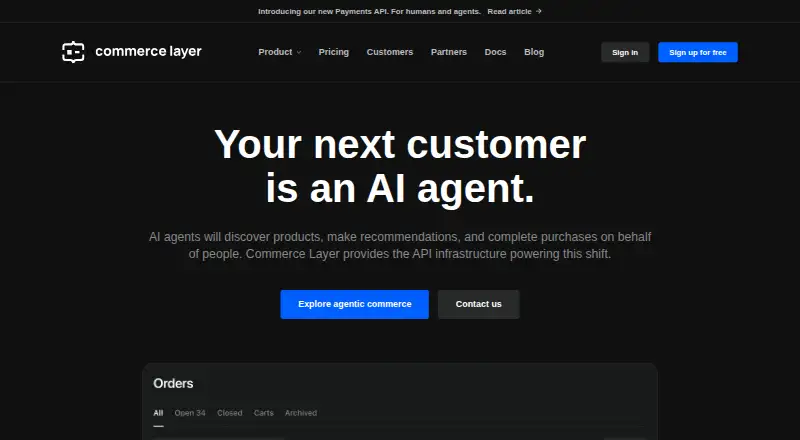
Review
<p>Commerce Layer is a hosted transactional commerce API for brands adding purchases to digital and in-store experiences. It suits teams building across markets and channels that can integrate through APIs. Its shared commerce layer spans checkout, orders, promotions and POS, but the hosted-only deployment and 100-order monthly Developer allowance narrow its fit.</p><h2>Overview</h2><p>Rather than supplying a single storefront, Commerce Layer provides commerce functions that teams can connect to headless sites, existing websites, mobile apps, connected devices and other channels. That makes it a candidate for brands that want to shape the customer experience themselves and coordinate selling across markets and stores. Teams seeking an off-the-shelf storefront or an on-premise deployment should look elsewhere.</p><h2>Key features</h2><h3>Checkout and order management</h3><p>The stateless checkout supports multiple markets and currencies and can connect to payment gateways and tax calculators. Commerce Layer says common payment providers work out of the box, while manual or external payment services are also supported. Its distributed order management system unifies inventory across locations and automates order steps from reservation through shipping. Together, these capabilities suit operations that need to coordinate online and store fulfillment rather than manage each channel separately.</p><h3>Promotions and in-store selling</h3><p>Market-specific promotion rules can be built with a visual editor or a JSON-based DSL, giving both nontechnical and developer-led teams a way to configure offers. The POS uses the same API as online channels and supports store inventory, endless aisle and shareable selling links. That common API can help teams connect in-store selling with their wider commerce setup.</p><h3>Integration, access and reliability</h3><p>The platform supports third-party integrations, including a documented Zapier app, and its homepage cites more than 400 API endpoints and real-time webhooks with over 100 trigger events. OAuth 2.0 and resource-level permissions provide controls over API access. Commerce Layer states an average API response time below 90 ms and guaranteed uptime of 99.99%. Its security page cites SOC 2 Type 2, PCI DSS Level 1 Provider and ISO 27001 certifications. The homepage advertises 24/7 support, though support differs by plan.</p><h2>Pricing</h2><p>Commerce Layer uses a freemium model, but neither plan has a published price. The Developer plan provides one organization, two users, two markets, 1,000 SKUs and 10 links, along with 100 free live orders per month and unlimited test orders. It includes community support. That makes it a constrained starting point for evaluation or smaller deployments, but the live-order allowance is a hard ceiling for production use unless the team moves to another arrangement.</p><p>Enterprise includes unlimited organizations, users, markets, SKUs and links, with orders per year custom quoted and dedicated support. It is the more relevant fit for larger or multi-market operations that need room beyond Developer’s caps, but teams will need to discuss the order commitment and price with sales. There is no standard free trial; Enterprise trial options can be discussed with sales. The freemium offer therefore gives teams a capped live plan and test orders, not a separate trial period.</p><h2>Platforms</h2><p>Commerce Layer is hosted and supports web, iOS, Android and API use. Its omnichannel orientation covers digital and in-store selling, but there is no on-premise version. Teams that require self-hosting or control of the deployment environment should favor a different platform.</p><h2>Who it's for</h2><p>Commerce Layer is best suited to brands and development teams building headless commerce, adding transactions to existing sites or apps, or coordinating online and store activity across markets. Its market-aware checkout, shared online and POS API, and distributed inventory view support those needs. It is less suitable for teams that want a conventional finished storefront, need self-hosting, or expect a standard trial before committing.</p><h2>Pros and cons</h2><ul><li><strong>Pros:</strong> One API spans checkout, order management, promotions and POS, supporting coordinated commerce across digital and store channels.</li><li><strong>Pros:</strong> Multiple markets and currencies, market-specific promotions, and inventory visibility across locations suit international, omnichannel operations.</li><li><strong>Pros:</strong> The Developer plan permits unlimited test orders and 100 free live orders per month, providing a bounded way to start.</li><li><strong>Cons:</strong> Developer is limited to two users, two markets, 1,000 SKUs and 10 links, as well as 100 live orders per month.</li><li><strong>Cons:</strong> Both plans have custom pricing, and there is no standard trial, making cost and pre-purchase evaluation less straightforward.</li><li><strong>Cons:</strong> Hosted-only deployment excludes teams that require an on-premise or self-hosted system.</li></ul><h2>Alternatives</h2><p>Choose <a href="/platforms/big-cartel/">Big Cartel</a> for a small catalog and straightforward store: its free Gold plan allows five products and one customizable store template, while Platinum is $15 a month for 50 products. <a href="/platforms/bagisto/">Bagisto</a> is a better fit for teams seeking a free open-source, self-hosted download, provided they can meet its PHP, database and memory requirements. <a href="/platforms/sylius/">Sylius</a> offers an open-source edition under the MIT license with community support and on-premise distribution, making it a relevant option when deployment control matters.</p><p><a href="/platforms/vendure/">Vendure</a> is another freemium, self-hosted API commerce framework. <a href="/platforms/bigcommerce/">BigCommerce</a> is a paid alternative with a free trial and a Core plan at $29 a month, suited to readers considering a priced platform rather than custom-quoted plans. <a href="/platforms/fourthwall/">Fourthwall</a> has a free plan for catalog products, a customizable shop, memberships and social selling integrations; its Pro plan is $15 a month. <a href="/platforms/lemon-squeezy/">Lemon Squeezy</a> has no monthly fee for ecommerce features, with transaction fees applying when sales are generated. <a href="/platforms/medusa/">Medusa</a> is a freemium, self-hosted API option; its Develop plan starts at $29 a month.</p><p>For broader comparison, browse <a href="/best/ecommerce-platforms/">Ecommerce platforms</a> or <a href="/best/headless-ecommerce-platforms/">Headless Ecommerce Platforms</a>.</p><h2>Verdict</h2><p>Commerce Layer is a strong fit for teams building international, omnichannel commerce around their own digital experiences: the shared API ties together checkout, inventory, orders, promotions and POS. Choose it when that breadth and API-led architecture matter more than deployment flexibility. Look elsewhere if you need self-hosting, a standard trial, or transparent pricing before making a commitment.</p>
Our take
Commerce Layer combines checkout, order management, promotions, and POS around a shared API. Its hosted-only model and lack of a standard trial matter for teams evaluating deployment fit.
- ["Checkout supports multiple markets and currencies", "POS and online channels use the same API", "Lists 400+ API endpoints and 100+ webhook events", "OAuth 2.0 and resource-level permissions control access", "Developer includes 100 free live orders monthly"]
- ["No trial period is offered", "No on-premise version is available", "Enterprise order pricing is custom quoted"]
- Pick it ifIt suits brands building headless commerce, mobile, or omnichannel experiences that need checkout, inventory, promotions, and order workflows through an API. Teams requiring self-hosted deployment or a trial period should note those options are unavailable.
Pricing
- Developer1 organization · 2 users · 2 markets · 1,000 SKUs · 10 links · unlimited test orders · 100 free live orders/month · Core API · community supportFree
- Enterpriseunlimited organizations · unlimited users · unlimited markets · unlimited SKUs · unlimited links · custom orders/year · Metrics API · Provisioning API · dedicated support · custom roles · custom identity provider · enterprise SLAsOn request
As commercelayer.io lists them, checked 14 Oct 2026.