Community Data: Free Open Startup Database
communitydata.io · checked 9 Oct 2026
An open startup data resource covering more than 1 million people and companies, with a public GraphQL API and free access.
How it plugs in
Signal on Startup Databases6.1#5 of 26
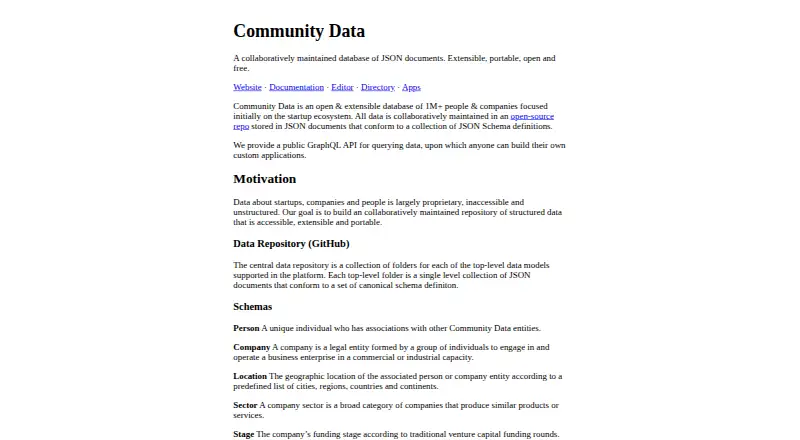
Community Data is a free, open-source database covering more than 1 million people and companies, initially centered on startups. Its records use JSON documents checked against defined schemas. Anyone can contribute through GitHub, while a public GraphQL API supports applications that query the data. A proof-of-concept web editor is also available.
Review
In a line
An open database for more than 1 million people and companies, maintained collaboratively with startups as its initial focus.
What it does
The project stores structured records for people, companies, locations, sectors, funding stages, and curated collections. Company profiles and funding data are included.
Developers can query the collection through its public GraphQL API and build applications around it. Scripts that draw on public APIs or websites can structure information for import into the project’s schemas.
How it connects
The data is kept as JSON files in an open-source repository. Each file follows a JSON Schema, which is a set of rules describing valid fields and values. Every commit is checked against those rules; invalid documents are rejected.
Contributors use GitHub to create or edit files. The proof-of-concept editor is a Next.js app connected to the GitHub API, and its contributors authenticate with GitHub accounts. Person records may use Twitter, LinkedIn, or a personal website as proof sources. The project uses the MIT License, copyright 2025.
Good fit
Community Data suits developers and other users who need structured startup ecosystem information, company profiles, funding details, or a source for their own applications.
It also fits contributors who want to add or correct records directly in an open repository. Developers can build apps with the GraphQL API and list them in the project’s apps repository.
Watch for
The editor is described as a proof of concept, so contributors should be comfortable working through GitHub. Records must match the project’s schemas or the commit will fail.
Ownership checks record a verified owner by GitHub username, and pull requests from listed owners are merged automatically without review. Schema changes go through pull requests and monthly governance calls.
Pricing
Community Data is free. The Community Data plan includes the open-source database and public GraphQL API.
Verdict
Choose Community Data if you want openly maintained startup records, a queryable API, or a repository you can extend yourself. It is also a fit for teams building tools that need people, company, location, sector, or funding-stage data.
Look elsewhere if you need a polished, managed research product or do not want GitHub-based contribution and ownership steps. The project’s scope starts with startups, and the editing workflow remains a proof of concept.
Our take
Community Data is a sensible starting point for developers who need free startup-related records in a reusable format. Its public GraphQL endpoint can feed custom apps, while the repository allows direct additions and corrections. The trade-off is a contributor workflow built around GitHub, schema rules, and ownership checks rather than a finished data-management suite. Because the collection begins with the startup ecosystem and the editor is only a proof of concept, buyers should confirm that its coverage and workflow match their project before adopting it.
- Free access to the database and public GraphQL API
- More than 1 million people and companies are covered
- Open JSON repository that anyone can contribute to
- Schema checks reject invalid data commits
- MIT-licensed project with GitHub-based workflow
- Editor is only a proof-of-concept application
- Invalid JSON documents cause commits to be rejected
- Initial focus is the startup ecosystem
- Owner pull requests can merge without review
- Pick it ifDevelopers building apps with startup ecosystem data; Teams wanting an open, contributable data source; Users needing company and funding records
- Skip it ifYou need a polished managed database instead of a GitHub workflow; Your project falls outside the startup-focused coverage; You cannot work with schema-validated JSON files
Pricing
The Community Data plan costs $0 and includes the open-source database plus public GraphQL API.
- Community DataOpen-source database · public GraphQL APIFree
As communitydata.io lists them, checked 9 Oct 2026.
Questions
Is Community Data free?
Yes. The Community Data plan is free and includes the open-source database and public GraphQL API.
How large is the database?
The project describes its database as containing more than 1 million people and companies.
What data does it cover?
Its schemas include people, companies, locations, sectors, funding stages, and curated collections. Company profiles and funding data are included.
Can I add or edit records?
Yes. Anyone can create or edit a JSON file in the repository. The proof-of-concept editor uses GitHub accounts for contributor authentication.
How can developers use the data?
A public GraphQL API lets developers query the records and build custom applications. Developers can also list projects in the apps repository.
What happens if a record is invalid?
Each commit is checked against its matching JSON Schema. A commit containing an invalid document is rejected.
What license does it use?
The project states that it uses the MIT License, copyright 2025.