CosyVoice: Free Multilingual Text-to-Speech
github.com · checked 3 Oct 2026
Multilingual speech synthesis for voice cloning, APIs, and self-managed deployment.
How it plugs in
Signal on Text-to-Speech Software7.5#59 of 223
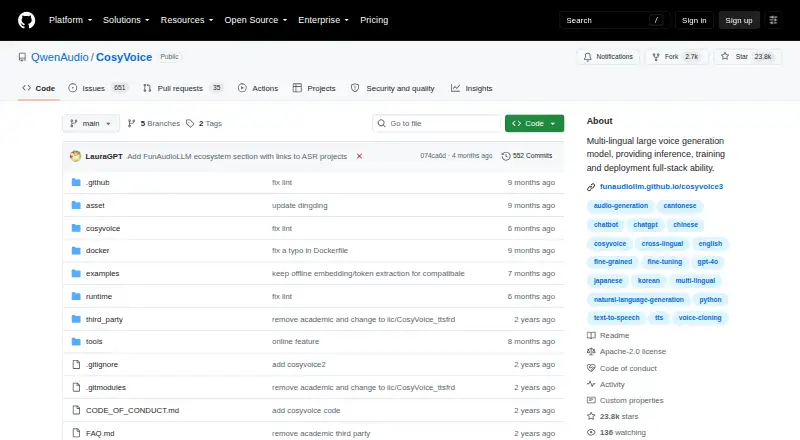
Under the Apache License 2.0, CosyVoice provides text-to-speech on Linux with API and self-hosting options. It offers multilingual and cross-language zero-shot cloning, audio streaming, pronunciation tools, and WAV export. The repository describes Python 3.10 installation, model downloads, and Docker, FastAPI, gRPC, Triton, or TensorRT-LLM deployment.
Review
In a line
CosyVoice is a multilingual text-to-speech system that can generate speech, train models, and support deployment. It is free software for self-managed use.
What it does
CosyVoice turns text into spoken audio and supports voice cloning. Fun-CosyVoice 3.0 targets zero-shot speech generation across multiple languages, including cross-language cloning. Its third version spans nine languages and over 18 Chinese dialects or accents.
Instructions can specify language, dialect, emotion, speed, and volume. Pronunciation inpainting accepts Chinese Pinyin and English CMU phonemes. Numbers, special symbols, and varied text formats can be read without a traditional frontend module.
The system can stream text input into audio output, with latency reported as low as 150 ms. Audio export is in WAV format.
How it connects
CosyVoice runs through an API on Linux or as a self-hosted installation. The Apache-2.0 repository documents FastAPI and gRPC servers plus clients.
The documented setup uses Conda with Python 3.10. Pretrained models can be obtained from ModelScope or Hugging Face. Docker deployment is documented, along with NVIDIA Triton and TensorRT-LLM acceleration.
CosyVoice 2 and 3 support vLLM 0.11.x or newer and vLLM 0.9.0; versions between those releases are untested. The optional ttsfrd normalization wheel is specified for Linux x86_64. For other voice cloning software, check platform and setup requirements before choosing.
Good fit
CosyVoice suits people who need multilingual speech generation, zero-shot voice cloning, or streaming output in a self-hosted Linux environment. It also fits teams that want API-based deployment through FastAPI or gRPC.
Its controls for dialect, emotion, speed, volume, and pronunciation can help with directed speech output. For general text-to-speech software, compare the required hosting model and export needs.
Watch for
This is a self-managed project rather than a listed hosted subscription. The documented setup requires Python 3.10, Linux for the optional ttsfrd wheel, and separate model downloads.
The repository says its content is for academic purposes and to demonstrate technical capabilities. Check whether that purpose, the Apache-2.0 license, and your own deployment responsibilities fit your project.
Only WAV export is listed. vLLM support is limited to the stated releases, while versions between them are untested. Support is directed to GitHub Issues and an official Dingding chat group.
Pricing
CosyVoice is free. Its Open-source software plan carries no charge, and there are no paid plans listed.
Verdict
Choose CosyVoice if you can run and maintain software on Linux and want multilingual speech, cloning, streaming, and API deployment without a plan fee. Its source code, model downloads, and documented Docker, FastAPI, and gRPC paths give technical users several deployment routes.
Look elsewhere if you need a hosted service, a different export format, or a setup that avoids managing Python, models, and infrastructure.
Our take
CosyVoice is a practical choice for technically capable users who want free, self-hosted multilingual speech synthesis and voice cloning. It offers broad language and dialect coverage, instruction-based controls, streaming, and API deployment options. The trade-off is operational work: installation, model downloads, Linux-oriented requirements, and infrastructure are your responsibility. Its stated academic and technical-demonstration purpose also deserves review before commercial projects. Choose it when control and zero software cost matter more than a managed service or broader output-format support.
- Apache-2.0 software is free, with source code and models available to download
- Coverage includes nine languages and over 18 Chinese dialects or accents
- Multilingual and cross-language zero-shot voice cloning
- Deployment routes include FastAPI, gRPC, Docker, Triton, and TensorRT-LLM
- Streaming from text input to audio output is reported at latency as low as 150 ms
- Self-hosted Linux setup requires Python 3.10 and model downloads
- Only WAV export is listed
- The optional ttsfrd normalization wheel targets Linux x86_64
- Repository content is described as for academic and technical demonstration
- vLLM versions between 0.9.0 and 0.11.x are untested
- Pick it ifLinux users building multilingual speech APIs; Teams needing self-hosted voice cloning and streaming; Projects comfortable managing models and deployment
- Skip it ifYou need a hosted, managed text-to-speech service; You require export formats other than WAV; You cannot maintain Python, models, and self-hosted infrastructure
Pricing
CosyVoice has one listed plan, Open-source software, at no cost. No paid plans are listed.
- Open-source softwareThe repository provides downloadable source code and models; no paid plans are listed. · Apache-2.0 licensed repository · self-managed installation and deploymentFree
As github.com lists them, checked 3 Oct 2026.
Questions
Is CosyVoice free?
Yes. The Open-source software plan costs nothing, and no paid plans are listed.
What platforms does CosyVoice support?
The facts list API, Linux, and self-hosted use. The optional ttsfrd normalization wheel is specified for Linux x86_64.
Can CosyVoice clone voices?
Yes. Fun-CosyVoice 3.0 is intended for multilingual and cross-language zero-shot voice cloning.
Which languages and dialects are covered?
The 3.0 release covers nine languages and more than 18 Chinese dialects or accents.
What audio format can it export?
WAV is the listed export format.
Does CosyVoice provide an API?
Yes. The deployment documentation provides FastAPI and gRPC servers and clients.
What does installation require?
Installation is documented with Conda and Python 3.10; pretrained models are downloaded via ModelScope or Hugging Face.