Crystallize: Headless Commerce Platform Review
crystallize.com · checked 28 Sept 2026
Hosted composable commerce system bringing product, content, media and commerce APIs together.
How it plugs in
Signal on Ecommerce platforms6.6#38 of 280
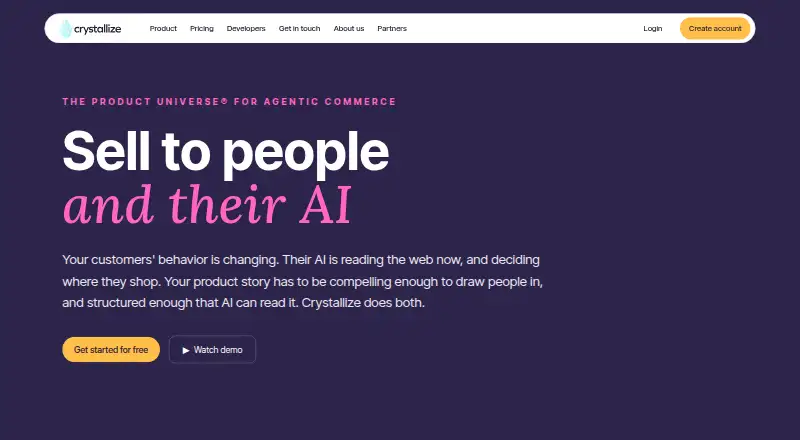
Crystallize is a hosted, headless commerce platform for omnichannel sales. Its Product Universe brings products, content, media and commerce into a shared model, admin and API. The commerce engine covers pricing, subscriptions, customer hierarchies, fulfillment and checkout analytics. It offers free and paid plans, GraphQL and MCP access, payment integrations, and an open-source CLI.
Review
In a line
Crystallize serves omnichannel businesses through a hosted composable commerce platform. It combines product, content, media and commerce management with a headless architecture.
What it does
Products, content, media and commerce live together in the Product Universe's model, administration and API. Its commerce engine handles product and pricing models, subscriptions, customer hierarchies, fulfillment pipelines and checkout analytics.
You can sell digital products, recover abandoned carts and use the platform across web, mobile, kiosk and other front ends.
How it connects
Crystallize is API-first and provides APIs and webhooks for ERP, CRM, payment and logistics connections. Through native GraphQL and MCP interfaces, AI agents can read catalogs, draft quotes, configure subscriptions and fill carts.
Documented payment integrations include Stripe, Klarna, Vipps, Dintero, Adyen, Mollie, Montonio, Quickpay, Two and Razorpay. Its open-source CLI downloads from GitHub and supports CI/CD automation.
The platform runs through web and API access, with macOS and Windows support. It is hosted on Amazon Web Services, uses MongoDB Atlas databases and Elasticsearch Cloud search indexes.
Good fit
Crystallize suits teams building custom commerce experiences across several sales channels. Its platform-agnostic front end lets businesses choose web, mobile, kiosk or other presentation layers.
It also fits organizations that need subscriptions, varied pricing, customer structures, fulfillment workflows or checkout reporting in one commerce system.
Watch for
Particle and Atom permit a single tenant for each project or store, whereas Crystal provides three for production, staging and development. Check which setup matches your release process.
Transaction fees vary. Review the usage limits for orders, items, bandwidth and API calls before choosing a plan.
Pricing
Crystallize has a free Particle plan, billed with metering per month. It includes one tenant, unlimited users and languages, the full feature set, 25 orders, 100 items, 5 GB bandwidth and 25,000 API calls.
Atom costs $949 a month, billed with metering per month. It includes one tenant, unlimited users and languages, the full feature set, 500 orders, 5,000 items, 50 GB bandwidth and 500,000 API calls.
Crystal is price on request and billed with metering per month. It provides three tenants, enterprise features, SAML/SSO and tenant cloning. Particle includes community support and online docs; Atom adds a Pro SLA; Crystal adds dedicated engineering Slack, an Enterprise SLA, professional services, advisory access and roadmap access.
Verdict
Choose Crystallize if you need a hosted commerce backend that can serve several front ends and connect to business systems through APIs and webhooks. The free tier gives small projects a starting point, while higher plans add capacity, support and multi-tenant environments.
Look elsewhere if your project does not need composable architecture, custom front ends or the listed commerce workflows. Compare it with Headless Ecommerce Platforms and Ecommerce platforms before committing.
Our take
Crystallize makes sense for businesses that want one hosted system for catalog content, commerce logic and multiple sales channels. Its API-first design, GraphQL and MCP access, payment connections and open-source CLI support custom builds. The free plan can cover a small store, while Atom raises usage limits and Crystal adds enterprise controls and three tenants. Budget for metered billing and variable transaction fees, and confirm that the one-tenant limit on the lower plans will not restrict your workflow.
- A free Particle plan is available
- Product, content, media and commerce management share one stack
- GraphQL, MCP, APIs and webhooks are built in
- Frontends can target web, mobile, kiosk and other platforms
- The open-source CLI supports CI/CD automation
- Atom starts at $949 per month plus metering
- Transaction fees vary
- Particle and Atom allow only one tenant
- Crystal pricing is available on request
- Pick it ifTeams building custom omnichannel commerce experiences; Businesses needing subscriptions and complex pricing models; Projects that connect ERP, CRM, payment or logistics systems
- Skip it ifYou do not need a headless, API-first commerce setup; A single-tenant limit will not fit your development workflow; You need fixed transaction fees or a published enterprise price
Pricing
Particle is free with metering and low usage limits. Atom costs $949/month plus metering. Crystal is quote-based with enterprise features and three tenants.
- Atom+ metering/month · 1 tenant per project · unlimited users · full feature set · unlimited languages · 500 orders · 5000 items · 50 GB bandwidth · 500000 API calls$949/mo
- Particle+ metering / month · 1 tenant per project · unlimited users · full feature set · unlimited languages · 25 orders · 100 items · 5 GB bandwidth · 25000 API callsFree
- Crystal+ metering / month · 3 tenants included · unlimited users · unlimited languages · enterprise features · SAML / SSO · tenant cloningOn request
As crystallize.com lists them, checked 28 Sept 2026.
Questions
Is there a no-cost Crystallize tier?
Yes. Particle is free, with monthly metering, one tenant, 25 orders, 100 items, 5 GB bandwidth and 25,000 API calls.
What does Crystallize cost?
Atom costs $949 a month plus metering. Particle is free plus metering, while Crystal pricing is available on request.
Which payment services work with Crystallize?
Yes. Listed integrations include Stripe, Klarna, Vipps, Dintero, Adyen, Mollie, Montonio, Quickpay, Two and Razorpay.
Does Crystallize provide an API?
Yes. It is API-first, with APIs, webhooks, GraphQL and MCP for connecting systems and working with catalogs, quotes, subscriptions and carts.
Which front ends can connect to Crystallize?
Its headless, platform-agnostic setup supports web, mobile, kiosk and other front ends.
Is Crystallize open source?
The Crystallize CLI is open source, downloads from GitHub and supports CI/CD automation. The hosted commerce platform is separate.
What tenant allocation comes with each plan?
Particle and Atom provide one tenant per project or store. Crystal provides three for production, staging and development.