darkzwarmer: Free Open-Source Email Warmup
github.com · checked 7 Oct 2026
Open-source email warmup that runs on your machine and links inboxes across your domains.
How it plugs in
Signal on Email Warmup Software6.3#6 of 24
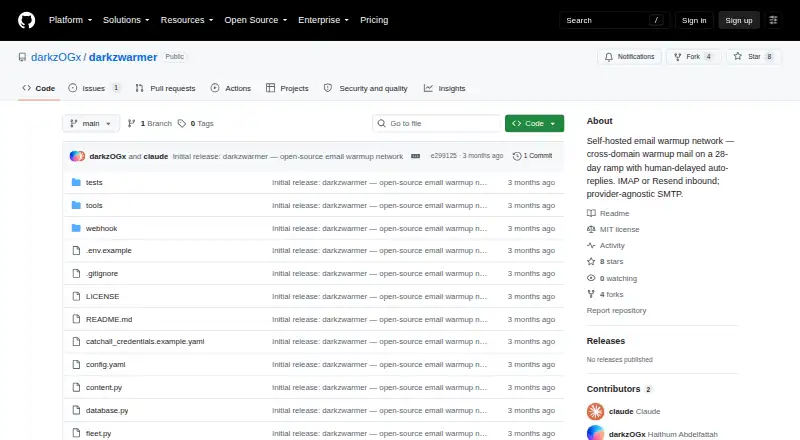
darkzwarmer is a free, MIT-licensed Python tool for warming email inboxes you own. It creates inboxes across your domains, exchanges messages between different domains, and sends delayed replies. You run it on Linux, macOS, Windows, or a self-hosted machine, with your own SMTP and inbound mail setup.
Review
In a line
darkzwarmer is an open-source email warmup program for mailboxes and domains you control. It runs as a self-hosted Python service rather than a hosted web app.
What it does
The tool generates inboxes across user-provided domains and sends warmup messages between them. Each inbox talks only to inboxes on other configured domains, not to same-domain pairs.
The per-inbox daily volume climbs from 5 messages to 35 during the first 28 days, then remains there. Sends use a default local schedule of 07:00–19:00; consecutive messages are separated by 2–8 minutes, and weekends are paused.
The network waits a random 30 minutes to 4 hours before replying in the same thread. It ignores mail from outside the network. You can set inbox counts, sending windows, delays, reply timing, steady-state volume, daily ceilings, and optional wave cohorts that add new inboxes on a schedule.
How it connects
Outbound mail uses configurable SMTP. Examples named in the README are Amazon SES, SMTP.com, Postmark, Mailgun, Brevo, and SendGrid.
Inbound mail can arrive through IMAP or Resend. The Resend arrangement relies on a Vercel webhook together with an Upstash Redis queue.
Python 3.11 or newer and SQLite form the runtime foundation. After a crash or reboot, the tool can continue, and a unique index blocks duplicate replies. Secrets are supplied locally through environment variables; credential files and the database are git-ignored.
Good fit
darkzwarmer suits people who own multiple domains and want to operate their own private warmup network. It can handle multiple mailboxes and lets you set a custom schedule and per-inbox limits.
It runs on Linux, macOS, Windows, or an always-on machine or VPS. Windows has unattended-operation scripts; Linux and macOS can use a service manager or terminal session.
Watch for
Setup calls for at least two domains, outbound SMTP, and a method for receiving mail. Python 3.11 or newer and an always-on computer or VPS are also required.
Provider rate or quota limits can make sends fail. Setting up Resend requires a Vercel webhook and Upstash Redis, while IMAP requires your own mail access details.
The maker says the software is for domains and mailboxes you own and control. The MIT-licensed project is provided without a warranty.
Pricing
darkzwarmer costs nothing and its source is open. There is no free trial because the project itself has no paid plan or trial period.
Verdict
Choose darkzwarmer if you can manage domains, mail services, Python, and an always-on host. Its controls cover ramp-up, timing, replies, mailbox growth, and daily caps, while SQLite keeps its operating state.
Skip it if you want a hosted warmup service, a guided setup, or a single-domain arrangement. The project leaves provider quotas and the mail infrastructure to you, so the setup workload is part of the trade-off.
Our take
darkzwarmer is a practical choice for technically comfortable owners of several domains who want a private, no-license-cost warmup network. It offers detailed timing controls, delayed in-thread replies, and recovery after restarts. The trade-off is that you handle SMTP, inbound mail, Python 3.11+, and an always-on host, along with provider quotas. Its MIT license allows use under that license, but the project comes without a warranty. Readers seeking a managed service should look elsewhere.
- No license fee; source is available under the MIT license
- Cross-domain inbox traffic avoids same-domain pairs
- Custom timing, volume, reply, and daily-send controls
- Runs on Linux, macOS, Windows, or a self-hosted machine
- Resumes state after crashes or reboots
- At least two owned domains are needed
- Needs SMTP, inbound mail, Python 3.11+, and always-on hosting
- Provider rate or quota limits can cause send failures
- Resend inbound setup needs Vercel and Upstash Redis
- Provided without a warranty
- Pick it ifOwners of multiple domains managing their own warmup network; Users comfortable running Python services on an always-on host; Teams needing configurable inbox schedules and limits
- Skip it ifYou want a hosted service with setup and infrastructure handled for you; You have only one domain or cannot provide inbound and outbound mail
Pricing
The project has no charge and no trial or paid plan; hosting, SMTP, inbound mail, and related services are your responsibility.
Questions
Is darkzwarmer free?
Yes. The source is open and the project is available under the MIT license, with no separate free trial.
Which operating systems can run it?
The project describes operation on Windows, Linux, and macOS. It can run on an always-on machine or VPS.
What do I need before setup?
Python 3.11 or later, at least two owned domains, outbound SMTP, and a way to receive mail are required.
How does the warmup volume change?
Daily volume per inbox begins at five messages, reaches 35 by day 28, and then stays at that level.
Can I use my own mail providers?
Yes. Outbound delivery uses configurable SMTP, with Amazon SES, SMTP.com, Postmark, Mailgun, Brevo, and SendGrid among the listed examples. Inbound mail can use IMAP or Resend.
Does it send to outside addresses?
No. The maker says it emails only its own network. Inboxes send across configured domains and ignore outsider mail.
What happens after a restart?
Runtime state lives in SQLite, and the README says the process resumes after crashes or reboots while a unique index prevents duplicate replies.