
DAS-Security ATIP
ti.dbappsecurity.com.cn · checked 11 Oct 2026
A self-hosted system for threat indicators, attack intelligence, vulnerabilities, and response automation.
How it plugs in
Signal on Threat Intelligence Platforms5.2#12 of 32
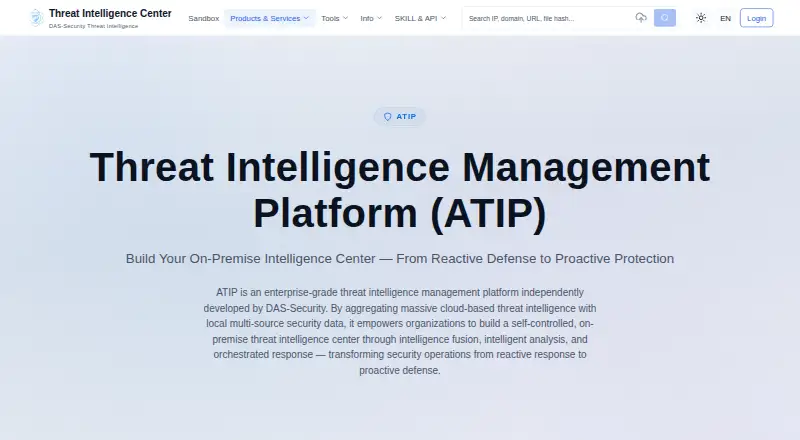
ATIP brings together threat feeds, network-threat analysis, and APT tracking through Hengnao AI. It covers IPs, domains, URLs, file hashes, vulnerabilities, and threat groups. Teams can work through a web interface, REST API, Kafka, offline packages, or MCP, including on-premise and isolated-network setups. Pricing is paid and available on request.
Review
In a line
DAS-Security ATIP is a threat-intelligence platform that unifies multi-source data, network threat analysis, and APT incident tracking through Hengnao AI.
Web, API, and self-hosted options are available. DAS-Security, the English name for 安恒信息技术股份有限公司, makes it.
What it does
ATIP examines indicators of compromise such as IP addresses, domains, URLs, and file hashes, adding threat-analysis fields and blocking-level judgments. Its listed collections include 11B+ intrusion-detection IPs, 312M+ compromised-detection records, 10B+ file-hash samples, and 5,000M+ malicious URLs.
The catalog also contains 35K+ vulnerability records and 600+ threat organizations with TTP attack matrices. Its AI workflow automates collection, translation, summarization, threat analysis, risk scoring, knowledge-graph construction, and RAG retrieval.
Alert handling can use threat level and impact scope; other capabilities include internet-exposure checks, website-tampering risk alerts, attack-IP profiles, and IP or domain tracing. Cloud-sandbox analysis accepts submitted files or URLs, and the service scans AI-agent skill packages.
Vulnerability intelligence is matched with company assets, with severity rescored through Adaptive Vulnerability Prioritization Technology. Daily, weekly, and monthly usage reports can be sent by scheduled email.
How it connects
The RESTful API provides IOC queries for security operations platforms, SIEM monitoring systems, and SOAR response systems. API calls use an API key, return JSON, and consume one quota each.
Sources may include DAS-Security, third-party providers, organizational sharing, and locally produced intelligence. Delivery is available through API, Kafka streams, offline packages, or MCP, connecting with SIEM, SOAR, NGSOC, AiLPHA, and security devices. The MCP threat-intelligence service is listed for Claude Desktop, Cursor, and Kiro.
Blocking workflows can target firewalls, WAF, IDS/IPS, and EDR, while DingTalk and WeCom can receive notifications. Deployment remains fully on-premise for internet-connected, air-gapped, or network-isolated environments; direct, proxy, gateway, and offline update methods are supported, with complete refreshes daily.
Good fit
ATIP fits security teams seeking centralized indicator enrichment, threat discovery, APT tracking, vulnerability prioritization, and incident response. Its feeds and analysis address zero-day exploits and other sophisticated attacks.
It also suits organizations that want automated blocking, scheduled intelligence reports, or control over where intelligence data remains.
Watch for
This is a self-hosted, on-premise product, so check whether your team can operate that model and its required network or offline update path.
Confirm the API quota model before large-scale use: each query consumes one quota.
The maker does not publish a set price. Ask about licensing, deployment, data feeds, and support before committing.
Pricing
ATIP is paid software, with pricing available on request.
Verdict
ATIP is worth considering for organizations needing broad indicator and vulnerability coverage, AI-assisted intelligence processing, and response actions that remain inside an on-premise or isolated environment. API, streaming, offline, and MCP delivery provide several operating options.
It may be a poor match if you need a public, ready-priced service or a cloud-only deployment. Before choosing it, confirm the API quota, supported security tools, update method, and the scope of the intelligence feeds included in your quote.
Our take
DAS-Security ATIP targets organizations running formal security operations rather than casual threat lookups. It combines large indicator collections, vulnerability and actor records, AI processing, and response automation in a deployment that can remain inside the organization. Buyers should confirm that its integrations and operating model meet their requirements before requesting a quote.
- Handles IPs, domains, URLs, and file hashes
- Runs on-premise, including air-gapped and network-isolated environments
- Provides API, Kafka, offline, and MCP delivery
- Supports automated blocking and threat notifications
- Links vulnerability data with enterprise assets
- Pricing is available only on request
- Self-hosted deployment is required
- Each API query consumes one quota
- Integration coverage must be checked against listed systems
- Pick it ifSecurity teams managing threat intelligence and incident response; Organizations needing isolated or on-premise data control; Teams using API, streaming, or automated blocking
- Skip it ifYou need published pricing; You want a cloud-only service with no self-hosted operation; Your tools are outside the listed integration options
Pricing
ATIP is paid software and pricing is provided on request. Request a quote covering deployment, feeds, API use, and support.
Questions
What is DAS-Security ATIP?
ATIP is a threat-intelligence center that brings together multi-source intelligence, network threat analysis, and APT incident tracking through Hengnao AI.
What indicators does ATIP cover?
Coverage includes IP addresses, domains, URLs, and file hashes, along with threat-analysis fields and blocking-level judgments.
Can ATIP run in an isolated network?
Yes. Fully on-premise deployment supports air-gapped and network-isolated environments, with offline updates.
Does ATIP have an API?
Yes. Its RESTful API uses API-key authentication, returns JSON, and consumes one quota per query.
Which AI clients work with its MCP service?
The listed compatible clients are Claude Desktop, Cursor, and Kiro.
How much does ATIP cost?
It is paid software, and pricing is available on request.
Near it
All alternatives →- TThreatnote#11 on this board
- NTNirad TIP#13 on this board
- SVSecurity Vision TIP#10 on this board
- FI
 Flashpoint Ignite#14 on this board
- TIThreat Intelligence Platform#9 on this board
- SMShodan Monitor#15 on this board
- TThreatForge#8 on this board
- CV
 Cyble Vision#16 on this board
- YYeti#7 on this board
- GCGoogle Cloud Secret Manager#17 on this board