Databasement: Self-Hosted Database Backups
github.com · checked 7 Oct 2026
Self-managed web application for planning, retaining, and recovering database backups.
How it plugs in
Signal on Database Backup Software6.1#14 of 27
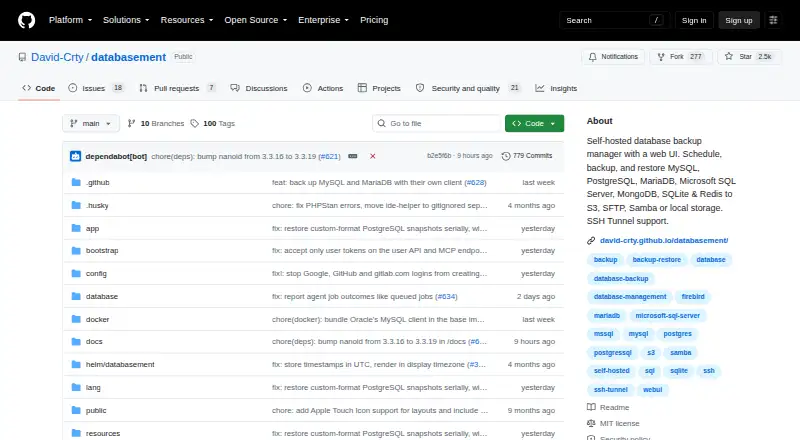
Databasement is an open-source web application you operate on your own infrastructure. It schedules database backups, places them in several storage destinations, and restores snapshots to compatible servers. Coverage includes SQL and NoSQL engines, SSH or outbound-agent connectivity, team administration, notifications, and automation via REST and MCP interfaces.
Review
In a line
Databasement provides a self-hosted web interface for scheduling, creating, and recovering database-server backups. It can run on Linux through Docker, Kubernetes, or a native Ubuntu setup.
What it does
You can schedule recurring backups daily, weekly, or at a custom frequency. Retention can follow time-based rules or GFS policies, and point-in-time recovery is supported.
Compatible servers can receive restored snapshots. A scheduled restore can refresh a target database from the most recently completed snapshot.
How it connects
Supported engines are MySQL, PostgreSQL, MariaDB, Microsoft SQL Server, MongoDB, SQLite, Firebird, Redis, and Valkey. Destinations range from local disks to S3-compatible and Azure Blob storage, with Samba/SMB and SFTP/FTP also available.
A bastion or jump server can be used for private-database access through SSH tunnels, authenticated by password or key. Remote agents work outward over HTTPS, create dumps in isolated networks, and upload them.
Failed jobs can notify Email, Slack, Discord, Telegram, Pushover, Gotify, or a Webhook. Scripts, CI/CD pipelines, and AI assistants can use the REST API and MCP server for automation.
The code is released under the MIT License. Team options include organizations, isolated workspaces, role-based access, OAuth/SSO, and optional two-factor authentication. OAuth providers include Google, GitHub, GitLab, and generic OpenID Connect providers.
Good fit
Databasement suits teams that want to run their own backup service and keep control of deployment and storage. It can cover mixed database environments, including SQL servers, MongoDB, SQLite, Firebird, Redis, and Valkey.
It also fits teams that need scheduled restores, alerting, remote agents for isolated networks, or API-driven backup work in scripts and deployment pipelines.
Watch for
Redis and Valkey backups are supported, but restoring them is not currently available. Restore verification is not provided.
This is self-hosted software, so you must provide and maintain the environment where it runs. Check that your database versions and target servers are compatible before relying on cross-server restores.
Pricing
Databasement is free and has a free plan; no trial is offered. The project is MIT-licensed open-source software.
Verdict
Choose Databasement if you need a no-cost backup application that you can deploy yourself, connect to varied database systems, and automate through an API or MCP server. Its storage choices, remote-agent design, alerts, and team controls cover many operating setups.
Look elsewhere if you require Redis or Valkey restore, built-in restore verification, or a hosted service instead of managing your own deployment.
Our take
Databasement is a practical option for organizations that want open-source database backups without a license bill. It supports many database engines and storage targets, while SSH tunnels and outbound agents help with restricted networks. Team identity controls and job alerts add operational coverage, and the REST API plus MCP server make automation possible. The main trade-offs are self-hosting, the lack of restore verification, and the inability to restore Redis or Valkey snapshots. Confirm those limits fit your recovery plan before adopting it.
- Free plan with no license charge
- Handles nine database types across SQL and NoSQL systems
- Stores backups locally or on S3-compatible and other remote targets
- REST API and MCP server support automation
- Offers team access controls, SSO, and optional two-factor authentication
- Self-hosted deployment is required
- Redis and Valkey restores are unavailable
- No restore verification feature
- No free trial is offered
- Pick it ifTeams running their own backup infrastructure; Mixed database environments needing scheduled backups; Automation through scripts, CI/CD, or AI assistants
- Skip it ifYou need Redis or Valkey restore support; You want a hosted service instead of self-hosting; Restore verification is required
Pricing
Databasement is free and includes a free plan. No free trial is offered.
Questions
Is Databasement free?
Yes. Databasement has a free plan, and no free trial is offered.
Which databases can it back up?
The supported list covers MySQL, PostgreSQL, MariaDB, Microsoft SQL Server, MongoDB, SQLite, Firebird, Redis, and Valkey.
Can Databasement restore Redis or Valkey?
No. Backups for Redis and Valkey are supported, but their restoration is not currently available.
Where can backups be stored?
Storage options include local storage, S3-compatible storage, Azure Blob Storage, Samba/SMB, and SFTP/FTP.
Can it reach private databases?
Yes. SSH tunnels can connect through a bastion or jump server, and remote agents can upload backups over outbound HTTPS.
Does Databasement have an API?
Yes. A REST API and MCP server are available for scripts, CI/CD pipelines, and AI assistant integrations.
How is Databasement deployed?
You can deploy it with Docker, Docker Compose, Kubernetes with Helm, or a native Ubuntu installation.