
Datalore: Collaborative Data Notebooks and Pricing
jetbrains.com · checked 18 Nov 2026
A shared browser workspace for writing code, studying data, making charts, and publishing notebooks.
How it plugs in
Signal on Coding Playgrounds7.1#6 of 138
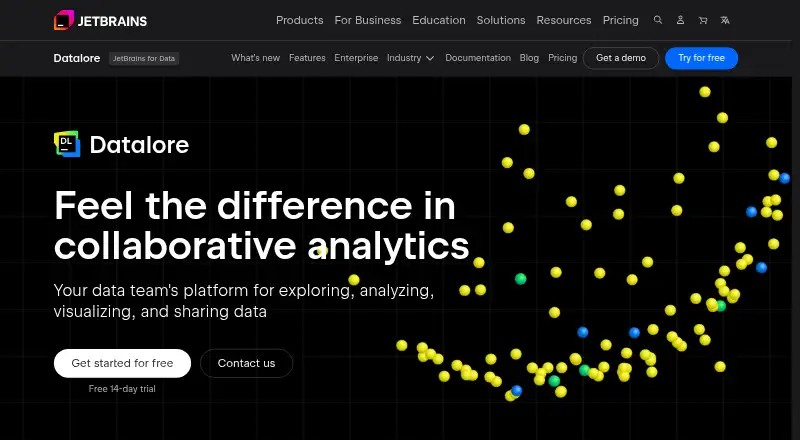
Datalore brings collaborative data work into Jupyter-compatible notebooks. Python, Kotlin, Scala, and R are available alongside database links and built-in SQL cells. Teams can work together in real time, publish reports, schedule notebook runs, and use a public Run API. Users can choose hosted or self-managed deployment, with a no-cost tier and a 14-day trial.
Review
In a line
Datalore is a browser-based data science platform for examining, analyzing, charting, and sharing data. Its main workspace is a collaborative notebook.
What it does
Jupyter-compatible notebooks provide coding assistance for Python, Kotlin, Scala, and R. Datalore AI can draft Python, SQL, and R code, describe findings, and help repair errors.
Teams can edit code together in real time and give others view or edit access. A notebook can become an interactive data story or a static or interactive report.
Schedules can run notebooks hourly, daily, weekly, or monthly, including parameterized schedules. Data Explorer cells let users filter, transform, and chart dataframes without writing extra code.
How it connects
Connections are available for Amazon Redshift, Azure SQL Database, MariaDB, MySQL, Oracle, PostgreSQL, and Snowflake. Native SQL cells offer highlighting and completion, then pass query results into pandas DataFrames for Python work.
Notebook workspaces can mount AWS S3 and Google Cloud Storage buckets as folders. Datalore can also clone and pull public or private Git repositories.
Its public Run API starts notebook runs, accepts control parameters, and returns status and output artifacts. Requests use bearer tokens and notebook and owner IDs. Supported notebook formats include .ipynb, .datalore, .zip, .py, .kts, .scala, .r, and .html.
Good fit
Datalore suits data teams that want shared notebooks, database analysis, charts, and reports in one web workspace. It can also fit organizations that need scheduled runs, GPU compute, version history, or a hybrid execution model.
The On-Premises edition is aimed at organizations needing a customer-controlled cloud, datacenter, hybrid setup, private or air-gapped operation, custom identity providers, and single sign-on.
Watch for
Cloud Free permits unlimited notebooks but only two simultaneous runs, one workspace, one interactive report, 120 CPU S machine hours, and 10 GB of cloud storage.
On-Premises runs through Docker Compose or Kubernetes on 64-bit Linux. ARM, macOS, and Windows hosts are not supported. The documented minimum server has four CPU cores and 4 GB of RAM, with more memory suggested as users increase.
Datalore is proprietary software rather than open source. Check whether its supported deployment systems and database connections match your environment before choosing it.
Pricing
The Cloud Free tier offers unlimited notebooks, 120 CPU S machine hours, 10 GB of cloud storage, two concurrent notebooks, one workspace, and one interactive shareable report. A 14-day trial is also available.
The Cloud plan costs $350.04 a year, billed annually ($29.17 per month). Each team member gets 750 CPU L machine hours, six Datalore credits, and 20 GB of cloud storage.
On-Premises pricing is available on request. It can be self-hosted or run as a JetBrains-managed dedicated instance, with unlimited free viewers and control over computation and storage.
Verdict
Choose Datalore if your work centers on shared notebooks and you need a path from data connections to analysis, scheduled execution, and shareable reports. The free plan gives small teams a way to start, while paid Cloud adds per-member capacity and On-Premises covers controlled infrastructure.
Look elsewhere if you require open-source software, need to host on ARM, macOS, or Windows, or cannot work within the stated free-plan quotas. Teams should also confirm that their databases, identity systems, and preferred deployment method are supported.
Our take
Datalore is a sensible choice for teams that want collaborative notebooks, SQL-backed analysis, and report sharing without assembling separate tools. Its free Cloud plan can support light exploration, while the paid Cloud and On-Premises options address higher usage or stricter infrastructure needs. The main checks are platform restrictions for self-hosting, proprietary licensing, storage and compute limits, and compatibility with your databases and identity provider. It is less suitable for buyers seeking open-source code or hosts outside 64-bit Linux for on-premises deployment.
- Jupyter-compatible notebooks cover Python, Kotlin, Scala, and R
- Real-time editing, sharing controls, and version history
- Native SQL cells connect results to Python data work
- Public Run API supports parameters and returned artifacts
- Hosted and self-managed deployment choices
- Cloud Free permits only two notebooks to run simultaneously
- Cloud Free includes one workspace and one interactive report
- On-Premises needs 64-bit Linux; ARM, macOS, and Windows are unsupported
- Proprietary software, not open source
- On-Premises pricing is available only on request
- Pick it ifTeams sharing notebooks, database analysis, and reports; Organizations needing scheduled runs or controlled hosting; Data work across Python, SQL, R, Scala, or Kotlin
- Skip it ifYou need open-source software or self-hosting on macOS, Windows, or ARM; Your workload requires more compute, storage, or concurrent notebooks than Cloud Free provides; Your required database or identity setup is not supported
Pricing
A free Cloud Free plan is available, plus a 14-day trial. Cloud costs $350.04 per year when billed annually ($29.17/month) and adds per-member compute, credits, and storage. On-Premises pricing is by request.
- Cloud FreeUnlimited notebooks · two parallel notebooks · one shared workspace · one interactive report · notebook export · Notebook API · 120 CPU S machine hours · 10 GB storageFree
- Cloud annualannually · Same Cloud features; price shown per user per month$29.17/mo
- Cloudmonthly · Datalore AI · unlimited parallel notebooks · real-time collaboration · version history · unlimited database connections and SQL queries · unlimited reports and workspaces · scheduled notebooks · team management · 750 CPU L hours per team member · 6 credits per member · 20 GB storage$35/mo
- On-PremisesSelf-hosted or a dedicated instance managed by JetBrains; unlimited viewers for freeOn request
As jetbrains.com lists them, checked 15 Oct 2026.
Questions
Does Datalore have a free plan?
Yes. Cloud Free offers unlimited notebooks, two simultaneous notebook runs, one workspace, one interactive report, 120 CPU S machine hours, and 10 GB of cloud storage.
Which languages does Datalore support?
Its notebooks support Python, Kotlin, Scala, and R, with SQL cells for database queries. Datalore AI can assist with Python, SQL, and R code.
Can Datalore connect to databases?
Yes. Listed connections include Amazon Redshift, Azure SQL Database, MariaDB, MySQL, Oracle, PostgreSQL, and Snowflake.
Does Datalore offer an API?
The public Run API starts notebook executions, accepts interactive-control parameters, and returns run status and artifacts. It uses bearer-token authentication.
Can Datalore be self-hosted?
Yes. On-Premises can run in a customer-controlled cloud, datacenter, or hybrid environment through Docker Compose or Kubernetes on 64-bit Linux.
What does Datalore Cloud cost?
The Cloud plan is $350.04 a year, billed annually, which equals $29.17 per month. Each team member receives 750 CPU L machine hours, six credits, and 20 GB of storage.