Dethernety Threat-Modeling Platform Review
dether.net · checked 15 Oct 2026
Graph-native threat modeling for visual architecture maps and attack-path review.
How it plugs in
Signal on Threat Modeling Software7.3#1 of 23
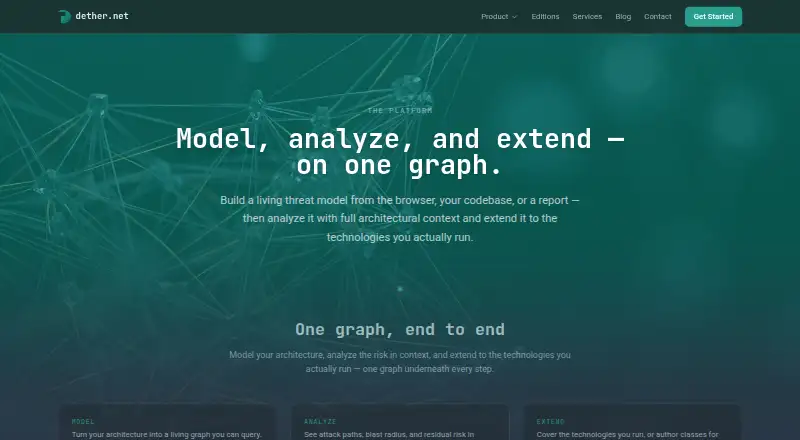
Dethernety is an open-source threat-modeling platform that represents architecture as a graph. Build models in the browser, with code, or from reports, then examine attack paths, blast radius, controls, and residual risk. It offers web, API, and self-hosted use, including offline work with a graph database you operate.
Review
In a line
Dethernety is a graph-based threat-modeling platform for building and analyzing architecture models. The open-source edition runs on infrastructure you control and supports operation without cloud calls.
What it does
Models may be assembled through the browser, code, or imported reports. They represent components, data flows, boundaries, trust zones, and controls as connected items.
Using the complete architecture graph, Dethernety derives exposures, attack paths, blast radius, chokepoints, and residual risk. Exposures link to MITRE ATT&CK techniques, while controls map to D3FEND countermeasures for finding coverage gaps.
Analysis can use fixed graph queries, single-agent AI assistance, or multi-agent LangGraph workflows. Findings can become remediation issues and stay synchronized with external trackers through issue modules.
How it connects
Neo4j and Memgraph are the graph database options named by the platform, and users run those databases themselves. Source deployments expose a public GraphQL endpoint locally at /graphql.
JSON and split-file ZIP exports let teams edit models offline, keep them under version control, and import them again. Its command line supports CI/CD automation and threat-model-as-code workflows.
JavaScript and TypeScript modules add design, analysis, issue, frontend, and backend extensions. Modules can use OPA/Rego policy rules. The Dethereal Claude Code plugin provides 14 slash commands, five specialized agents, and 22 MCP tools.
Good fit
Security teams can use the browser interface for visual modeling and collaborative review. DevOps teams can use the command line for version-controlled models and CI/CD checks.
Dethernety suits teams covering AWS, Azure, Kubernetes, containers, or self-managed infrastructure. Its catalog includes specialized modules, modeled classes, configurable attributes, evaluated threats, cited sources, and ATT&CK techniques.
The platform supports attack-path analysis, risk prioritization, templates, and framework mappings. Evidence attached to findings can reference CVE, NIST 800-53, CWE, CIS, MITRE ATT&CK, and D3FEND.
Watch for
For a source deployment, the documented stack includes Node.js 18 or newer, pnpm 9.13 or newer, Neo4j or Memgraph, and an OIDC identity provider. The BYODt container setup requires Docker with Compose or Podman 4.1 or newer.
With the open-source edition, models, data, and findings remain on infrastructure you manage, and the system can operate offline. Optional cloud evaluations send only closed-vocabulary configuration attributes and discard payloads. The maker says there is no background telemetry or usage-data traffic.
BYODt and BYODt Team are described as coming soon, while Hosted SaaS is planned for later; package composition and pricing remain under development. Enterprise includes dedicated support and deployment help.
Pricing
The Open Source plan costs nothing and provides the complete self-hosted platform, your own graph database, and offline capability. A free trial is also listed.
BYODt, BYODt Team for five or 20 seats, Enterprise, and Hosted SaaS are all price on request. BYODt and Team terms remain in progress; Enterprise is contracted, and Hosted SaaS is scheduled for a later release.
Verdict
Dethernety makes sense for teams seeking an open-source, self-hosted method to map architecture and trace how threats move through it. Security and DevOps groups able to run a graph database may value keeping models with code.
Check the deployment requirements and the unfinished commercial plans before adopting it across a wider organization. Teams wanting a ready-made hosted service should wait for the planned SaaS edition or compare other threat-modeling software.
Our take
Dethernety fits organizations that want control over threat-model data and the option to work offline. Its graph storage, visual editor, command-line workflow, API, and issue synchronization cover both security review and automated delivery pipelines. The free open-source plan removes licensing cost but still requires your team to run the platform and a supported graph database. Commercial options are not yet settled, and hosted service is planned rather than available. Consider it when self-hosting is acceptable and graph-based analysis matches your process.
- Free, open-source self-hosted edition
- Offline operation with data kept on your infrastructure
- Visual, code, and report-based modeling
- Attack-path and blast-radius analysis
- GraphQL API plus JSON and ZIP export
- Self-hosting needs a graph database and identity provider
- Commercial package terms remain unfinished
- BYODt and Team are marked coming soon
- Hosted SaaS is planned for later
- Pick it ifSecurity teams mapping architecture and attack paths; DevOps teams applying threat-model-as-code in CI/CD; Organizations requiring offline, self-hosted analysis
- Skip it ifYou need an available managed SaaS product now; Your team cannot operate Neo4j or Memgraph; You require finalized commercial plan details
Pricing
The Open Source plan is free. BYODt, BYODt Team, Enterprise, and Hosted SaaS are price on request; some remain under development or are planned.
- Open SourceFull platform · self-hosted · bring your own graph database · offline-capableFree
- BYODtPricing being finalized · Self-hosted · cloud-served specialized modules · closed-vocabulary attributes only leave your networkOn request
- BYODt Team — 5 or 20 seatsPricing being finalized · 5 or 20 seats · self-hosted · shared package accessOn request
- EnterpriseBy contract · Self-hosted · own identity provider · air-gap-friendly · dedicated supportOn request
- Hosted SaaSPlanned later · Per-customer isolated managed deployment · separate network, identity, storage and computeOn request
As dether.net lists them, checked 15 Oct 2026.
Questions
Is Dethernety free?
Yes. The Open Source plan is free, and a free trial is listed.
Can Dethernety run offline?
Yes. Its open-source edition supports fully offline operation without cloud calls.
Where does Dethernety store models?
Models use graph structures in Neo4j or Memgraph, with those databases hosted by the user.
Does Dethernety have an API?
Source deployments make a public GraphQL API available at the local /graphql endpoint.
Can models be moved between systems?
You can export models as JSON or split-file ZIPs, edit them offline, version them with code, and import them again.
What does Dethernety integrate with?
Issue modules connect with external trackers and synchronize remediation issues in both directions.
What are the deployment requirements?
The documented source setup uses Node.js 18+, pnpm 9.13+, Neo4j or Memgraph, and an OIDC provider. The container quickstart uses Docker Compose or Podman 4.1+.
Are hosted plans available?
BYODt and BYODt Team are marked coming soon. Hosted SaaS is scheduled for later, while commercial pricing remains in progress.