
Cloud Development Environments
DevZero: Kubernetes Optimization and Inference Routing
devzero.io · checked 15 Oct 2026
Kubernetes optimization for workload sizing, node capacity, security checks, and AI inference routing.
How it plugs in
Signal on Cloud Development Environments6.7#6 of 27
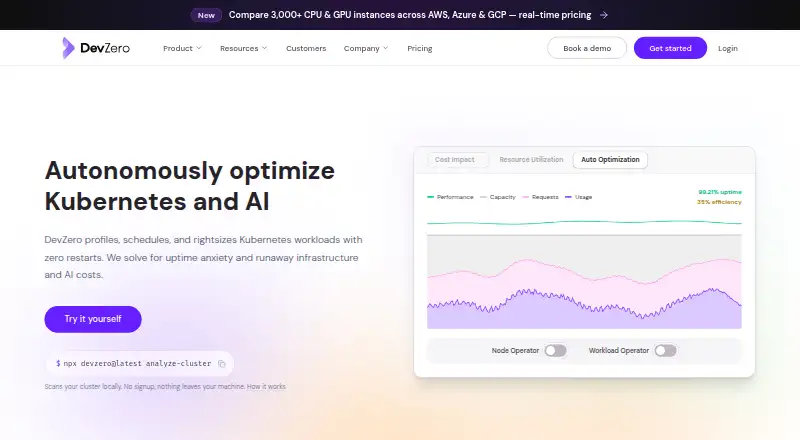
DevZero helps teams optimize Kubernetes workloads, node capacity, security, and fleet costs. It analyzes resource use, recommends or applies sizing changes, monitors GPUs, and can migrate stateful workloads without pod restarts. Separate inference tools route AI requests across providers. A free plan covers monitoring; paid Kubernetes optimization starts at $5 a month.
Review
In a line
DevZero helps teams rightsize Kubernetes workloads, adjust node capacity, scan security issues, and track costs across clusters.
A separate self-hosted gateway sends inference requests to supported model providers and can fail over between them.
What it does
Its operators examine CPU, GPU, replica, node, and network use. The resulting recommendations can target workload resources, replica counts, or node capacity, and teams may apply those changes. A checkpoint-and-restore system moves stateful workloads during changes without restarting pods.
The platform combines cost, utilization, and drill-down views across clusters, clouds, and regions. Security checks cover image vulnerabilities, Kubernetes misconfigurations, RBAC issues, and compliance with CIS, NSA, and Pod Security Standards.
The inference product routes requests between providers and adds failover, caching, and model evaluation.
How it connects
Its quickstart names Amazon EKS, Google GKE, Microsoft AKS, Oracle OKE, and self-managed or on-premises clusters. Slack and webhook channels receive alerts, while Terraform and Pulumi providers manage resources as code.
The command-line tool uses DevZero personal access tokens and a configurable API endpoint. The inference tier exposes an OpenAI-compatible API. Supported services include OpenAI, Anthropic, Gemini, AWS Bedrock, Azure OpenAI, Mistral, and OpenAI-SDK-compatible providers.
The hosted service is proprietary overall, although DevZero describes the read operator as open source and marks its public zxporter repository Apache-2.0. The Pulumi provider repository uses MIT.
Good fit
DevZero names platform engineers, DevOps teams managing multiple clusters, and engineering leaders tracking cloud spend among its users.
It suits organizations that need shared fleet visibility, automated Kubernetes resource policies, GPU monitoring, or provider failover for AI inference. Terraform resources cover clusters, workload policies, and Karpenter-based node policies.
Watch for
The free Kubernetes tier provides monitoring and visibility, but not node rightsizing or workload migration. The in-place scaling feature is available only on Kubernetes 1.33 or newer with the required feature gate; some changes instead use rolling restarts.
For optimization analysis, the read operator gathers Kubernetes resource, workload, object, image-tag, and network-flow metadata. DevZero says it does not collect secrets, ConfigMap values, environment variables, application payloads, or container filesystems.
The command-line setup requires Node.js 18 or newer, npm or npx, kubectl access, and Helm 3 for operator installation.
Pricing
The Free Kubernetes plan costs $0 and includes unlimited clusters, monitoring, cost visibility, network monitoring, departmental cost attribution, audit logging, multi-cloud governance, 30-day retention, and community support. A free trial is available.
Pro is $5 per month, billed monthly without an annual commitment, at $5 per CPU each month. It adds workload optimization, live migration, infrastructure and GPU optimization, spot management, forecast scaling, performance alerts, 180-day retention, a dedicated account manager, and an SLA.
Enterprise is price on request and adds security scanning, SSO/SAML, chargeback export, custom SLAs, longer retention, and dedicated on-call service. Free inference costs nothing with 100 requests per day, 20-plus open models, and three shared providers. Inference Enterprise is price on request; pay-as-you-go has a 4% platform fee on inference spend, with no minimum or commitment.
Verdict
Choose DevZero if your team operates several Kubernetes clusters and wants one place for resource sizing, cost views, policy automation, and security checks. Its provider list and OpenAI-compatible endpoint also fit teams routing inference traffic across services.
The free Kubernetes plan is mainly for visibility. Budget for Pro when you need automated optimization or migration, and check the Kubernetes version requirement before relying on in-place changes. Enterprise tiers make more sense when you need identity controls, custom service commitments, chargeback exports, or dedicated support.
Our take
DevZero fits platform and DevOps teams that manage multiple Kubernetes environments and need cost, utilization, workload policy, and security visibility together. Its free plan is useful for monitoring, while paid plans add rightsizing, migration, GPU optimization, and support commitments. The inference products are relevant when requests must move between AI providers with caching and failover. Check cluster version, operator requirements, data residency needs, and the limits of the free inference allowance before choosing a plan.
- The Free plan offers unlimited clusters and cost visibility.
- Supports EKS, GKE, AKS, OKE, and self-managed clusters.
- Can migrate stateful workloads without restarting pods.
- Offers Terraform, Pulumi, Slack, and webhook connections.
- Inference tier supports multiple major model providers.
- Free Kubernetes tier does not allow rightsizing or workload migration.
- The in-place scaling feature requires Kubernetes 1.33 or newer.
- CLI setup requires Node.js 18+, kubectl, and Helm 3.
- Inference free tier allows only 100 requests per day.
- Overall hosted product is not open source.
- Pick it ifPlatform teams managing several Kubernetes clusters; Teams tracking cloud spend, GPU use, and workload capacity; AI teams needing provider routing and failover
- Skip it ifYou only need basic Kubernetes monitoring with no optimization actions.; Your clusters cannot meet the Kubernetes 1.33 in-place scaling requirement.; You need an entirely open-source hosted product.
Pricing
A free Kubernetes plan covers monitoring and visibility. Enterprise plans are price on request. Free inference is capped at 100 requests per day; inference pay-as-you-go charges a 4% platform fee on inference spend.
- Free$0/month · Unlimited clusters · monitoring and cost visibility · network monitoring · departmental cost attribution · audit logging · multi-cloud governance · 30-day retention · community supportFree
- Free inference$0 platform fee · 100 requests/day · 20-plus open models · 3 shared providers · playground and OpenAI-compatible API · latency and throughput metrics · 7-day activity logFree
- ProBilled monthly · No annual commitment · $5 per CPU/month · workload optimization and live migration · infrastructure and GPU optimization · spot management · forecast scaling · performance alerts · 180-day retention · dedicated account manager and SLA$5/mo
- EnterpriseCustom · Everything in Pro · security scanning · SSO/SAML · chargeback export · custom SLAs · 180-day-plus retention · dedicated on-callOn request
- Inference EnterpriseCustom volume pricing · Committed capacity · private routing · contractual SLAs · AWS Marketplace invoicing · SSO/SAML and SCIM · residency controls · named account teamOn request
- Inference pay-as-you-go4% platform fee on inference spend · no minimum or commitment · 500-plus models · 70-plus providers · $50K/month BYOK traffic without fees · budgets · prompt caching · spend alerts · email and shared Slack supportOn request
As devzero.io lists them, checked 15 Oct 2026.
Questions
What is DevZero used for?
DevZero analyzes and manages Kubernetes workload resources, replicas, nodes, GPUs, costs, and security checks. It also provides an AI inference gateway that routes requests among providers and supports failover.
Which Kubernetes services does DevZero support?
The quickstart names Amazon EKS, Google GKE, Microsoft AKS, Oracle OKE, and self-managed or on-premises clusters.
Does DevZero have a free plan?
Yes. The Free Kubernetes plan costs $0 per month and includes unlimited clusters, monitoring, cost visibility, network monitoring, governance, audit logging, 30-day retention, and community support.
Is DevZero open source?
The hosted product is not open source. DevZero describes its read operator as open source; the zxporter repository is Apache-2.0 and the Pulumi provider repository is MIT.
What data does DevZero collect?
It collects Kubernetes resource, workload, object, image-tag, and network-flow metadata. It says the read operator does not collect secrets, ConfigMap values, environment variables, application payloads, or container filesystems.
What does Pro cost?
Pro costs $5 per month, billed monthly without an annual commitment, at $5 per CPU/month. It adds workload optimization, live migration, infrastructure and GPU optimization, and other listed features.
What are the inference limits on the free tier?
Free inference allows 100 requests per day, 20-plus open models, and three shared providers, plus a playground and OpenAI-compatible API.