Container Development Environments
Dory: Local Docker, Kubernetes, and VM Development
usedory.dev · checked 9 Oct 2026
Free, open-source development software that runs locally on Apple Silicon Macs.
How it plugs in
Signal on Container Development Environments6.0#34 of 40
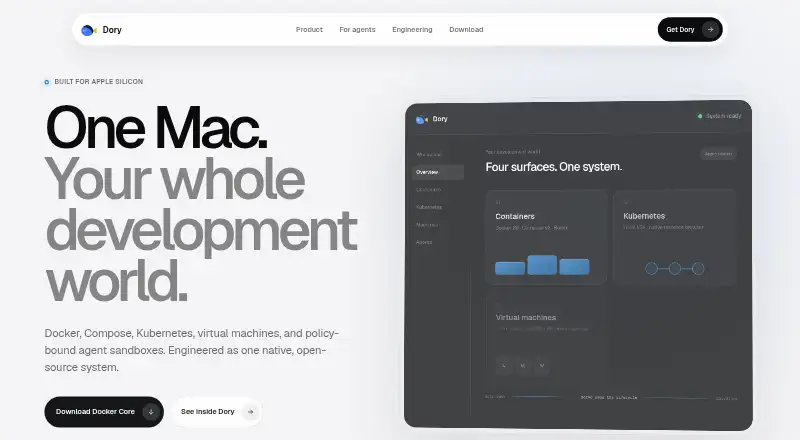
Dory brings Docker, Compose, Kubernetes, virtual machines, and agent sandboxes together locally on Apple Silicon Macs. It uses standard Docker tools, offers local k3s clusters, and can create isolated project environments. The GPL-3.0 software is free to use without an account or cloud control plane.
Review
In a line
For Apple Silicon Macs, Dory provides a local development environment. It combines containers, local Kubernetes, Linux virtual machines, and isolated agent sandboxes.
What it does
Dory's standard Docker context connects Docker 29, Compose v2, BuildKit, and Buildx. Its local k3s workflow downloads the selected image when you create a cluster.
Project-specific environments can run in dedicated virtual machines. They use non-root execution, explicit mounts, and networking disabled by default.
ARM64 Linux desktops and headless machines are supported, with separate identities, disks, resources, shares, and snapshots for each.
How it connects
Docker tools connect through the standard Docker context. Dory exposes a versioned MCP contract locally over stdin and stdout; read-only mode prevents execution and sandbox changes.
Dory uses the GPL-3.0 license, leaving its code available for inspection. Downloads require Docker Core, while Kubernetes, Linux machine and desktop runtimes, and guest images are optional signed components.
Dory describes a migration process that inventories, checks, copies, verifies, and commits while leaving the source untouched.
Good fit
Apple Silicon Mac users can use Dory for containers, Compose projects, local Kubernetes, Linux virtual machines, and agent workspaces in one local system.
It is also a fit for people who need non-root sandboxes, disabled-by-default networking, resource controls, or ARM64 Linux desktop and server machines.
Watch for
Dory's desktop platform is macOS. Custom ARM64 ISOs are currently Preview, and macOS and Windows guests are roadmap items without dates; Windows 11 ARM and macOS guests are marked deferred.
The Docker data disk defaults to a 128 GiB logical limit and can expand to 2 TiB. Requests to shrink it are rejected before any change.
The Docker socket permits only its owner, while published ports bind to localhost unless you intentionally broaden access.
Pricing
Dory is free and includes a free plan. There is no separate free trial.
Verdict
For an Apple Silicon Mac, Dory brings Docker, Compose, k3s, Linux machines, and controlled agent sandboxes into one local setup. Its GPL-3.0 license, account-free setup, and absence of telemetry or a cloud control plane may suit privacy-conscious teams.
Look elsewhere if Windows or macOS guest support is needed now, custom ARM64 ISOs must be beyond Preview, or the default Docker disk is too small. Check the 2 TiB maximum and the localhost networking defaults before moving existing workloads.
Our take
For Apple Silicon Mac development, Dory suits projects that need more than containers alone. Local k3s, ARM64 Linux machines, and isolated agent environments are available without an account or cloud service. The free GPL-3.0 model lowers the barrier to trying it. Guest support for macOS and Windows is not available yet, custom ARM64 ISOs remain Preview, and storage starts with a 128 GiB ceiling. Teams should confirm these limits fit their projects before switching.
- Free plan available without an account or cloud control plane
- Docker 29, Compose v2, BuildKit, and Buildx are exposed via a standard Docker context
- Kubernetes clusters can use a local k3s workflow
- Dedicated non-root agent VMs with networking off by default
- GPL-3.0 code is open to inspection
- Desktop support is limited to macOS
- Custom ARM64 ISO support remains in Preview
- macOS and Windows guests have no dated release
- The Docker data disk begins with a 128 GiB logical limit
- Pick it ifApple Silicon Mac developers needing containers and local Kubernetes; Teams wanting Linux VMs and controlled agent sandboxes; Users who prefer open-source, local-only tooling
- Skip it ifYou need Windows or macOS guest machines today; You require custom ARM64 ISOs without Preview status; Your Docker data needs exceed the 2 TiB maximum
Pricing
Dory is free, with a free plan and no separate trial period.
Questions
What operating systems does Dory run on?
Its desktop platform is macOS, focused on Apple Silicon Macs. ARM64 Linux desktops and headless machines are supported as well.
Does Dory include Kubernetes?
Yes. A local k3s workflow is available, and the chosen image downloads when you create a cluster.
Is Dory open source?
Yes. Dory uses GPL-3.0 licensing, and its code is open to inspection.
Can Dory work without an account or cloud service?
No account or cloud control plane is required, and the maker says Dory has no telemetry.
How large can the Docker data disk be?
The logical limit is 128 GiB by default, expandable to 2 TiB. Shrink requests are rejected before changes are made.
Can Dory run agent sandboxes?
Yes. Dedicated VMs can host project-specific environments with non-root execution, explicit mounts, and networking off by default.