Database Schema Comparison Tools
driftcurve: Free Household Retirement Planning Engine
github.com · checked 15 Oct 2026
Open-source retirement planning engine for household forecasts, scenarios, and spending guardrails.
How it plugs in
Signal on Database Schema Comparison Tools7.3#1 of 25
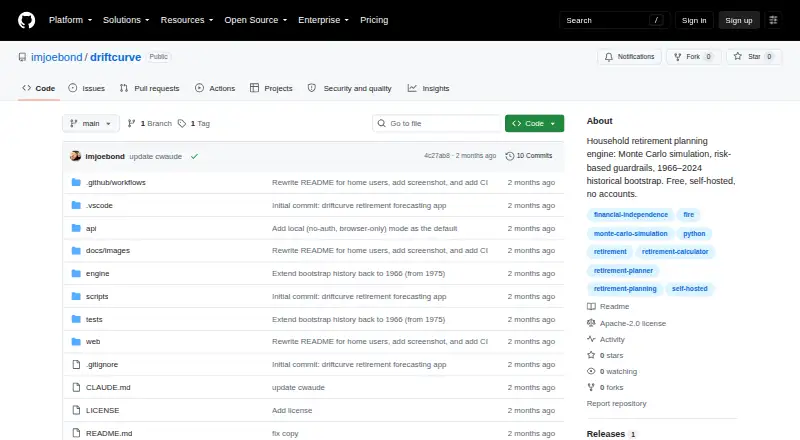
driftcurve is a free, open-source retirement planning engine that models a whole household. It runs Monte Carlo forecasts using market history from 1966 through 2024, supports custom return assumptions, and compares scenarios. Risk-based guardrails calculate spending levels linked to portfolio thresholds and success probabilities. You can run it locally or enable a hosted multi-user mode.
Review
In a line
driftcurve is a household retirement-planning engine. It models finances and simulates possible retirement outcomes.
What it does
Build scenarios for several household members, with separate retirement dates and savings rates. Inputs cover traditional, Roth, taxable, cash, real-estate and cryptocurrency assets, plus mortgages, HELOCs, student loans, pensions, Social Security and property sales.
Its default Monte Carlo forecast resamples individual years from market history covering 1966–2024. The series include S&P 500 stocks, 10-year Treasuries, residential real estate, inflation and Bitcoin.
You can recenter historical returns around your own long-run targets or use fixed yearly rates. A Compare page places two scenarios on one chart. Spending guardrails solve for monthly spending and adjust it when portfolio thresholds and success probabilities change.
How it connects
driftcurve runs as a web app, a self-hosted service or an API. The documented API includes forecast, guardrails, configuration, authentication, profile and scenario endpoints. Python callers can create Scenario objects and call the forecast engine directly.
In local mode, household data and saved scenarios stay in browser storage, with no account or server database. Enabling hosted mode adds email/password accounts, server sessions, and profiles and scenarios saved in driftcurve.db. The project is open source under the Apache License 2.0.
Good fit
This suits households planning retirement or financial independence who need to model several people, account types, debts, income sources and property sales. It also fits users comparing assumptions and withdrawal plans; see other retirement planning software options.
The spending solver is useful when you want starting monthly spending plus higher and lower levels tied to portfolio thresholds and success probabilities.
Watch for
Guardrails require a retirement year and a positive liquid portfolio. The README estimates each guardrail calculation at about 20–45 seconds.
There is no account synchronization, and tax modeling is basic. Forecasts are projections based on historical data and your assumptions, not predictions or guarantees. The maker says driftcurve is not financial, investment, tax or legal advice.
Running it yourself requires Python 3.10 or newer, a virtual environment, installed requirements and Uvicorn.
Pricing
The Free plan costs free. It is self-hosted, has no subscription, and needs no account when you use local mode. There is no free trial because the project itself is free.
Verdict
Choose driftcurve if you want an open-source retirement model that keeps local household data in your browser and lets you vary market assumptions, compare scenarios and calculate spending guardrails.
Look elsewhere if you need synchronized financial accounts, detailed tax planning, instant calculations or professional advice. Hosted mode adds accounts and database storage, but local setup still requires Python and command-line steps.
Our take
driftcurve is a practical fit for people who want to build detailed household retirement scenarios without paying a subscription. Its broad household inputs, historical resampling, adjustable return assumptions and spending guardrails cover both accumulation and withdrawal planning. The trade-offs are meaningful: setup is self-hosted, calculations can take up to 45 seconds, taxes are only basic, and accounts do not sync automatically. Treat results as educational projections rather than advice, and confirm that your scenario includes a retirement year and positive liquid assets before relying on guardrail results.
- Free, open-source project under Apache License 2.0
- Models multiple household members, debts, pensions and property sales
- Uses market history from 1966–2024 for Monte Carlo forecasts
- Spending guardrails link withdrawals to success probabilities
- Local mode stores data in browser storage without an account
- No account synchronization
- Basic tax modeling
- Guardrails need a retirement year and positive liquid portfolio
- Guardrail calculations take about 20–45 seconds
- Self-hosting requires Python 3.10 or newer
- Pick it ifHouseholds planning retirement or financial independence; Users comparing scenarios and withdrawal assumptions; People wanting local, open-source planning software
- Skip it ifYou need automatic financial-account connections or detailed tax planning; You want instant calculations or professional financial advice; You prefer software that requires no local setup
Pricing
The Free plan is self-hosted with no subscription. Local mode needs no account. There is no separate free trial.
- Freeself-hosted · no subscription · no account in local modeFree
As github.com lists them, checked 15 Oct 2026.
Questions
Is driftcurve free?
Yes. Its Free plan is self-hosted, has no subscription, and local mode does not require an account.
What market data does driftcurve simulate?
Default simulations resample annual data from 1966–2024 for S&P 500 stocks, 10-year Treasuries, residential real estate, inflation and Bitcoin.
Can it model a whole household?
Yes. It supports multiple people, separate retirement dates and savings rates, many account types, debts, mortgages, pensions, Social Security and property sales.
Does driftcurve connect to financial accounts?
No. The facts list no account synchronization. In local mode, data stays in browser storage.
What are spending guardrails?
They calculate initial monthly spending plus higher and lower levels tied to portfolio thresholds and success probabilities.
How long do guardrail calculations take?
The README estimates roughly 20–45 seconds. A retirement year and positive liquid portfolio are required.
Is driftcurve financial advice?
No. It is described as a modeling and educational tool. Forecasts are projections from historical data and user assumptions, not predictions or guarantees.
Near it
All alternatives →- DSdbForge Studio for PostgreSQL#2 on this board
- GC
 GitHub CodeQL#3 on this board
- DDBDiff#4 on this board
- Ddbdiff#5 on this board
- Aapgdiff#6 on this board
- Ssqldef#7 on this board
- S
 Skeema#8 on this board
- WMWindows Malicious Software Removal Tool#9 on this board
- DDBC#10 on this board
- UUserFolderMigrator#11 on this board