Early Alert software review
earlyalert.me · checked 3 Oct 2026
Text-based wellness check-ins, referrals and an organizational dashboard for spotting distress.
How it plugs in
Signal on Student Engagement Software5.2#14 of 25
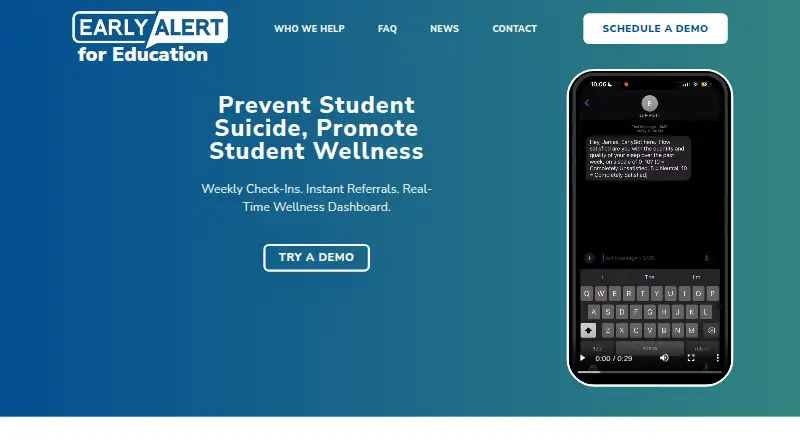
Early Alert sends customizable wellness questions by text, usually weekly, then points people to organizational resources, self-help steps or crisis counseling when needed. Its web dashboard shows de-identified patterns and clusters. Organizations set wellness areas, resources, frequency and demographic fields. The service runs through a web portal and SMS rather than a mobile app.
Review
In a line
Early Alert is a text-based wellness check-in service for organizations supporting people who may be in distress. It combines participant check-ins, support referrals and a wellness dashboard.
What it does
A typical check-in asks participants to rate one wellness domain from 0 to 10. Weekly delivery is the default, while organizations can alter timing and choose domains including mental, physical, relational, spiritual or financial health.
If a reply points to a wellness challenge, the service can direct the participant to institutional resources, self-help micro-interventions or live crisis counseling. It also supports student surveys, automated campaigns, SMS outreach, engagement analytics and risk alerts.
The dashboard groups de-identified responses in real time so an organization can look for broader patterns or clusters of distress.
How it connects
There is no mobile app for Early Alert; participants sign up on their organization’s web portal and then get text messages.
Organizations supply the support resources tied to each wellness area. Early Alert can help find vetted outside resources when an organization has a gap. Wellness areas, resources, check-in timing and dashboard demographic fields can all be customized.
The maker estimates that mapping wellness domains to resources takes approximately 30 minutes to set up. Ongoing operation is described as requiring no administrative time.
Good fit
The maker says Early Alert can serve colleges, universities, K-12 districts, Veteran Serving Organizations, employers, hospitals, clinics and other groups supporting people experiencing distress.
It fits organizations that want regular outreach, referrals to their own services and aggregate signals about where distress may be concentrated.
Watch for
Early Alert does not function as an emergency response service. Responses are not watched continuously, and the service does not promise review or response by a particular deadline. People in immediate danger should call emergency services or a hotline.
For a possible safety concern, a text advises the user to contact 911 or the organization’s safety department. The maker says a team member reviews the information within two business days; under an agreed process, a counselor may also try to make contact and start a wellness check.
Identifiable responses are generally withheld from the organization, except when safety requires sharing them. Subscriber data is kept on a secure U.S. server with individual logins and multi-factor authentication. Identifiable data remains until deletion is requested, while de-identified data may be kept indefinitely for analytics.
Live crisis counseling is available when needed but is not meant to create an ongoing therapeutic relationship. Check that the organization can provide suitable resources and safety procedures.
Pricing
Early Alert is a paid service, with pricing on request.
Verdict
Early Alert suits institutions and employers that want a scheduled text check-in without asking participants to install an app. Its customizable questions and resource mapping can connect responses to existing support channels, while aggregate data can show wider trends.
It is less suitable for teams needing continuous crisis monitoring, guaranteed rapid intervention or an ongoing therapeutic relationship. Buyers should confirm how their safety protocol handles alerts, which resources they will provide and how long they want identifiable data retained.
Our take
Choose Early Alert if your organization needs recurring SMS wellness questions, links to its own support services and an aggregate view of distress patterns. The web-portal registration and approximately 30-minute mapping process are part of setup. Do not treat it as an emergency line: messages are not watched continuously, response timing is not guaranteed and counseling is not ongoing therapy. Before purchase, agree on safety procedures, resource coverage, demographic fields and data-retention expectations, then request a quote.
- Weekly text check-ins can be customized in frequency and scored from 0 to 10.
- Organizations can tailor wellness areas, resources and dashboard fields.
- Participants use a web portal and SMS, not a separate app.
- Dashboard data is de-identified and grouped to show patterns.
- Setup is estimated at about 30 minutes, with no ongoing administrative time.
- It is not an emergency response system or around-the-clock monitoring service.
- A response within a specific time is not guaranteed.
- Live crisis counseling is not intended as ongoing therapy.
- Pricing is available only on request.
- De-identified data may be retained indefinitely for analytics.
- Pick it ifColleges, employers and care organizations running wellness outreach; Programs that need referrals plus aggregate distress trends
- Skip it ifYou need continuous emergency monitoring or guaranteed immediate intervention.; You require a long-term therapeutic relationship inside the service.; You want published plans or self-serve pricing.
Pricing
Paid service with pricing on request.
Questions
Is Early Alert an app?
No. Sign-up occurs through the organization’s web portal, and check-ins arrive as text messages.
How often are check-ins sent?
Early Alert normally sends them weekly, though an organization can choose another interval.
What happens after a concerning answer?
A concerning response can trigger links to organizational resources, self-help micro-interventions or live crisis counseling. For a potential safety concern, the user is advised by text to contact 911 or organizational safety.
Does the organization see individual answers?
Organizations generally receive de-identified aggregate dashboard data; identifiable information is shared only when a safety concern requires it.
How is subscriber data protected?
The service stores subscriber data on a secure U.S.-based server, with access limited through individual logins and multi-factor authentication.
How long is data kept?
Identifiable data remains until the subscriber asks for deletion, while de-identified data may remain indefinitely for analytics.
Who can use Early Alert?
The maker names colleges, universities, K-12 districts, Veteran Serving Organizations, employers, hospitals, clinics and similar organizations.
How much does it cost?
Early Alert is paid, and the provider supplies pricing on request.