
eDB embedded multi-model database
embeddedos.org · checked 5 Oct 2026
A free, open-source embedded database for EoS devices, combining SQL, documents, key-value data, graphs, and search.
How it plugs in
Signal on Multimodel Databases5.9#18 of 26
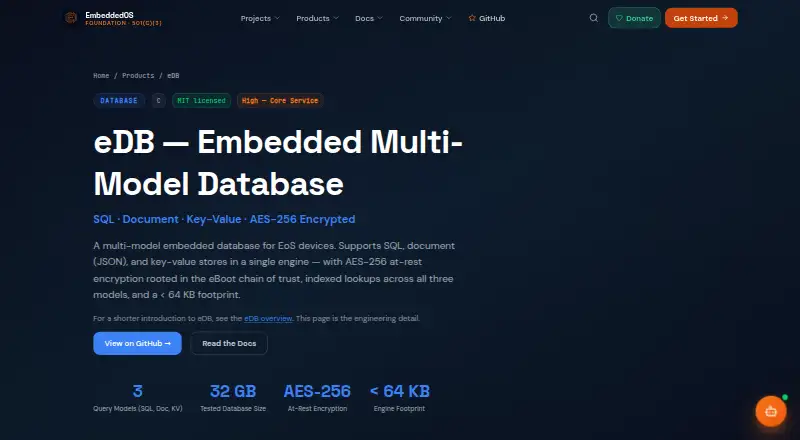
For EmbeddedOS (EoS) devices, eDB provides a free database under the MIT license. Its stores cover SQL, JSON documents, key-value records, graph data, and full-text indexes. The self-hosted engine runs on Linux and through an API, with storage on common flash, cards, or RAM. It targets persistent device data such as logs, configurations, model metadata, and health records.
Review
In a line
For EoS devices, eDB serves as an embedded database with several data models. It brings together SQLite-compatible SQL, JSON documents, key-value records, graph queries, and full-text search.
What it does
Persistent device information—such as sensor logs, AI model metadata, user settings, device state, and health records—can be kept in the database. Its SQL subset includes CREATE, INSERT, SELECT, UPDATE, DELETE, and JOIN operations.
SQL uses B-tree indexes, key-value records use hash indexes, and document text searches use inverted indexes. ACID transactions and write-ahead logging help preserve changes through power failures. Flash wear leveling is described as extending the life of NOR and NAND storage.
How it connects
As an EoS service task, eDB uses eBoot for encryption keys and EIPC for capability-secured queries between processes. Stored data is protected at rest with AES-256-GCM; keys come from the eBoot TPM measurement.
The project carries the MIT license and is developed in the open. Its linked repository README describes a Python engine, a FastAPI HTTP API, and a React/TypeScript database-manager interface, with Python 3.11 or later required. It is self-hosted and available through an API on Linux. Its combination of models places it in the multimodel database category.
Good fit
EoS applications needing local, persistent storage are the target for eDB. The maker names sensor logging, AI model metadata, configuration, device state, and health records, including medical, financial, and defense uses.
NOR flash, NAND flash, eMMC, SD cards, and volatile RAM are supported. The listed engine footprint is below 64 KB of flash, allowing a small embedded installation.
Watch for
The product is for EoS devices, so check that your hardware and software stack use EmbeddedOS, eBoot, and EIPC as required. Deployment is self-hosted rather than a hosted database service.
Testing has reached 32 GB, but the storage medium sets the actual database limit. SQL is a SQLite-compatible subset rather than a promise of complete SQLite coverage. The project README specifies Python 3.11 or later for its described implementation.
Foundation support covers build failures, board bring-up, toolchain setup, and documentation questions; other enquiries are handled in arrival order. Security reports are answered within 48 hours under a 90-day responsible-disclosure timeline.
Pricing
eDB has no charge. The EmbeddedOS products page characterizes the ecosystem as open-source, MIT-licensed, and available forever at no cost.
The listed plan is free, and no trial period is offered.
Verdict
Choose eDB when an EoS device needs several data models in one small, self-hosted store, plus transactions, encryption, and flash-aware durability. Its open MIT license and API-based tooling may suit teams that can manage their own device software.
Look elsewhere if you need a managed cloud database, broad SQL compatibility, or a platform outside the EoS stack. Confirm the storage size, Python requirement for the described repository implementation, and available support before committing.
Our take
eDB is a practical option for teams building EmbeddedOS devices that must retain local data across restarts and power loss. Its free MIT license removes purchase cost, while support for SQL, documents, key-value records, graphs, and text search can reduce the need for separate stores. The trade-off is a narrow operating context: deployment is self-hosted, integrations depend on EoS services, and SQL is only a SQLite-compatible subset. Teams should verify their hardware, storage medium, and development environment before adopting it.
- Free forever under an MIT license
- Brings SQL, document, key-value, graph, and full-text capabilities together
- ACID transactions with write-ahead logging
- AES-256-GCM encryption at rest
- Engine footprint listed below 64 KB of flash
- Designed for EmbeddedOS devices and self-hosted deployment
- SQL support is a SQLite-compatible subset
- Testing reached 32 GB; actual capacity depends on storage
- Repository implementation requires Python 3.11 or later
- A trial period is not offered
- Pick it ifEmbeddedOS devices needing persistent local data; Projects combining several data models in one store; Teams prepared to operate self-hosted software
- Skip it ifYou need a managed cloud database service; Your platform is not EmbeddedOS; You require full, unrestricted SQL compatibility
Pricing
eDB is free with a free plan and no trial period. The ecosystem is described as open-source, MIT licensed, and free forever.
Questions
What is eDB?
eDB is an embedded database for EmbeddedOS devices that handles multiple models. It supports SQL, JSON documents, key-value data, graph querying, and full-text search.
Is eDB free?
Yes. eDB has a free plan, and the EmbeddedOS products page describes the ecosystem as open-source, MIT licensed, and free forever.
Where can eDB run?
It is self-hosted and runs on Linux and through an API. On EoS devices, it operates as an EoS service task.
What storage does eDB support?
NOR flash, NAND flash, eMMC, SD cards, and volatile RAM are supported storage options.
How large can an eDB database be?
Capacity is governed by the storage medium; testing has reached 32 GB. The engine footprint is listed below 64 KB of flash.
Does eDB encrypt data?
Yes. AES-256-GCM protects data at rest, with keys derived from the eBoot TPM measurement.
What support is available?
Foundation support covers build failures, board bring-up, toolchain setup, and documentation questions. Security reports receive a response within 48 hours.
Near it
All alternatives →- A
 AllegroGraph#17 on this board
- AC
 Azure Cosmos DB for NoSQL#19 on this board
- M
 MapLarge#16 on this board
- YA
 YugabyteDB Anywhere#20 on this board
- S
 SurrealDB#15 on this board
- GC
 Google Cloud Spanner#21 on this board
- DDolphinDB#14 on this board
- TD
 Tarantool DB#22 on this board
- OOrientDB#13 on this board
- Rrasdaman#23 on this board