Elassandra: Cassandra Storage with OpenSearch Search
elassandra.org · checked 3 Oct 2026
Open-source Cassandra database with OpenSearch built into every node.
How it plugs in
Signal on Wide-Column Databases5.2#10 of 22
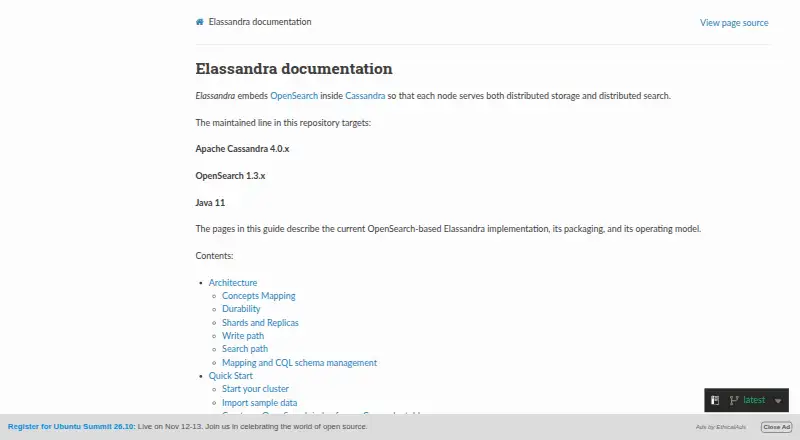
Elassandra combines Apache Cassandra storage with embedded OpenSearch search. It maps search indexes and documents to Cassandra structures, supports OpenSearch HTTP requests and CQL queries, and can run on Linux as self-hosted software. Its maintained release line is based on Cassandra 4.0.x, OpenSearch 1.3.x, and Java 11. You can install it from packages, Docker, or Helm.
Review
In a line
Elassandra is an open-source database that places OpenSearch inside Apache Cassandra. Every node handles both distributed storage and distributed search.
What it does
Elassandra stores data in Cassandra while maintaining a local search view with OpenSearch. Each OpenSearch index corresponds to a Cassandra keyspace, while the current document model uses a Cassandra table.
Data placement and replicas follow Cassandra ownership and keyspace replication. Cassandra is the durable layer, so a restarted node can rebuild its search view from Cassandra state. Horizontal scaling, transactions, and multi-region use are supported.
Immediate visibility after a write trades against write latency, whereas scheduled refreshes lower that cost.
How it connects
You can send searches through the OpenSearch-compatible HTTP API or through CQL, Cassandra's query language. Responses use the standard OpenSearch search format.
The documentation lists compatibility with OpenSearch plugins, OpenSearch Dashboards, and Spark. It is open source and is listed for Apache Cassandra environments.
You can install it from a tarball, Debian package, RPM, Docker image, or Helm chart. Elassandra requires Cassandra's Murmur3 partitioner.
Good fit
Elassandra suits teams that want Cassandra's distributed storage and durability together with OpenSearch queries, without maintaining separate storage and search systems.
It can fit self-hosted Linux deployments that already use Cassandra concepts, OpenSearch tools, or Spark. Schema can be created from an OpenSearch index or inferred from an existing Cassandra schema through OpenSearch mappings.
Watch for
Deleting an index removes search metadata and files, but does not remove its backing Cassandra keyspace or table by default. Plan cleanup separately.
Document version fields such as _version, _seq_no, and _primary_term are not global conflict controls. Indexing documents also increases the work performed by Cassandra writes, particularly for complex documents.
The maintained line covers Cassandra 4.0.x, OpenSearch 1.3.x, and Java 11. Validate advanced upstream features before relying on them in production. Local demos usually need about 1.5 GB to 2 GB of RAM per node.
Pricing
Elassandra is free to use. It is open source and includes a 30-day trial.
Verdict
Choose Elassandra when one self-hosted system must provide Cassandra-backed durability, distributed scaling, and OpenSearch-compatible search. Its deployment packages and Docker or Helm options support different operating setups.
Avoid committing without checking feature compatibility with the maintained software versions and planning for refresh cost, write overhead, Murmur3 partitioning, and index-deletion behavior.
Our take
Elassandra is a practical choice for organizations that already operate Cassandra and need built-in OpenSearch search. It keeps Cassandra as the durable source while allowing HTTP or CQL searches, scaling by Cassandra’s partition and replica rules. The trade-offs are operational: search indexing consumes write resources, immediate freshness raises latency, and some document-version fields cannot enforce global conflict control. Check the supported Cassandra, OpenSearch, and Java versions, plus advanced feature compatibility, before using it for production workloads.
- Combines Cassandra storage with OpenSearch search in each node
- Uses Cassandra replication and token ownership for placement
- Searches through the OpenSearch HTTP API or CQL
- Offers Docker, Helm, package, and tarball deployments
- Free and open source with a 30-day trial
- Requires the Murmur3 partitioner
- Indexing documents increases Cassandra write work
- Making writes immediately searchable can raise latency
- Index deletion does not remove backing Cassandra data by default
- Document version fields are not global conflict controls
- Pick it ifSelf-hosted Cassandra teams needing integrated search; Linux deployments using OpenSearch tools or Spark; Systems requiring distributed, multi-region storage and search
- Skip it ifYou need unsupported advanced upstream features without validation; You cannot plan for Cassandra write overhead from search indexing; You need index deletion to automatically erase stored Cassandra data
Pricing
Elassandra is free and open source, with a 30-day trial. There are no paid plans listed in the facts.
Questions
Is Elassandra free?
Yes. Elassandra is open source, free to use, and comes with a 30-day trial.
What does Elassandra combine?
OpenSearch runs within Apache Cassandra, giving each node distributed storage alongside distributed search.
How can I query Elassandra?
Search through the OpenSearch-compatible HTTP API or use CQL. Results follow the standard OpenSearch search format.
Which versions does the maintained line target?
The documented maintained release supports Apache Cassandra 4.0.x, OpenSearch 1.3.x, and Java 11.
What happens when I delete an index?
Search metadata and files are removed, but the backing Cassandra keyspace or table remains by default.
Does Elassandra support immediate search results?
Yes, but refreshing immediately after writes increases write latency. Refresh scheduling is separate from Cassandra replication.
What partitioner is required?
Elassandra requires Cassandra's Murmur3 partitioner.
Near it
All alternatives →- GC
 Google Cloud Bigtable#9 on this board
- AT
 Azure Table Storage#11 on this board
- HEHPE Ezmeral Data Fabric#8 on this board
- SMScyllaDB Manager#12 on this board
- AAApache Accumulo#7 on this board
- DADataStax Astra DB#13 on this board
- AC
 Azure Cosmos DB for NoSQL#6 on this board
- THTranswarp Hyperbase#14 on this board
- BTBaidu Tera#5 on this board
- CO
 Cloudera Operational Database#15 on this board