
Fabric Commerce Platform
fabric.inc · checked 4 Oct 2026
Fabric Commerce Platform helps brands manage product merchandising for AI shopping channels.
How it plugs in
Signal on Omnichannel Commerce Software5.2#15 of 22
Brands, retailers, and merchandising teams can use Fabric Commerce Platform as cloud-based merchandising software. Its Merchandising Studio measures product presence in AI responses, reveals shopper intent, and improves catalog material. API-first connections link commerce, product-data, analytics, and AI channels, with REST access plus multi-store, B2B, marketplace, and inventory capabilities.
Review
In a line
Fabric gives brands and retailers cloud tools for presenting products through AI shopping channels.
Across those channels, Merchandising Studio follows product visibility, shopper intent, and catalog content.
What it does
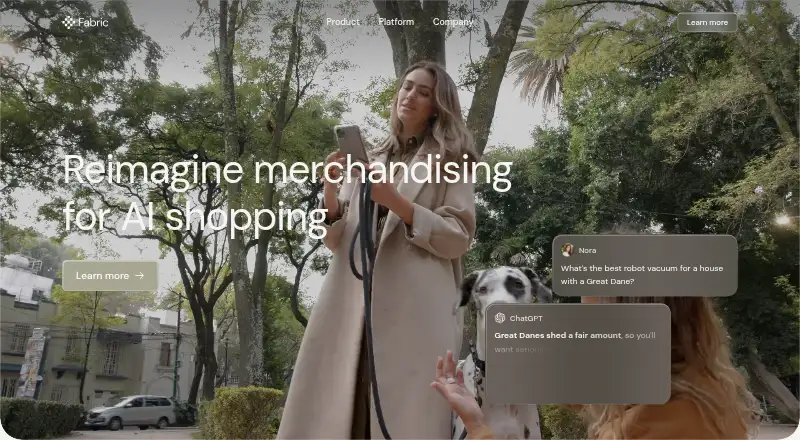
The studio reports whether AI answers recommend products and compares their frequency against competing products. It also gathers shopper prompts and purchase intent from ChatGPT, Perplexity, Gemini, and Claude.
Fabric can enhance product descriptions, attributes, brand material, FAQs, and image alt text to match brand guidelines. Supplier websites, B2B portals, specification sheets, and files can be read, after which products are validated for activation.
Teams can connect Google Analytics data to track results over time and run experiments that compare strategies.
How it connects
API-first delivery carries Fabric connections into commerce systems, AI engines, social shopping, and commerce pages. REST API access is available, and the platform is tuned for UCP, ACP, and other changing protocols.
Fabric names Shopify, Salesforce, SAP, Adobe, Oracle, Akeneo, Salsify, inriver, NetSuite, commercetools, and Microsoft among its supported connections. Its listed AI destinations include ChatGPT, Gemini, Claude, Perplexity, Amazon, Walmart, Meta, Instagram, and TikTok.
The service is cloud deployed and accommodates multiple stores, B2B commerce, marketplaces, and inventory management.
Good fit
Brands, retailers, and merchandising teams looking to improve product appearance when shoppers ask AI what to buy may find Fabric suitable.
It is aimed at companies with tens of thousands of SKUs. Fabric says it manages more than 10 million products and attributes and handles a billion API calls a year.
Watch for
Deployments are described as taking weeks, so teams should plan implementation time before committing.
Check that your commerce, product-data, analytics, and target AI channels match the listed connections. Pricing and product questions go through a contact form.
Fabric says data is used only as instructed, kept separate between customers, masked for sensitive fields by default, and encrypted in transit and at rest. It also offers granular permissions and human approval for every change that ships.
Pricing
This is paid software, with pricing supplied on request. Buyers must contact Fabric for a quote and product information.
Fabric says a real team member responds through its contact form without ticket queues or bots.
Verdict
Choose Fabric if your team manages a large catalog and needs to track and improve product discovery across AI shopping services. Its catalog enrichment, analytics, permissions, and API-first approach support structured merchandising work.
Look elsewhere if you need a published price or an immediate deployment timeline. The weeks-long rollout and contact-based sales process may require planning before purchase.
Our take
Fabric is a fit for established brands and retailers that already operate several commerce or product-data systems and want a dedicated view of AI shopping visibility. Its catalog tools, shopper-intent signals, analytics connection, and approval controls cover both content work and ongoing measurement. The service is cloud-based, paid, and sold through a contact process, with deployment measured in weeks. Confirm your systems and desired AI channels are supported before requesting a quote.
- Tracks product recommendations and visibility in AI answers
- Improves catalog material according to brand guidelines
- Links with major commerce and product-data platforms
- Handles multi-store, B2B, marketplace, and inventory scenarios
- Provides permissions and human review for changes before publication
- Pricing is available only by request
- Deployments are described as taking weeks
- Teams seeking a non-cloud setup may find the deployment model unsuitable
- Pick it ifBrands and retailers managing large product catalogs; Merchandising teams focused on AI shopping visibility; Companies coordinating several commerce and product-data platforms
- Skip it ifYou need a public price before speaking with the vendor; You require deployment in days rather than weeks; Your systems or target channels are outside the listed connections
Pricing
Pricing for this paid platform is provided on request; contact Fabric for a quote and product information.
Questions
What is Fabric Commerce Platform?
Fabric provides cloud merchandising tools for brands, retailers, and merchandising teams. Merchandising Studio follows product visibility in AI shopping channels and supports catalog enrichment.
Which AI channels does Fabric list?
Its listed AI engines and channels include ChatGPT, Gemini, Claude, Perplexity, Amazon, Walmart, Meta, Instagram, and TikTok.
Does Fabric offer API access?
Yes. Fabric uses an API-first model, with REST access spanning commerce systems, AI engines, social shopping, and commerce pages.
What systems can Fabric connect to?
The listed connections cover Shopify, Salesforce, SAP, Adobe, Oracle, Akeneo, Salsify, inriver, NetSuite, commercetools, and Microsoft.
How much does Fabric cost?
The platform is paid, and pricing is available on request. Contact Fabric for a quote and product information.
How long does deployment take?
Fabric describes deployments as taking weeks and says the system supports companies with tens of thousands of SKUs.
What security controls does Fabric describe?
Fabric says data is encrypted in transit and at rest, sensitive fields are masked by default, and customer data is not shared across customers.
Near it
All alternatives →- SESpryker Enterprise Marketplace#14 on this board
- SCSAP Commerce Cloud#16 on this board
- SSCAYLE#13 on this board
- FFynd#17 on this board
- VVVinculum Vin OMS#12 on this board
- KCKibo Commerce#18 on this board
- S
 Shopware#11 on this board
- V
 VTEX#19 on this board
- GOGinesys One#10 on this board
- LSLOC Store Management Suite#20 on this board