GamePulse Review: Open-Source Analytics You Host
github.com · checked 9 Oct 2026
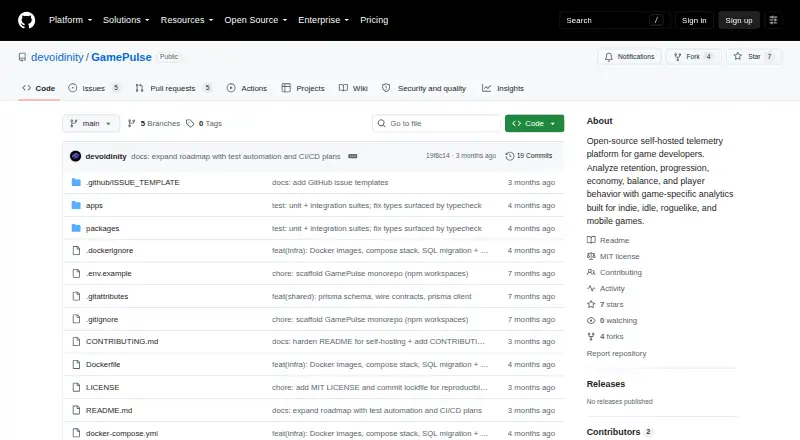
Game telemetry and analytics you can run yourself, with the source available to inspect and modify.
How it plugs in
Signal on Game Analytics Software5.2#28 of 32
GamePulse lets teams collect and analyze game events under a free, MIT-licensed model. It offers retention cohorts, funnels, progression and economy analysis, idle-game metrics, and nightly rule-based alerts. A web dashboard, API, JavaScript SDK, and Docker Compose deployment are included. Several planned capabilities are still unavailable because the project remains in an early MVP/alpha stage.
Review
In a line
GamePulse provides game telemetry and analytics as an open-source system. You run it yourself through its web dashboard, API, or self-hosted deployment.
What it does
Its player-event reports cover retention cohorts, funnels, progression drop-off, economy, idle-game adoption, and dead content.
The economy module follows currency sources and sinks, plus average and percentile balances, while checking for inflation. A nightly rules engine can flag dead upgrades, challenging levels, stockpiled currencies, and inflation. AI-assisted insights are not part of the current MVP.
How it connects
GamePulse exposes an OpenAPI 3 interface and validates event batches before processing them asynchronously. The JavaScript SDK works in both browsers and Node.js, automatically batching events, queuing them offline, and applying retry backoff.
Organizations and projects, JWT authentication, ingestion API keys, and Owner, Admin, Analyst, and ReadOnly roles are included. Docker Compose can launch PostgreSQL, Redis, database migrations, the API, worker, and dashboard together.
Good fit
It suits indie, idle, roguelike, mobile, and simulation game teams that need retention, funnel, progression, or economy analysis on infrastructure they control.
The browser and Node.js SDK can collect events, while the dashboard and API support analysis and access for different team roles.
Watch for
The project remains an early MVP/alpha, so its APIs can change before version 1.0. Running it from source requires Node.js 24 or later, npm 9 or later, PostgreSQL 14 or later, and Redis 6 or later.
Unity and Godot SDKs, a project-member management screen, adjustable insight thresholds, an event schema registry, and data-retention or GDPR deletion tools are roadmap items rather than current features.
For production self-hosting, the maker advises replacing development JWT secrets, limiting CORS, and ending TLS at a reverse proxy.
Pricing
There is no charge to use GamePulse, which is released under the MIT open-source license.
Verdict
Choose GamePulse if your team can operate a self-hosted stack and wants game analytics with an open-source license, an API, and JavaScript event collection.
Look elsewhere if you need ready-made Unity or Godot SDKs, built-in retention or GDPR deletion controls, configurable alert thresholds, or a product beyond alpha maturity.
Our take
GamePulse makes sense for teams that prefer owning the deployment and can handle PostgreSQL, Redis, and the other services in its Compose setup. Its analytics cover common game questions, from player retention to currency inflation, and the MIT license removes subscription cost. The trade-off is an early alpha project with changing APIs and several operational features still on the roadmap. Teams building with Unity or Godot should wait for the planned SDKs or choose a tool that already supports those engines.
- No-cost MIT-licensed software
- Self-hosted deployment with Docker Compose
- Coverage of retention, funnels, progression, and economies
- JavaScript collection for browser and Node.js
- Rule-based alerts for several game problems
- Early MVP/alpha with APIs subject to change
- Unity and Godot SDKs are not yet available
- No current GDPR deletion or data-retention tools
- Requires Node.js, PostgreSQL, Redis, and npm versions
- AI-assisted insights are outside the MVP
- Pick it ifIndie and mobile teams seeking analytics they can host themselves; Teams examining retention, progression, and virtual economies; Event collection from browsers or Node.js
- Skip it ifUnity or Godot SDKs are a current requirement; You require built-in player deletion and retention controls; You want a mature, fixed API before version 1.0
Pricing
The open-source GamePulse repository is MIT licensed and available without a fee.
Questions
Is GamePulse free?
Yes. It is available at no cost under the MIT license.
Where can GamePulse run?
It supports an API, self-hosted deployment, and a web dashboard. Docker Compose can start its documented services together.
Which engines currently have SDK support?
The JavaScript SDK supports browsers and Node.js. Unity and Godot SDKs remain on the roadmap.
What kinds of analytics does GamePulse offer?
Its reports cover retention cohorts, funnels, progression drop-off, economy metrics, idle-game adoption, and dead-content analysis.
Can it identify inflation in the economy?
Yes. The economy module follows currency sources and sinks, balances, and inflation. A nightly rule-based analyzer can flag inflation.
What does self-hosting require?
Source installation needs Node.js 24 or later, npm 9 or later, PostgreSQL 14 or later, and Redis 6 or later.
Is GamePulse ready for production?
The project describes itself as an early MVP/alpha, and its APIs may change before version 1.0.