Gammu SMSD: Free Self-Hosted SMS Management
wammu.eu · checked 8 Oct 2026
Free, self-hosted SMS service that stores incoming texts and sends queued messages through a GSM modem.
How it plugs in
Signal on SMS Gateway Software6.1#14 of 36
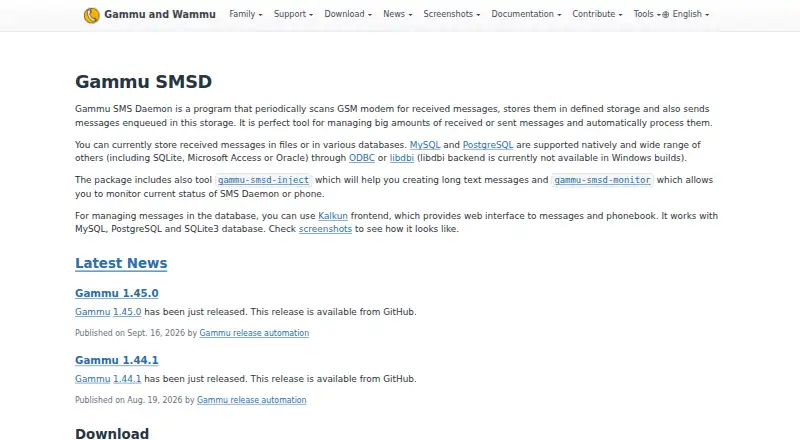
Gammu SMSD is a free, self-hosted service for handling two-way SMS through a GSM modem. It checks for new messages, stores them in files or databases, sends queued texts, and can run a program when messages arrive. Linux and Windows builds are available, with source code and distribution packages for Linux.
Review
In a line
Gammu SMSD is a background service that manages text messages through a GSM modem. It receives and stores texts, then sends messages waiting in its queue.
What it does
During its repeating work cycle, SMSD checks for incoming texts, sends queued messages, checks phone status, and waits for the configured interval. It supports incoming SMS, two-way messaging, and delivery reports.
Received messages can be saved in files or databases. When a message arrives, a configured RunOnReceive action can start a user program for further processing.
The package also includes gammu-smsd-inject for creating long text messages and gammu-smsd-monitor for watching the service or phone status.
How it connects
SMSD can use its FILES backend, which keeps message data in chosen folders and reads outgoing message files from another folder. Native database support includes MySQL and PostgreSQL; ODBC and libdbi provide additional database choices.
Programs can add messages through the C SMSD_InjectSMS() function or Python's gammu.smsd.SMSD.InjectSMS(). Kalkun is a separate web interface for managing messages and a phonebook with MySQL, PostgreSQL, or SQLite3.
Gammu is open-source software released under the GNU General Public License version 2. SMSD comes with Gammu, although Linux distributions may package it separately. For a wider shortlist, see SMS Gateway Software.
Good fit
SMSD suits organizations that need to handle many sent or received texts and automate processing. It fits self-hosted Linux or Windows setups built around a GSM modem.
Phones that support AT commands or IrMC are generally supported. The project offers public community help and privately arranged commercial support.
Watch for
This is self-hosted software, so you manage the modem, phone connection, storage, and service settings yourself. The libdbi database backend is not available in Windows builds.
Newer Symbian phones are not supported according to the phone database. Check that your phone supports AT commands or IrMC before choosing it.
Pricing
Gammu SMSD is free. There is a free plan and no free trial because the software itself has no paid plan listed.
Commercial support can be arranged privately, but the project does not publish fixed-price support packages.
Verdict
Choose SMSD when you want free software that keeps SMS handling on your own Linux or Windows system, with file or database storage and hooks for automatic processing.
Look elsewhere if you need a hosted service, a Windows setup based on libdbi, or support for newer Symbian phones.
Our take
Gammu SMSD is a practical choice for teams that already have a compatible GSM modem and want local control over message storage and delivery. Its free GPLv2 license, database options, delivery reports, and C and Python injection interfaces cover automated SMS workflows. The trade-off is administration: you handle the hardware and configuration, and Windows users lose the libdbi option. Compatibility also needs checking for each phone, especially newer Symbian models. Consider it for self-managed messaging rather than a ready-made hosted inbox.
- Free software with no paid plan
- Supports incoming, outgoing, and two-way SMS
- Stores messages in files, MySQL, or PostgreSQL
- Can run a program when messages arrive
- Includes injection and status-monitoring utilities
- Self-hosted setup requires managing a GSM modem or phone
- libdbi database support is unavailable in Windows builds
- Newer Symbian phones are not supported
- Commercial support has no published fixed prices
- Pick it ifSelf-hosted teams processing large SMS volumes; Linux or Windows systems with a compatible GSM modem; Workflows that need file or database storage
- Skip it ifYou want a hosted SMS service instead of local software; Your phone is a newer Symbian model; You need libdbi database support on Windows
Pricing
Gammu SMSD is free, with no paid tiers and no free trial. Optional commercial support is privately arranged at an unspecified price.
Questions
Is Gammu SMSD free?
Yes. SMSD is distributed as free software under the GNU General Public License version 2. There is no paid plan or free trial.
Which systems can run SMSD?
It runs on Linux and Windows, and is designed for self-hosted use. Downloads include source code, Windows binaries, and links to Linux packages.
Where does SMSD save messages?
It can save received messages in files or databases. MySQL and PostgreSQL are supported directly, with other choices available through ODBC or libdbi.
Can SMSD send and receive texts?
Yes. It receives incoming SMS, sends messages queued in storage, supports two-way messaging, and can provide delivery reports.
Does SMSD have an API?
Yes. Messages can be added through the C SMSD_InjectSMS() function or Python's gammu.smsd.SMSD.InjectSMS() interface.
What phones work with SMSD?
Phones capable of AT commands or IrMC are generally supported. The phone database says newer Symbian phones are not supported.
Is there a web interface?
The maker points to Kalkun, which manages messages and a phonebook using MySQL, PostgreSQL, or SQLite3.