Gearman Software Review
gearman.org · checked 15 Oct 2026
Open-source framework for distributing jobs across machines and processes.
How it plugs in
Signal on Task Queue Software7.6#3 of 37
Gearman is a free, BSD-licensed framework for sending work from clients to worker programs through a job server. It supports background and priority jobs, parallel processing, load balancing, persistent queues, failover across servers, and client and worker APIs in many languages. Gearman runs self-hosted on Linux, macOS, and Windows.
Review
In a line
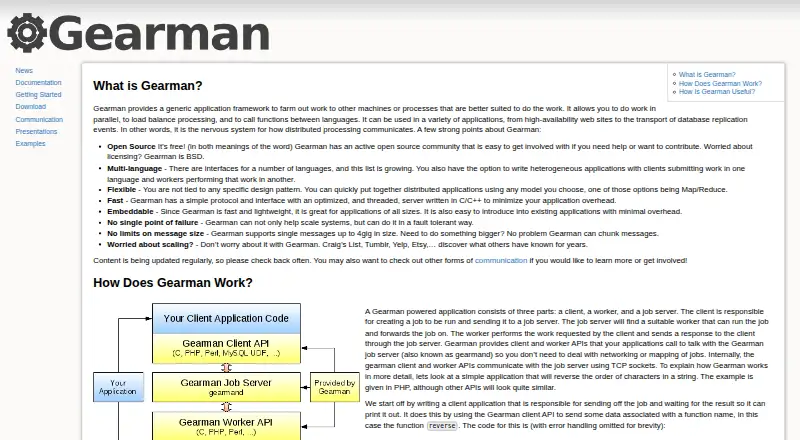
Gearman is an open-source framework that distributes application work among machines or processes. You run it yourself, using a client, a job server, and workers.
What it does
A client submits a job, the job server routes it, and a worker performs it. This lets work run in parallel or outside the process that submitted it.
Workers can be pooled across machines. The server sends new jobs to available workers, which supports load balancing as demand grows. Gearman also supports background asynchronous jobs and high- or low-priority submissions.
The system supports messages up to 4 GB and can split larger messages into chunks. Clients and workers can connect to multiple job servers and fail over when one server stops.
How it connects
Gearman is self-hosted and provides client and worker interfaces for C, C#/.NET, Go, Java, Lisp, Node.js, PHP, Perl, Python, Ruby, and Rust. A client and worker may use different languages if they understand the workload sent through Gearman's protocol.
The binary protocol uses TCP port 4730 by default. A separate text-based protocol handles administration. An experimental HTTP plugin maps GET and POST requests to jobs.
MySQL and PostgreSQL user-defined functions can expose Gearman client calls to SQL queries, triggers, and stored procedures. The pure Perl client and worker API supports SSL, and gearmand can be built with certificates for encrypted connections.
The project is BSD licensed and includes a C job server, libgearman, command-line tools, documentation, and build or package instructions. See task queue software for other options.
Good fit
Gearman suits teams that need a self-hosted job queue for parallel work, background processing, or worker pools spread across machines.
It fits mixed-language systems because clients and workers can use different language APIs. Persistent queues, priority handling, multiple servers, and database functions cover several common integration patterns.
Packages and installation guidance cover RHEL/Fedora, Debian/Ubuntu, Windows, source builds, and Git checkouts. Homebrew provides macOS and Linux bottles.
Watch for
Gearman does not provide scheduled jobs. In-memory queues lose pending jobs after a crash or restart; persistent queues apply only to background jobs.
The HTTP protocol plugin is marked experimental. GearmanSharp is described as incomplete and does not yet implement the full protocol, so check its coverage before choosing C#/.NET.
Building on Ubuntu may require GCC, autoconf, bison, flex, libtool, make, Boost, libcurl, libevent, memcached, UUID, SQLite, and MySQL development packages.
Pricing
Gearman is free. The open-source software includes a self-hosted job server plus client and worker APIs under BSD-licensed components.
There is no free trial because the software itself is free rather than a trial-based service.
Verdict
Choose Gearman when you want an open-source queue and worker system that you operate yourself, especially for parallel or background work across several languages and machines.
It is a weaker match if you need built-in scheduling, durable recovery for every queue type, or a complete GearmanSharp implementation.
Our take
Gearman is a sensible choice for organizations that can run their own job server and need workers to process tasks in parallel, across machines, or in different programming languages. Its free BSD-licensed code, priority modes, failover options, and database hooks give buyers practical building blocks without a subscription. The trade-offs are operational: scheduling is absent, crash recovery depends on queue type, and some interfaces are incomplete or experimental. Confirm language support, persistence needs, and build requirements before adopting it.
- Free, open-source software under BSD licensing
- Supports parallel, background, and priority jobs
- Workers and clients can use different languages
- Failover across multiple job servers
- Messages up to 4 GB with chunking for larger ones
- No built-in scheduled jobs
- In-memory queues lose pending jobs after crashes or restarts
- Persistent queues apply only to background jobs
- GearmanSharp does not implement the full protocol
- HTTP integration is marked experimental
- Pick it ifSelf-hosted teams running background or parallel jobs; Mixed-language worker and client systems; Workloads that need worker pools and failover
- Skip it ifYou need scheduled jobs built into the queue; You require durable recovery for every queue type; You depend on a complete GearmanSharp implementation
Pricing
Gearman is free open-source software. The plan is a self-hosted job server with client and worker APIs under BSD-licensed components; there is no separate trial period.
- GearmanOpen source · BSD licenseFree
- Gearman open-source softwareself-hosted job server · client and worker APIs · BSD-licensed componentsFree
As gearman.org lists them, checked 7 Oct 2026.
Questions
Is Gearman free?
Yes. Gearman is free, open-source software with BSD-licensed components and a self-hosted job server.
What languages does Gearman support?
Official interfaces cover C, C#/.NET, Go, Java, Lisp, Node.js, PHP, Perl, Python, Ruby, and Rust.
Does Gearman support scheduled jobs?
No. The listed capabilities include background and priority jobs, but not scheduled jobs.
How does Gearman divide work?
A client submits a job, a job server routes it, and a worker performs it. Workers can run across machines or processes.
Are Gearman queues persistent?
The server supports persistent queues, but in-memory queues lose pending jobs after a crash or restart. Persistent queues apply only to background jobs.
Can Gearman use databases?
MySQL and PostgreSQL user-defined functions can expose Gearman client calls to SQL queries, triggers, and stored procedures.
Does Gearman support encrypted connections?
The pure Perl client and worker API supports SSL. Gearmand can be built with SSL and configured with server and client certificates.
Where can Gearman run?
It is self-hosted and listed for Linux, macOS, Windows, and API use. Installation guidance covers packages, source builds, and Git checkouts.