Genyo Govern AI review
genyo.ai · checked 11 Oct 2026
Web-based AI governance and compliance platform for financial firms facing EU rules.
How it plugs in
Signal on AI governance tools5.6#21 of 56
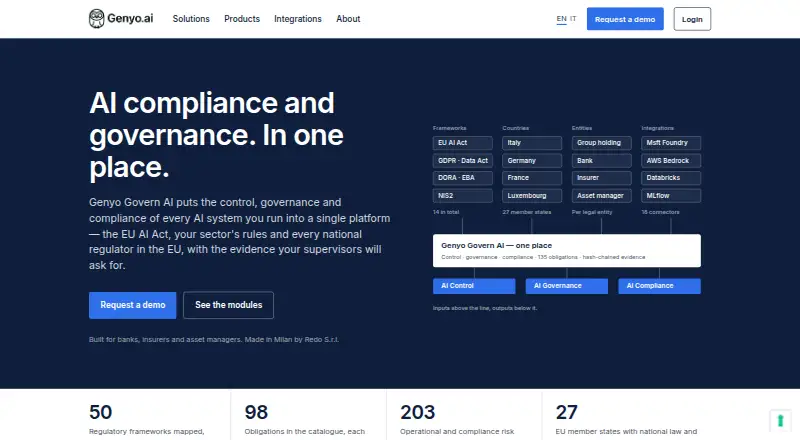
Financial institutions can use Genyo Govern AI to oversee AI governance from one platform. It maintains AI-system inventories, maps obligations across EU and national rules, manages risk and oversight evidence, and supports post-market monitoring. Information from model, observability, security, privacy, and testing tools can be viewed together through read-only connectors.
Review
In a line
Financial organizations can use Genyo Govern AI through the web to govern their AI systems. The platform brings together compliance work, controls, records, and evidence for EU regulations and sector rules.
What it does
For every AI system, the register records its risk class, provider or deployer role, lifecycle stage, EU database status, models, and associated risks. Oversight records cover all five Article 14(4) measures, the people responsible, and evidence that those measures operate in practice.
Teams can map requirements from the EU AI Act, GDPR, Data Act, DORA, NIS2, EBA guidelines, Solvency II, MiFID, and national rules for EU member states. Modules can produce Annex IV technical documents, join FRIA and DPIA workflows, and assemble supervisor inspection dossiers.
Post-market monitoring applies measures and thresholds to individual models. A crossed threshold may create an incident record.
How it connects
Genyo Govern AI is cloud-deployed and offers read-only connectors. These connectors can pull registries, run information, telemetry, or security signals from tools including Azure ML, AWS SageMaker, Databricks Unity Catalog, MLflow, Weights & Biases, and Datadog.
The listed connections also cover Dynatrace, Microsoft Purview and Presidio, NVIDIA NeMo Guardrails, Garak, PyRIT, DeepEval, and RAGAS. These connectors do not write back to those systems.
For a wider view of this category, see [[list:ai-governance|AI governance tools].
Good fit
Financial firms such as banks, insurers, and asset managers can use the product to maintain a formal record of AI systems, risks, controls, and regulatory duties.
Registers, regulatory overlays, and roles can be maintained separately for each legal entity, with a holding company able to view combined risk and obligation status.
Watch for
Connections are read-only, so changes must be made in the connected platforms themselves. Check that the listed connectors cover your current tools and that the required EU or national rules are included in your process.
Genyo Govern AI targets financial-sector organizations, not a general business audience.
Pricing
The maker does not publish a plan price; prospective users are directed to request a demo.
The terms provide 14 calendar days of trial access starting when the platform is first accessed. Continued use is then subject to the fees in the commercial offer.
Verdict
Genyo Govern AI fits financial groups that need one place to track AI inventories, regulatory mappings, assessments, oversight evidence, and monitoring incidents across several legal entities.
It may not suit teams that need connectors to update other systems, publicly posted pricing, or a product aimed beyond banking, insurance, and asset management.
Our take
Choose Genyo Govern AI when EU financial regulation is central to your AI program and you need documented controls, assessments, and evidence for supervisors. Groups with complex structures can maintain governance by entity and see an aggregated holding-company view. The 14-day trial lets teams review the workflow before committing, but the commercial cost is disclosed only after a request. Organizations needing two-way integrations or a broad, non-financial audience should look elsewhere.
- AI register captures risk, lifecycle, roles, models, and linked risks
- Maps EU and national financial rules in one platform
- Generates Annex IV, FRIA, DPIA, and inspection documents
- Model thresholds may open incident records
- Provides entity-specific registers alongside consolidated group views
- Connectors operate in read-only mode and cannot change connected tools
- Pricing is provided only through a commercial offer
- The product is primarily intended for banks, insurers, and asset managers
- Pick it ifBanks, insurers, and asset managers handling EU AI compliance; Financial groups needing entity and holding-company governance
- Skip it ifYou require connectors that write changes back to source systems; You need public pricing or a product for non-financial organizations
Pricing
Pricing is available on request. Trial access lasts 14 calendar days from first platform access; continued use afterward follows the fees in the commercial offer.
Questions
What does Genyo Govern AI provide?
It is a web platform for AI governance, compliance, controls, and evidence designed for banks, insurers, and asset managers.
Which regulations and guidelines are covered?
Coverage includes the EU AI Act, GDPR, Data Act, DORA, NIS2, EBA guidelines, Solvency II, MiFID, and national rules for EU member states.
Can it connect with ML and monitoring tools?
Yes. The maker lists connections such as Azure ML, AWS SageMaker, Databricks Unity Catalog, MLflow, Weights & Biases, Datadog, and Dynatrace.
Can connected systems be updated through these integrations?
No. The connectors are read-only and retrieve registries, runs, telemetry, or security signals without writing to connected platforms.
Does the service offer a trial period?
Yes. The terms provide a 14-calendar-day trial beginning with first platform access; later use is charged under the commercial offer.
Where can buyers find the price?
The maker does not publish a price. Buyers must request a demo and receive pricing in a commercial offer.
Can one deployment cover multiple legal entities?
Yes. Each legal entity can maintain its own register, regulatory overlays, and roles, while a holding company can view consolidated risk and obligation status.