Ginkgo: Family-Office Wealth Management Platform
iginkgo.com · checked 14 Oct 2026
Ginkgo brings together, validates, projects and presents financial information for family offices.
How it plugs in
Signal on Family Office Software5.9#2 of 24
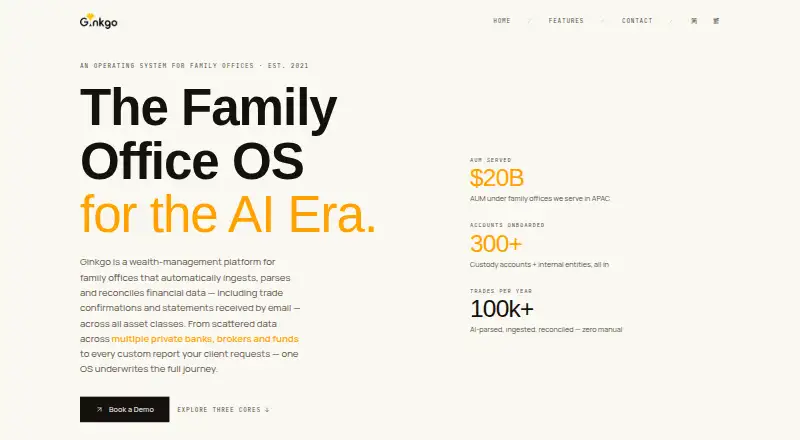
The platform serves single- and multi-family offices, ultra-high-net-worth families and corporate investment platforms. It combines custodian feeds, APIs and emailed files, then reconciles holdings across many asset types. Forecasting covers future income, calls, maturities and option events. Users build reports, dashboards and cash-flow views through a web app or API. Pricing is by request, with a paid trial.
Review
In a line
Ginkgo operates as a wealth-management system for family offices. It brings financial information from different sources into one dataset, checks it and turns it into forecasts and reports.
What it does
The platform accepts custodian feeds, data APIs, email messages, PDFs, Excel files, contract terms and screenshots. Its Decoder service uses AI parsing and rule checks to turn those materials into structured data, while daily two-way trade reconciliation looks for errors and sends alerts.
Accounts from several private banks, brokers and funds can be brought together in Ginkgo. It supports look-through views across trusts, companies and personal accounts, with live currency conversion. Horizon projects coupons, dividends, capital calls, option exercises, maturities and structured-product observations, and places those expected events into a 10-year forward cash-flow waterfall.
Through Polymorph, users can set up tables, charts, documents, dashboards and other modules. Other tools cover structured-product conditions, convertible-bond triggers, fund statistics, private-equity capital calls and corporate-bond risk measures.
How it connects
Ginkgo runs on the web and through an API. It aggregates custodian feeds and data APIs, and can use Bloomberg feeds and sell-side research for corporate-bond analysis. Gmail access uses permissions to read transaction messages and add a processed label.
Data is hosted in AWS Singapore. Ginkgo describes AES-256 storage encryption, TLS during transfer, role-based access, multi-factor authentication and AWS key management. The company’s FAQ states that information remains in Singapore and falls under Singapore’s Personal Data Protection Act.
The public material is mainly feature pages, a detailed FAQ and a downloadable guide; no public SDK documentation is identified. Transaction text and attachments from Gmail are passed to external AI, language-model and OCR providers for extraction.
Good fit
The platform is designed for single-family offices, multi-family offices, ultra-high-net-worth families and corporate investment platforms. It suits teams that need consolidated reporting, entity management and automated imports across varied assets and custodians.
Reporting can be self-configured in about 10 minutes. Ginkgo says Excel report replicas are quoted for one day, while pixel-matched PowerPoint or PDF replicas are quoted for one week. Managed data operations come with no additional charge.
Watch for
Pricing is not posted as a standard list, and the trial follows deployment. A security FAQ says third-party certification status is still being confirmed.
During an account, processed mailbox material and derived transaction information are kept; within 90 days of closure, they are deleted or anonymized. Before linking mail, buyers should examine the Gmail permissions and the involvement of external AI, language-model and OCR processors.
Pricing
There is no free plan. Ginkgo instead provides a free four-to-eight-week deployment period with managed data operations. After deployment, the Trial plan costs $1000 per month on monthly billing, followed by the contract rate.
Contract customers pay a fixed annual fee whose amount is set by agreement. Ginkgo publishes no figure and says charges are not based on assets under management or usage.
Verdict
Ginkgo may suit an office seeking a central system for data from multiple custodians, entity-level consolidation, event projections and customized reports. Its coverage spans public, private, structured and digital assets, with alerts for several specialized instruments.
Consider alternatives if you need published rates, a free plan, confirmed third-party security certification or public developer documentation. Teams handling sensitive email data should also assess the stated external processing and Singapore-only storage requirements.
Our take
Ginkgo fits family offices that want automated collection and reconciliation instead of assembling spreadsheets from many banks and funds. Its forecasting and 10-year cash-flow view may help with planned distributions, calls and maturities, while configurable outputs support recurring reporting. The trade-offs are a quote-based contract, a paid monthly trial after deployment, and reliance on outside processors for Gmail content. Confirm the security-certification status, data-handling terms and required report formats before signing.
- Accepts feeds, APIs, email, PDFs, Excel files and screenshots.
- Reconciles trades daily and alerts users to detected errors.
- Forecasts income, calls, maturities and option events.
- Supports trusts, companies and personal accounts with currency conversion.
- Managed data operations are provided during deployment.
- There is no free plan; the post-deployment trial is $1000 a month.
- Contract pricing is not published.
- Third-party security certification is not yet confirmed.
- Gmail content and attachments are sent to external AI and OCR processors.
- No public SDK documentation is identified.
- Pick it ifFamily offices consolidating data from numerous custodians; Teams forecasting family-office cash flows and specialized assets; Corporate investment platforms needing configurable reports
- Skip it ifYou need published pricing or a permanently free tier.; You require confirmed third-party certification or public SDK materials.; Your policies prohibit external processing of Gmail attachments.
Pricing
Deployment lasts 4–8 weeks at no charge and includes fully managed data operations. The Trial costs $1000 per month after deployment, billed monthly. The Contract option uses a fixed annual fee set by agreement, without an AUM percentage or usage-based charges.
- Deployment4–8 week deployment · fully managed data operations includedFree
- Trialmonthly · Trial after deployment · contract rate follows$1,000/mo
- Contractfixed annual fee; rate by contract · No AUM percentage · no usage-based chargesOn request
As iginkgo.com lists them, checked 14 Oct 2026.
Questions
Who is Ginkgo for?
Ginkgo is built for single-family offices, multi-family offices and ultra-high-net-worth families, while also serving corporate investment platforms.
What files and feeds can it use?
It can take custodian feeds, data APIs, email, PDF statements, Excel files, contract terms and screenshot images.
Does Ginkgo offer an API?
Yes. Ginkgo lists an API and web access. Its public pages do not identify public SDK documentation.
Where is data stored?
The company says information is hosted in AWS Singapore, remains there and is handled under Singapore’s Personal Data Protection Act.
What does the trial cost?
After deployment, the Trial plan is billed monthly at $1000 per month; a contract rate follows.
Is a free plan available?
No. Deployment is free for four to eight weeks and includes fully managed data operations.
How does Ginkgo handle Gmail data?
The Gmail connector reads transaction messages and applies a processed label. Their bodies and attachments are sent to third-party AI, language-model and OCR processors.