gobfuscate Go Binary Obfuscation Review
github.com · checked 11 Oct 2026
A free command-line utility for obfuscating Go packages and binaries.
How it plugs in
Signal on Code Obfuscation Software5.0#30 of 34
gobfuscate builds Go binaries from altered source code so names, package paths, and strings are harder to read in the executable. It runs as a command-line desktop tool and is free under the BSD 2-Clause license. CGO, assembly files, build constraints, and some constant blocks limit what it can hide.
Review
In a line
gobfuscate is open-source software that builds Go binaries from obfuscated source code through a command-line workflow. Its purpose is to make information inside the resulting executable difficult or impossible to decipher.
What it does
The tool changes package names, global variable, constant, function, type, and method names. For strings, it generates functions that reconstruct masked-byte values and attempts to move string constants into variables.
It copies part of GOPATH and hashes package names and paths, which can remove details such as GitHub usernames from the executable. You run it with a package name, output path, and optional flags.
How it connects
Go packages and binaries are processed through gobfuscate's command-line build. Installation and invocation are shown in the README as `go get -u github.com/unixpickle/gobfuscate` and `gobfuscate [flags] pkg_name out_path`.
The source is open under the BSD 2-Clause license. Its flags cover tests, encryption, static linking, output folders, compiler tags, verbosity, padding, and hiding a Windows GUI.
Good fit
gobfuscate suits people shipping Go binaries who want package paths, identifiers, and strings less readable after compilation. It is also useful when a command-line build and free open-source software fit the workflow.
Its main job is name and string obfuscation for Go packages and binaries, rather than broader application protection.
Watch for
CGO packages cannot have package names renamed, and CGO blocks global-name and struct-method obfuscation under the stated restrictions. Packages containing assembly files also leave global names and struct methods unobfuscated.
Methods matching imported interface methods stay unchanged. Global names and struct methods that recur because of build constraints remain unobfuscated, and string constants in mixed const/int blocks do not convert successfully.
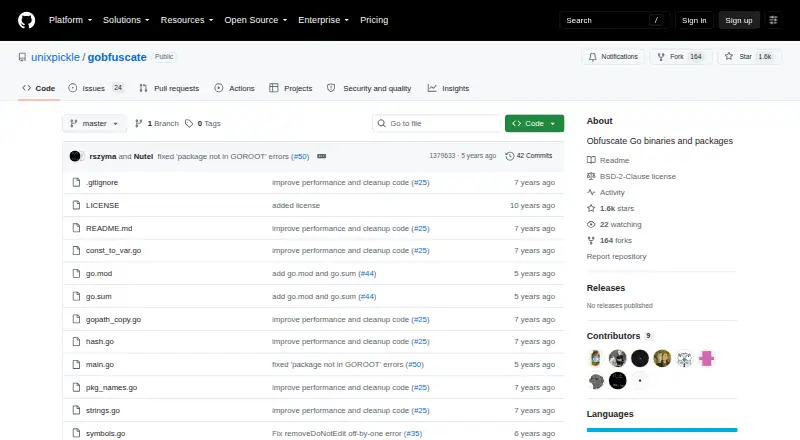
The repository has no release downloads listed, so installation is based on the source and README instructions.
Pricing
gobfuscate is free. The project identifies itself as open source and uses a BSD 2-Clause license.
Verdict
Choose gobfuscate if you distribute Go executables and want a free way to obscure identifiers, package paths, and many strings during the build.
Do not choose it when your code depends heavily on CGO or assembly, or when you need control-flow obfuscation or anti-tamper controls. Check your build constraints and constant blocks first, because those cases can leave names or strings exposed. For a wider starting point, see code obfuscation software.
Our take
gobfuscate is a focused option for Go developers who want source-level names and strings to be less visible in shipped binaries without paying for a license. Its command-line workflow and BSD 2-Clause terms keep the setup simple. Coverage is not complete: CGO, assembly, interface-matching methods, repeated build-constraint names, and certain constants can bypass parts of the process. It also does not provide control-flow obfuscation or anti-tamper features. Review your package makeup before relying on it for protection.
- Free and open-source under a BSD 2-Clause license
- Obfuscates package paths, identifiers, methods, and many strings
- Command-line build with flags for common Go build options
- Can obscure details such as GitHub usernames in package paths
- CGO limits package, global-name, and method obfuscation
- Assembly files and repeated build-constraint names leave symbols unchanged
- Interface-matching methods are not renamed
- Mixed const/int blocks prevent some string conversion
- No control-flow obfuscation or anti-tamper controls
- Pick it ifGo teams shipping binaries that need obscured names and strings; Users comfortable with a command-line build
- Skip it ifYour packages rely on CGO or assembly for code that must be hidden; You need control-flow obfuscation or anti-tamper protection
Pricing
Free open-source software under a BSD 2-Clause license; there is no paid plan listed.
Questions
What is gobfuscate?
It is open-source command-line software for producing Go binaries from obfuscated source, with the aim of making executable information harder to decipher.
What does gobfuscate change?
It hashes package paths and names, global identifiers, many type and method names, and rewrites strings so they are rebuilt from masked bytes.
How do I install and run it?
The README pairs `go get -u github.com/unixpickle/gobfuscate` with the command `gobfuscate [flags] pkg_name out_path`.
Does gobfuscate work with CGO?
Only partly. CGO packages cannot have package names renamed, and CGO prevents global-name and struct-method obfuscation under the stated restrictions.
What other cases limit obfuscation?
Assembly files and repeated names from build constraints leave global names and struct methods unchanged. Methods matching imported interfaces also stay unchanged.
How much does gobfuscate cost?
It is free and open source, with a BSD 2-Clause license.
Near it
All alternatives →- DDotfuscator#29 on this board
- I
 iXGuard#31 on this board
- IIka#28 on this board
- D
 DexGuard#32 on this board
- BO
 Babel Obfuscator#27 on this board
- YyGuard#33 on this board
- COCrypto Obfuscator for .NET#26 on this board
- RARedgate ANTS Performance Profiler#34 on this board
- T
 Themida#25 on this board
- ANAgile.NET#24 on this board