
GS2-Matchmaking: Game Matchmaking Service
docs.gs2.io · checked 14 Oct 2026
A managed game matchmaking service with ratings, party queues, seasons, and a public API.
How it plugs in
Signal on Game Matchmaking Software6.7#7 of 28
GS2-Matchmaking finds opponents by applying player and gathering conditions. It offers standard and seasonal gatherings, party play, ratings, blacklists, role limits, and server allocation. Official SDKs, a public API, and connected GS2 services handle chat, notifications, jobs, scripts, and rating workflows. A free Individual plan is available, alongside paid options for larger businesses.
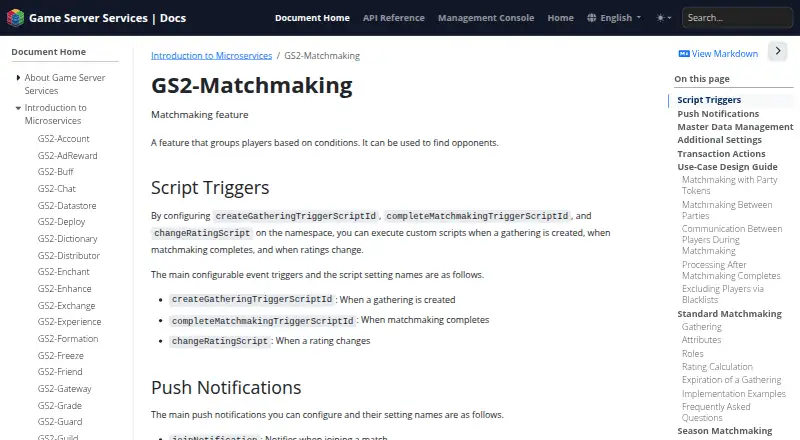
Review
In a line
GS2-Matchmaking groups game players according to selected conditions. It supports opponent search, party entry, and both temporary and season-long gatherings.
What it does
A standard flow starts with a player-created gathering; others can enter when its matchmaking conditions fit. Once the required player count is reached, the gathering is removed. Up to five player attributes are supported, with roles and per-role recruitment capacities; selected user IDs can also be blacklisted.
Parties can join or create a gathering through party tokens, including party-versus-party flows. A player token remains valid for 3 minutes, while a party token remains valid for 10 minutes. Ratings use a Glicko-2-based calculation: players begin at 1500 and their values change according to results.
For seasonal play, a persistent gathering remains available during a defined period and accommodates as many as 1,000 players. GS2-Schedule can define the period, while GS2-Experience rank is the sole search condition. Players generally cannot leave or rematch while that gathering persists.
When a match finishes, GS2-Gateway may deliver notifications, GS2-JobQueue may register jobs, and GS2-Script may execute custom scripts. Notifications can cover joining, leaving, completion, and rating changes, including forwarding to offline mobile devices.
How it connects
GS2 operates this managed service over HTTP on Android, iOS, Linux, macOS, Windows, web, and self-hosted environments. Its services are intended for smartphone, PC, console, and browser games. Latency or region conditions and server allocation are supported.
The public API documents matchmaking, rating, and early-completion operations, including request limits and result formats. Engine SDKs are available for Unity, Unreal Engine 5, and Godot 4; language SDKs cover Go, PHP, Java, C#, TypeScript, and Python, with Lua client examples in the matchmaking reference. Unity uses Unity Package Manager, while Godot 4 uses an addons/gs2 directory with Ez and low-level API layers.
For communication, the documentation points to GS2-Chat for traffic of up to three messages per second and GS2-Realtime for higher-frequency exchange. Completed matches can be connected to GS2-SeasonRating. Server-side Lua and AWS Lambda functions in the customer's AWS account can add processing logic.
GS2-Matchmaking is not open source. Unity and Godot SDKs use Apache License 2.0, although some Unity dependencies carry separate licenses.
Good fit
This service fits game teams seeking condition-based opponent search without running their own matchmaking backend. Standard flows include roles, attributes, ratings, parties, blacklists, and region or latency criteria.
It can also suit games that need persistent seasonal groups, post-match notifications, queued jobs, scripts, or rating updates. SDKs cover several major engines and programming languages.
Watch for
Season matchmaking is more limited than the standard mode: only GS2-Experience rank can be searched, standard matchmaking's complex conditions are unavailable, and players cannot leave after matching. A rematch generally means deleting the persistent gathering.
GS2 states that it does not defend game executables or runtime memory against tampering, though player data such as item counts is managed server-side. Free support is forum-based and may not address project-specific questions.
Professional and Enterprise plans carry a 99.99% monthly uptime commitment for each microservice; Individual is excluded. Rate limits, excess quotas, announced maintenance, customer environments, third-party failures, and force majeure do not count toward outage calculations.
Pricing
GS2-Matchmaking uses freemium pricing. Individual costs nothing for businesses whose previous-12-month sales are below USD 100,000; all features are included, but the GS2 logo must appear on the title screen. A free trial is also listed.
Professional Service is a $200 one-time option billed hourly, requires Business Support, and has a one-hour minimum per session. Prototyping is $1000 per month for a pre-release prototype, includes Business Support, and runs for up to three months.
Business Support is $3000 per month per project and provides private chat for up to 15 support hours monthly. Professional uses pay-as-you-go billing for businesses with at least USD 100,000 in prior-year sales: $0.00003–0.0001 per API request, with monthly usage below USD 100 free. Enterprise pricing is available on request, with a free allowance of up to USD 200 per month before usage fees.
Verdict
Choose GS2-Matchmaking when your game needs managed opponent grouping, party entry, ratings, or seasonal gatherings with SDKs for major engines. Related GS2 services handle messaging, notifications, queued work, scripts, and rating updates.
Look elsewhere if you require open-source matchmaking, broad search criteria in persistent seasons, or protection against tampered clients. Before choosing a plan, review the business threshold, logo requirement, support charges, usage billing, and SLA exclusions.
Our take
GS2-Matchmaking is a practical option for multiplayer teams needing opponent search, party queues, ratings, and seasonal groups through one managed service. Engine and language SDKs, the public API, and connected GS2 services cover common integration needs. Key trade-offs include narrow season searches, restrictions on leaving season groups, and no client-tamper protection. Smaller teams can start free, while larger businesses should examine logo rules, support charges, request pricing, and eligibility thresholds.
- Free Individual plan includes all features
- Supports parties, roles, ratings, blacklists, and region rules
- SDKs for Unity, Unreal Engine 5, Godot, and multiple languages
- Season gatherings can hold up to 1,000 players
- Post-match notifications, jobs, and scripts are supported
- Season matchmaking only searches by GS2-Experience rank
- Players generally cannot leave or rematch in a season gathering
- No protection against tampered game clients or runtime memory
- Free support is forum-based and may not address project-specific issues
- Professional and Enterprise pricing is not fully listed upfront
- Pick it ifGame teams needing managed opponent and party matchmaking; Games using Unity, Unreal Engine 5, Godot, or supported SDK languages; Projects combining matchmaking with seasons and GS2 services
- Skip it ifYou need open-source code or client anti-tamper protection; Your season mode requires complex search rules or player departures; You prefer fully published pricing without sales or usage thresholds
Pricing
Individual is free when previous-12-month sales are under USD 100,000. Paid options include $200 one-time Professional Service, $1000/month Prototyping, and $3000/month Business Support; Professional uses usage billing and Enterprise uses quoted pricing.
- IndividualSales under USD 100,000 in the previous 12 months · all features · GS2 logo required on title screenFree
- Professional Serviceper hour · Requires Business Support · minimum one hour per session$200 one-time
- PrototypingPre-release prototype phase · includes Business Support · maximum three months$1,000/mo
- Business Supportper project · Private chat support · up to 15 support hours monthly$3,000/mo
- EnterpriseASK · Free allowance up to 200 USD monthly; usage fee applies after limitOn request
- ProfessionalPay-as-you-go · Sales of USD 100,000 or more in the previous 12 months · USD 0.00003–0.0001 per API request · usage under USD 100/month freeOn request
As gs2.io lists them, checked 14 Oct 2026.
Questions
Does GS2-Matchmaking have a free plan?
Yes. Individual is free for businesses with previous-12-month sales under USD 100,000, includes all features, and requires the GS2 logo on the title screen.
Which game engines have SDKs?
Official SDKs are available for Unity, Unreal Engine 5, and Godot 4. Language SDKs cover Go, PHP, Java, C#, TypeScript, and Python; Lua client examples are also documented.
Can players match as a party?
Yes. Party tokens allow an already formed group to create or enter a gathering, including party-versus-party matchmaking. Player tokens last 3 minutes and party tokens last 10 minutes.
How does season matchmaking differ?
A seasonal gathering can contain up to 1,000 players for a defined period, but GS2-Experience rank is its only search condition. Players generally cannot leave or rematch while it remains active.
What happens after a match ends?
GS2-Gateway can deliver notifications, GS2-JobQueue can register jobs, and GS2-Script can run custom scripts. GS2-Realtime gathering creation is also supported.
Is GS2-Matchmaking open source?
No. Unity and Godot SDKs are distributed under Apache License 2.0, with some Unity dependencies under separate licenses.
What does Business Support cost?
Business Support costs $3000 a month per project and includes private chat support for up to 15 support hours monthly.
Near it
All alternatives →- EO
 Epic Online Services#6 on this board
- AG
 AccelByte Gaming Services#8 on this board
- U
 Unity#5 on this board
- PR
 Photon Realtime#9 on this board
- B
 brainCloud#4 on this board
- E
 Edgegap#10 on this board
- UV
 Unity Version Control#3 on this board
- SI
 Steam Input#11 on this board
- M
 Metaplay#2 on this board
- AG
 Amazon GameLift Servers#12 on this board