HCI MemTest: RAM Testing Software
hcidesign.com · checked 15 Oct 2026
RAM testing utility for Windows, with free, Pro and Deluxe editions for checking memory errors.
How it plugs in
Signal on PC Overclocking Software6.4#3 of 31
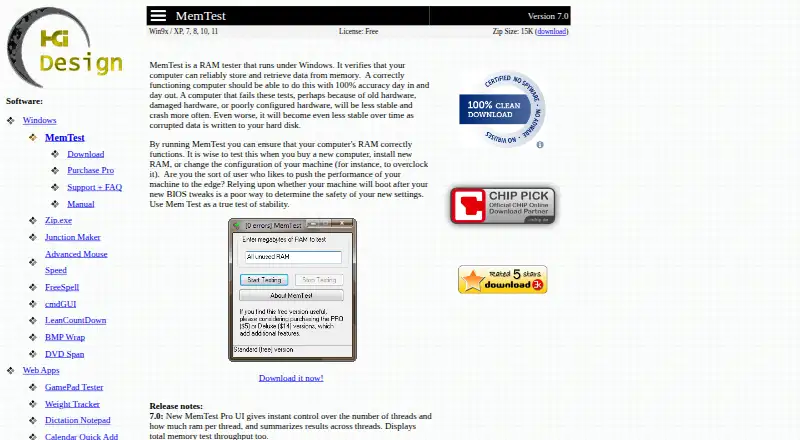
HCI MemTest checks whether a computer can write and retrieve data from RAM reliably. The free Windows edition is portable, while Pro adds automation, logging and background testing. Deluxe runs from bootable CD or USB, accesses all installed memory and requires CSM or legacy BIOS support. Plans are free, $5 one-time or $14 one-time.
Review
In a line
HCI MemTest is a memory-checking utility for Windows computers. It looks for errors when data is written to and read from RAM.
What it does
Use it after buying a computer, installing RAM or changing settings such as overclocking. HCI Design treats even one reported error as a sign of a memory or configuration problem.
The free edition runs from an unzipped folder. Pro adds controls for thread count and RAM per thread, combined results, total test throughput, continued testing after errors and a background “nice” mode.
Deluxe includes a 64-bit tester that starts from a bootable CD or USB. It can access all installed RAM before an operating system loads and reports memory-checking speed as a basic BIOS-settings benchmark.
How it connects
The maker lists Windows 9x, XP, 7, 8, 10 and 11 compatibility, and the product is listed for Windows and Linux. The free edition does not change the registry or other files; removal means deleting its folder.
Pro offers full command-line control for scheduled or automated tests and saves errors to disk. Deluxe requires a PC that supports CSM or legacy BIOS boot.
An online manual, included manual, FAQ and email support explain setup and use.
Good fit
HCI MemTest suits people checking newly installed memory, troubleshooting crashes or validating a system after configuration changes. Pro fits users who need repeatable tests, saved error reports or testing during normal computer use.
Deluxe is suited to checking all installed RAM without loading an operating system, provided the computer supports its boot requirement.
Watch for
The maker says 100% coverage should catch all errors except intermittent ones; those may need testing to about 400%. Allocating more memory than Windows can provide without swapping can make progress very slow.
Software cannot reliably identify the failing physical memory chip. To isolate a faulty board, test memory modules one at a time. The basic edition can test only about 2GB to 3.5GB per instance, and large systems may require one instance per processor thread.
Pricing
HCI MemTest has a free plan and no free trial. The MemTest edition is free and includes the version 7.0 Windows program as a 15K ZIP download with no ads.
MemTest Pro costs $5 one-time. It adds the advanced interface, command-line control, disk error logs, background “nice” mode and home or commercial use.
MemTest Deluxe costs $14 one-time. It includes Pro plus bootable CD or USB testing, a 64-bit tester, access to all RAM and a memory-speed benchmark.
Verdict
Choose the free edition for portable Windows memory checks. Pay for Pro if you need scheduled runs, logs or background testing. Choose Deluxe only when boot-time access to all RAM matters and the PC supports CSM or legacy BIOS.
Our take
HCI MemTest is a practical choice for checking RAM after an upgrade or system change, especially if you want a small portable download. The free edition covers straightforward Windows testing, while Pro adds useful automation and records. Deluxe is more specialized: it tests before the operating system starts and needs older-style boot support. Expect to isolate suspect modules yourself, and allow much higher coverage for intermittent faults. Buyers with large-memory, many-thread systems should account for the basic edition’s per-instance limits before choosing the free plan.
- Free, portable Windows edition with no ads
- Pro adds command-line scheduling and disk error logs
- Deluxe can test all installed RAM before Windows loads
- Background “nice” mode can run during normal use
- Basic edition tests about 2GB to 3.5GB per instance
- Large systems may need one instance per processor thread
- Deluxe requires CSM or legacy BIOS boot
- Software cannot identify the exact failing memory chip
- Pick it ifChecking RAM after installation or configuration changes; Scheduled or background testing with Pro; Full-memory boot testing on compatible PCs
- Skip it ifYou need automatic identification of the physical failed memory chip; Your PC lacks CSM or legacy BIOS support for Deluxe; You need broad per-instance coverage on a large, many-thread system
Pricing
Free edition available; Pro is $5 one-time; Deluxe is $14 one-time. There is no free trial.
- MemTest FreeRAM reliability testing · No advertisementsFree
- MemTestWindows program · Version 7.0 · 15K ZIP · free/no adsFree
- MemTest (free)Windows; Version 7.0; 15K ZIP downloadFree
- MemTest Prodelivered via email · Advanced UI · command-line control · disk error logs · background “nice” mode · home and commercial use$5 one-time
- MemTest Deluxedelivered via email · Includes Pro · bootable CD/USB · 64-bit tester · CSM/legacy BIOS required · tests all RAM · memory-speed benchmark$14 one-time
As hcidesign.com lists them, checked 20 Sept 2026.
Questions
What does HCI MemTest check?
It checks whether a Windows computer can reliably write data to RAM and retrieve it.
Is HCI MemTest free?
Yes. The basic MemTest edition is free. Pro costs $5 one-time and Deluxe costs $14 one-time.
Does it run on Linux?
The product is listed for Windows and Linux, while the documented MemTest program and version 7.0 compatibility list focus on Windows.
What does MemTest Pro add?
Pro adds thread and RAM-per-thread controls, combined results, command-line automation, disk error logs, background “nice” mode and continued testing after errors.
What is MemTest Deluxe?
Deluxe adds a 64-bit tester that boots from CD or USB, accesses all installed RAM and reports memory-checking speed.
How much coverage should I run?
The maker says 100% coverage should catch all errors except intermittent failures, which may need around 400% coverage.
Can it identify the bad memory chip?
No. The maker recommends testing modules separately to isolate a faulty board.