
HELM: Open-Source Model Evaluation Framework
crfm.stanford.edu · checked 8 Oct 2026
Open-source Python toolkit for clear, repeatable testing of language and multimodal models.
How it plugs in
Signal on LLM Evaluation Tools6.3#7 of 29
HELM is a no-cost Python toolkit for assessing foundation models, including language and multimodal systems. It puts datasets and benchmarks into a common format, tracks accuracy alongside efficiency, bias, and toxicity, and offers prompt review plus model-comparison leaderboards. HELM works with hosted APIs and privately run models, but has been in maintenance mode since June 2026, with no planned additions to features or leaderboard evaluations.
Review
In a line
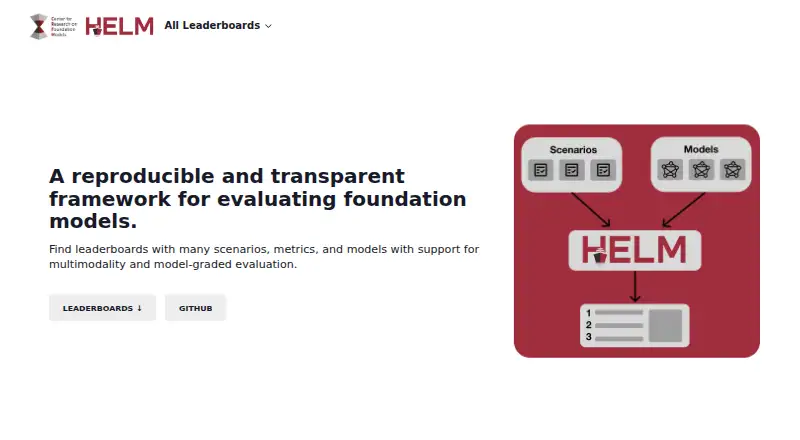
HELM is a Python-based open-source toolkit for assessing language and multimodal foundation models. It is designed to make model tests reproducible and transparent.
What it does
HELM offers datasets and benchmarks, including MMLU-Pro, GPQA, IFEval, and WildBench, in a consistent format. Evaluations may execute on your machine or call a model API, after which HELM summarizes the findings.
Its measurements go beyond correct answers to include efficiency, bias, and toxicity. A browser-based view exposes individual prompts and responses, and leaderboards place model results side by side across benchmarks such as Capabilities, Safety, and VHELM.
How it connects
The framework presents one interface for models from providers including OpenAI, Anthropic, and Google. You can also configure a private checkpoint on disk or a model server on a private network.
Python installation comes from PyPI using `pip install crfm-helm`. The documentation then shows commands for executing benchmarks, condensing results, and launching a local web server. HELM's repository is openly licensed under Apache-2.0. For other options, see LLM evaluation tools.
Good fit
HELM suits teams that need repeatable model comparisons, safety checks, or broader quality measurements. Its leaderboards cover domains such as medicine and finance, along with aspects like multilinguality and world knowledge.
Beyond built-in measures, HELM allows custom metrics, judge-model scoring, safety tests, and workflows involving human reviewers. Published evaluation results can be reproduced with the framework.
Watch for
HELM moved into maintenance mode on June 1, 2026. The project does not plan further feature work or leaderboard evaluations.
The maintainers characterize HELM as deliberately incomplete and invite the community to identify gaps. Scenarios and models can break when external APIs change or providers retire models, so check them for your intended use. Questions go through GitHub issues, handled as maintainer time allows.
Pricing
HELM is free and open source. There are no paid plans listed, and there is no separate free trial.
Verdict
Choose HELM if you want an inspectable evaluation framework with standard benchmarks, several model-provider connections, and the option to run private models. Its breadth of metrics and public leaderboards can help organize serious comparisons.
Look elsewhere if you need active feature development, guaranteed compatibility with changing provider APIs, or a support service with committed response times. Maintenance mode means HELM is primarily a framework to operate and maintain yourself, not a growing hosted product.
Our take
HELM is a sensible choice for researchers and engineering teams that value repeatable tests, open code, and detailed model comparisons. Its support for private checkpoints, API-based inference, custom metrics, and human review covers many evaluation setups. The tradeoff is its current maintenance status: the project will not add features or leaderboard evaluations, and outside API changes may require your attention. Pick it when control and transparency matter more than an actively expanding product or formal support commitment.
- Free Apache-2.0 open-source framework
- MMLU-Pro and GPQA are among its standardized benchmarks
- Metrics include efficiency, bias, and toxicity
- Works with provider APIs and private models
- Web UI and leaderboards help inspect results
- Feature work and leaderboard evaluations stop after June 1, 2026
- External API changes can break scenarios and models
- Project is intentionally incomplete
- Support depends on maintainer availability
- Pick it ifTeams comparing language or multimodal models; Researchers needing reproducible, inspectable evaluations; Private or self-hosted model testing
- Skip it ifYou need an actively developed product with new features; You require guaranteed compatibility as provider APIs change; You expect dedicated, time-bound support
Pricing
HELM is free software under the Apache-2.0 license. No paid plans are listed, and there is no separate free trial.
- HELMOpen-source Python framework; no paid plans listedFree
As github.com lists them, checked 8 Oct 2026.
Questions
What is HELM?
HELM is an open-source Python toolkit for transparent, reproducible testing of language and multimodal foundation models.
Which models can HELM evaluate?
It offers a common interface to models from providers such as OpenAI, Anthropic, and Google. Private checkpoints and private-network model servers can also be configured.
What does HELM measure?
Its metrics cover accuracy plus efficiency, bias, and toxicity. It also supports safety evaluations, custom metrics, model-as-judge scoring, and human review workflows.
Does HELM have a web interface?
Yes. The web UI exposes individual prompts and responses, while web leaderboards compare model results across benchmarks.
How do I install HELM?
Install the package from PyPI with `pip install crfm-helm`; the project then documents commands for running benchmarks, summarizing results, and launching a local web server.
Is HELM still actively developed?
The repository records a June 1, 2026 move to maintenance mode, with no planned new features or leaderboard evaluations.
What can break when using HELM?
Scenarios and models may stop working when external APIs change or providers deprecate models. The maintainers recommend testing them for your intended use.