Helm: Free Open-Source Software Synthesizer
tytel.org · checked 15 Oct 2026
Desktop electronic music synthesizer with open-source code for Linux, macOS and Windows.
How it plugs in
Signal on Software Synthesizers7.3#5 of 38
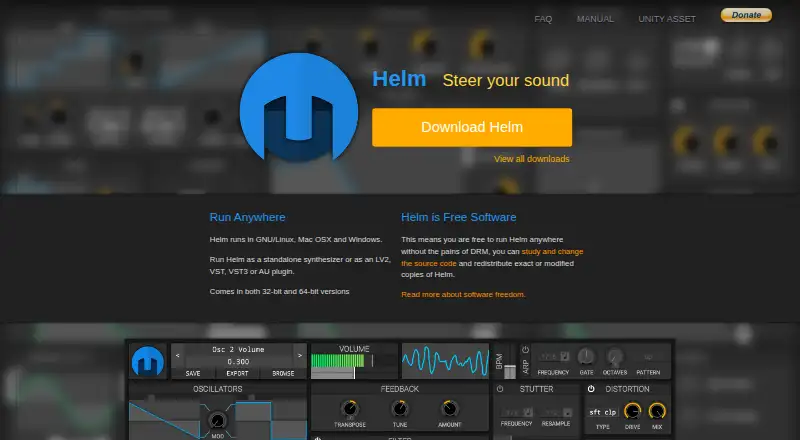
Helm is free software for making electronic music with a computer. Run the synthesizer on its own or host it as an LV2, VST, VST3 or AU plugin on Linux, macOS or Windows. It offers two oscillators, filters, modulation, sequencing and effects, with polyphony for 32 voices and MIDI assignment.
Review
In a line
Helm is a no-cost computer synthesizer for electronic music. It is open source and can run without digital rights management (DRM).
What it does
You can use Helm as a standalone synthesizer or load it inside music software as a plugin. Its sound-building tools include two oscillators, a sub oscillator, filters, modulation, a step sequencer, an arpeggiator and audio effects.
The synthesizer supports 32 simultaneous voices. Its modulation options include low-frequency oscillators, envelopes, keyboard controls, random values and polyphonic aftertouch. Built-in effects include formant filtering, stutter, distortion, delay and reverb.
Helm has 12 oscillator waveforms, up to 15 unison oscillators per oscillator and several filter types. With MIDI Learn, a hardware control can be mapped to a knob or slider. Presets can be saved as .helm patches or grouped in .helmbank collections.
How it connects
GNU/Linux, macOS and Windows are supported, each with 32-bit and 64-bit builds. Hosts can load Helm in LV2, VST, VST3 or AU form.
The source code is GPL-3.0 licensed open source. Developers can build standalone, LV2 and VST versions locally. Audio Helm integrates the synthesizer, sampler and sequencer into Unity through native audio components and controller components.
For related instruments, see Software Synthesizers or alternatives such as Vital and Surge.
Good fit
Helm suits people who want a no-cost synthesizer for electronic music, whether they work in a music application or prefer a standalone program. Its modulation, sequencing and effects cover subtractive-style sound design and experimental patches.
Unity developers may also use it to put a synthesizer, sampler and sequencer into a project. The manual covers synthesis modules, modulation, patch browsing, audio settings and performance controls.
Watch for
The project labels the current release beta and notes that bugs remain unresolved. Check that your operating system meets the listed requirements: Windows 7 or later, macOS 10.7 or later, Ubuntu Trusty 14.04 or later, or Debian Jessie or later.
Reviews mention that learning Helm can take time, and one calls its interface cluttered. Other comments characterize its sound as mainly digital and harsh, with less use for analog-style sounds. Reviews also say newer free instruments such as Vital and Surge offer more capability.
Pricing
Helm has no charge, and the offering does not include a free trial. The download allows you to pay nothing.
The maker shows optional contribution choices of $5, $10, $25, $50 or $100. These are contributions rather than required plan fees, and the standalone or plugin download remains available without DRM.
Verdict
Choose Helm if you need an open-source synthesizer that costs nothing and works across the main desktop operating systems. Its standalone mode and several plugin formats make it practical for different music setups, while MIDI mapping, patch files and Unity components add flexibility.
Look elsewhere if you need a polished, stable release, a less digital sound, or the broader feature set reviewers attribute to newer free instruments. Confirm your host supports one of Helm's plugin formats and accept that the project is still beta.
Our take
Helm offers electronic musicians a no-cost, open-source synthesizer for major desktop systems, with both standalone and plugin operation. Its 32-voice design, modulation tools, sequencing and effects provide plenty to explore without a purchase. The trade-offs are important: the release is beta, some reviewers find the interface difficult, and others hear a harsh digital character. Choose it when cost and flexibility matter more than polish, or consider another free instrument when stability and a larger modern feature set are priorities.
- Free download with optional contributions
- Open-source GPL-3.0 code and no DRM
- Standalone software plus LV2, VST, VST3 and AU plugin versions
- 32-voice polyphony with extensive modulation and effects
- Desktop support covers Linux, macOS and Windows
- Beta release with outstanding bugs
- Reviews mention that learning Helm can take time
- A reviewer has described the interface as cluttered or unattractive
- Sound may feel digital and harsh for analog-style work
- Newer free instruments may offer more capability
- Pick it ifElectronic musicians needing a free desktop synthesizer; Users who need standalone and plugin formats; Unity developers adding synth features
- Skip it ifYou need a stable, fully polished release; You prefer analog-style sound over a mainly digital character; You want the broader feature set of newer free instruments
Pricing
Helm itself is free, and paying nothing is permitted. The page displays optional contribution amounts of $5, $10, $25, $50 and $100. There is no free trial.
- Pay what you wantOptional contribution; page displays $5 input and $10, $25, $50 and $100 amounts · Standalone or plugin download · no DRM · pay nothing permittedOn request
As tytel.org lists them, checked 15 Oct 2026.
Questions
Is Helm free?
Yes. Helm is free software, and the download permits paying nothing. The page displays optional contribution amounts of $5, $10, $25, $50 and $100.
Which computers can run Helm?
Linux, macOS and Windows are supported in 32-bit and 64-bit versions. Listed requirements include Windows 7 or later, macOS 10.7 or later, Ubuntu Trusty 14.04 or later, and Debian Jessie or later.
Can Helm run inside music software?
Yes. Helm can run as an LV2, VST, VST3 or AU plugin, or as a standalone synthesizer.
Is Helm open source?
Yes. The source repository identifies Helm as GPL-3.0 licensed open-source software. The maker says it has no DRM and permits studying, changing and redistributing it.
Can I control Helm with hardware MIDI?
Yes. Right-click a knob or slider and use MIDI Learn to assign a hardware MIDI control.
Can I use Helm sounds in my own music?
The FAQ says sounds created with Helm belong to the person who played them, who holds their copyright.
Is Helm stable?
The project labels the release beta and warns that unresolved bugs remain.