Jitsu Event Pipeline Review
jitsu.com · checked 15 Oct 2026
Event pipeline that collects data from apps and sites and sends it to warehouses.
How it plugs in
Signal on Event Tracking Software7.7#1 of 24
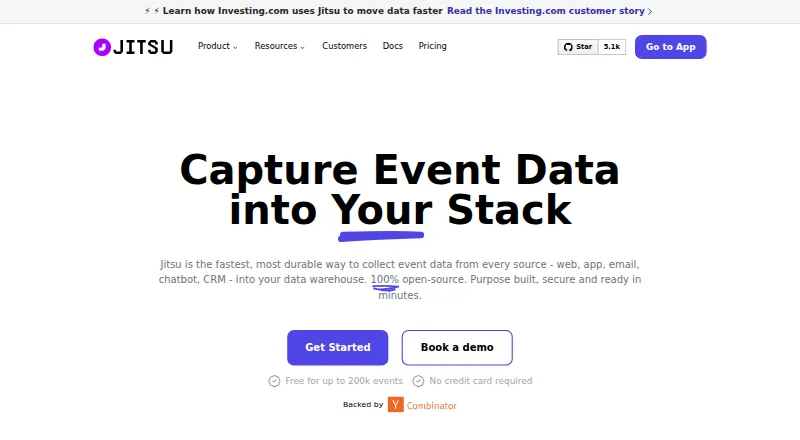
Jitsu is an event-data pipeline for collecting activity from websites, mobile apps, email, chatbots, and CRMs. It routes events to data warehouses and other destinations, with real-time delivery, optional batching, deduplication, schema creation, and identity stitching. Jitsu offers cloud hosting or MIT-licensed self-hosting, plus a free plan and paid tiers.
Review
In a line
Jitsu collects event data from websites, apps, email, chatbots, and CRMs, then sends it to data warehouses and other destinations.
It runs as a hosted cloud service or as open-source software on your own infrastructure.
What it does
Jitsu streams behavioral events to a chosen warehouse in real time and can batch them when needed. It buffers events in Kafka during warehouse maintenance, then resumes delivery when the warehouse is available.
The pipeline removes duplicate submissions and can create destination tables and columns from incoming fields. Identity stitching links anonymous activity to known users and can update historical records in supported warehouses.
JavaScript functions can filter, change, or enrich events before delivery. They can use storage, logging, HTTP fetch, and warehouse APIs.
How it connects
Jitsu lists more than 609 sources and more than 32 destinations, including warehouses, object storage, analytics tools, CRMs, and advertising platforms. Collection options include web snippets, HTTP and Pixel APIs, React Native, iOS, Android, and server-to-server connections.
An HTTP Management API handles workspaces, sites, destinations, connections, syncs, and functions with bearer API keys. Backend systems can send events through the Event HTTP API using an X-Write-Key header or basic authentication.
Documentation covers JavaScript, React, React Native, iOS, Android, HTTP, Segment proxy, and server-to-server SDKs. A command-line tool and an MCP server support API operations and pipeline configuration. Jitsu's public repository uses the MIT license. See Event Tracking Software for other event collection options.
Good fit
Jitsu suits teams that need one pipeline for web, mobile, and server events, then want those events in a warehouse or several destinations.
It can fit organizations that need real-time routing, automatic warehouse schemas, duplicate removal, identity stitching, or event changes before delivery. Cloud users get a configured ClickHouse warehouse with SQL-console and API access.
Self-hosting is available for teams that want open-source deployment on their own cloud or on-premise infrastructure.
Watch for
Feature-complete self-hosting requires Kubernetes, with operator-managed function servers and CronJobs for connector syncs. The recommended local setup uses Minikube, Helm 3 or newer, Git, and at least 8 GB of Minikube memory.
Docker Compose is deprecated and leaves out functions, profile builders, and connector syncs. Self-hosted deployments do not archive events automatically, while cloud backups retain data for up to seven days on Free and up to 90 days on paid plans.
Check event billing carefully: captured events are free, but billing counts active events successfully sent to at least one destination. If a function splits one event into several, each resulting event counts. Jitsu states that data is encrypted at rest with AES-256 and in transit with TLS, and that it is SOC 2 compliant.
Pricing
Jitsu has a free Free plan with unlimited captured events, 200k active events per month, unlimited connectors and destinations, one daily active sync, ClickHouse access, custom domains, identity stitching, and a configuration API.
The Open source plan is free forever under the MIT license, with self-hosting on any cloud provider, no usage limits, and community support. Business costs $99 a month and includes 2 million active events per month; extra active events cost $40 per additional 1 million, and extra monthly active syncs cost $20 each.
Enterprise pricing is on request. It adds custom active-event volume, one-minute connector syncs, unlimited monthly syncs, observability exports, profile builder, custom backup retention, a dedicated ingest shard, OIDC SSO, priority support, and an SLA. A free trial is available.
Verdict
Choose Jitsu if you want cloud or open-source deployment for collecting events across web, mobile, and backend systems, with warehouse delivery and controls for schemas, duplicates, and identities.
The Free plan may cover smaller pipelines, while Business adds a larger active-event allowance and faster syncs. Self-hosting avoids usage limits but brings Kubernetes and operational work. Compare its connector and warehouse coverage with tools such as RudderStack Customer Data Platform or Hightouch before deciding.
Our take
Jitsu is a practical choice for teams centralizing product and customer events in a warehouse without giving up a self-hosted option. Its free cloud plan has a defined active-event allowance, and the open-source edition removes usage limits in exchange for running the system yourself. Business pricing starts at $99 a month, with extra charges tied to active events and syncs. The main decision point is operations: production self-hosting needs Kubernetes, while cloud users get managed backups and ClickHouse access. Review destination coverage, event volumes, and backup needs before selecting a plan.
- Free cloud plan with unlimited captured events
- More than 609 sources and 32 destinations listed
- Real-time delivery with optional batching
- Open-source MIT-licensed self-hosting
- Deduplication and automatic warehouse schemas
- Feature-complete self-hosting requires Kubernetes
- Docker Compose deployment is deprecated and limited
- Billing counts active events sent to destinations
- Self-hosted deployments do not archive events automatically
- Pick it ifTeams routing web, mobile, and server events to warehouses; Organizations wanting cloud or MIT-licensed self-hosting; Pipelines needing identity stitching and schema automation
- Skip it ifYou cannot operate Kubernetes for a production self-hosted setup; Your billing model cannot accommodate active-event and sync charges; You need automatic event archiving in a self-hosted deployment
Pricing
Free cloud access is available with 200k active events per month. Open source is free forever with no usage limits when self-hosted.
- Free$0 · Unlimited captured events · 200k active events/month · unlimited connectors · one daily active sync · ClickHouse UI/API · unlimited destinations · custom domains · identity stitching · configuration APIFree
- Open sourceFree. Forever · MIT license · self-host on any cloud provider · cloud native · no usage limits · community supportFree
- Business$99 per month · Unlimited captured events · 2M active events/month · $40 per additional 1M events · hourly connector syncs · 5 monthly syncs · $20 per additional monthly active sync$99/mo
- EnterpriseCustom; contact us · Unlimited captured events · custom active-event volume · one-minute connector syncs · unlimited monthly syncs · observability exports · profile builder · custom backup retention · dedicated ingest shard · OIDC SSO · priority support and SLAOn request
As jitsu.com lists them, checked 15 Oct 2026.
Questions
Does Jitsu have a free plan?
Yes. The Free plan costs $0 and includes 200k active events per month, unlimited captured events, connectors, and destinations, plus one daily active sync.
How much does Jitsu Business cost?
Business costs $99 a month and includes 2 million active events per month. Additional active events cost $40 per 1 million, and extra monthly active syncs cost $20 each.
Can I self-host Jitsu?
Yes. The Open source plan is free forever under the MIT license and has no usage limits. Feature-complete production self-hosting uses Kubernetes.
What data sources and destinations does Jitsu support?
Its integrations page lists more than 609 sources and more than 32 destinations, including warehouses, object storage, analytics tools, CRMs, and ad platforms.
Does Jitsu offer an API?
Yes. A Management API administers workspaces and pipeline settings, while an Event HTTP API accepts backend events with an X-Write-Key header or basic authentication.
How does Jitsu handle duplicate or delayed events?
It can deduplicate repeated submissions. Kafka buffers events while a warehouse is unavailable and sends them after recovery.