JournalOS review: a structured, self-hosted diary
github.com · checked 11 Oct 2026
JournalOS is a diary for organizing structured records of day-to-day life.
How it plugs in
Signal on Journaling Software5.8#33 of 37
JournalOS is open-source software for keeping structured records of daily details such as sleep, mood, work, social events, travel, and weather. It runs on the web or on your own server. The project targets people who want structured memories, data ownership, and privacy, along with developers and power users. It focuses on structured entries rather than long-form journals, social sharing, coaching, or habit games.
Review
In a line
JournalOS is a diary that turns daily-life details into structured entries. It is available as a web app, an API, or a self-hosted installation.
What it does
JournalOS organizes notes across areas such as body and health, mind and emotions, work, social life, and places. Tracked details can include sleep, physical activity, mood, energy, work, social events, travel, and weather.
Older entries can be protected from edits in JournalOS. Users can also reach their data through a friendly URL with an LLM they choose. English and French are available translations.
How it connects
JournalOS is available through the maker's hosted server, or you can install it yourself. Self-hosting instructions cover Docker and manual installation.
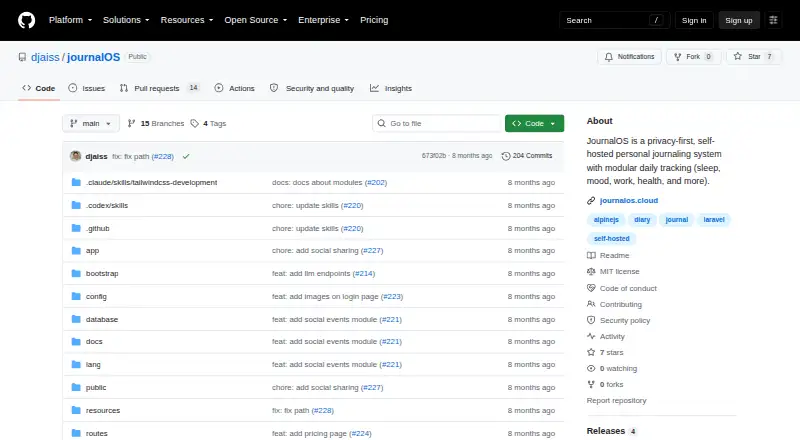
Its codebase provides a web app and API and uses the MIT license. The software is built as a Laravel monolith with server-rendered pages and AlpineJS interactions.
Good fit
JournalOS suits people who want structured daily memories, control of their data, and privacy-focused journaling. Developers and power users can also host the application or work with its software.
Its tracking areas fit users who want one place for personal, work, health, mood, social, travel, and weather notes.
Watch for
The project excludes long personal journals, social sharing, coaching, and habit gamification. Check that its structured approach matches how you want to write.
JournalOS says data is fully encrypted at rest but also warns that this has severe drawbacks. Its security policy asks for vulnerability reports by email and has no bug bounty program.
Pricing
JournalOS is free and open source.
You may use the hosted service or arrange hosting for your own installation.
Verdict
Choose JournalOS if ownership, self-hosting, and structured tracking matter more than free-form writing or social features. Its API, open license, and documented installation options give technical users room to manage the setup themselves.
Look elsewhere if you want a conventional long diary, built-in coaching, public sharing, or game-like habit tracking.
Our take
JournalOS is a sensible choice for people who want a private, structured record of daily life and are comfortable with either a hosted service or technical self-hosting. Its free MIT-licensed code and API can appeal to developers and power users. The trade-off is a narrower purpose: it does not aim to replace a long-form diary, social journal, coaching tool, or habit game. Review the encryption warning and security policy before deploying it for sensitive information, especially if you plan to run your own server.
- Free and open-source under the MIT license
- Self-hosting supports Docker or manual installation
- Tracks health, mood, work, social, travel, and weather details
- API access and an LLM-friendly data URL
- The maker says it has no ads, data resale, or behavioral manipulation
- Long personal journals are outside its intended use
- Social sharing, coaching, and habit gamification are not included
- Encryption at rest comes with stated severe drawbacks
- Self-hosting requires your own server setup
- No bug bounty program is offered
- Pick it ifStructured daily memory tracking; Privacy-minded users who want data ownership; Developers and power users
- Skip it ifYou want a long-form personal diary; You need social features, coaching, or game-like habits; You prefer software without self-hosting choices
Pricing
JournalOS is free and open source. The hosted service is available, and users can also run their own installation; no paid plans are listed.
Questions
Where can JournalOS run?
It runs on the web, offers an API, and can be self-hosted. Self-hosting documentation covers Docker and manual installation.
What can I track in JournalOS?
Tracking areas include body and health, mind and emotions, work, social life, and places, with examples such as sleep, mood, energy, work, travel, and weather.
Can I stop old entries from being changed?
Yes. Older journal entries can be protected against editing.
Does JournalOS support my own LLM?
A friendly URL lets users access their data with an LLM of their choice, according to the project.
Is JournalOS suitable for a traditional diary?
The project excludes long personal journals, focusing instead on structured daily details.
Who owns the data?
The maker says users own their data and that the service has no ads, data resale, or behavioral manipulation.
What languages are available?
Translations are available in English and French.