Kamu: Free Data Fabric for Traceable Data Sharing
kamu.dev · checked 30 Sept 2026
An open data fabric for traceable data sharing and processing across organizations.
How it plugs in
Signal on Data Fabric Software6.7#2 of 25
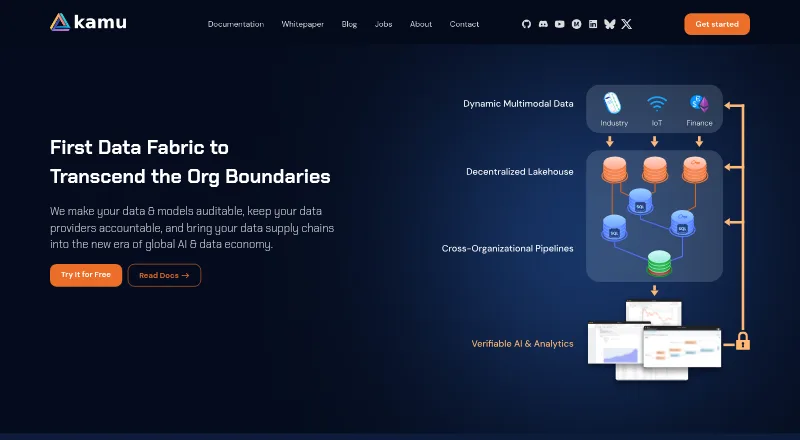
Kamu is a data fabric built around the Open Data Fabric format and protocol. Its CLI manages structured data, records its history, and runs SQL-based pipelines. Kamu Node provides a scalable server version for Kubernetes. It connects with several processing engines, databases, notebooks, BI tools, and common or decentralized storage.
Review
In a line
Kamu is a data fabric for sharing and processing structured data between independent organizations. It is designed to keep a verifiable record of where data came from and how it changed.
What it does
Kamu CLI is a command-line tool for managing dynamic data and building SQL-based extract, transform, and load pipelines. Temporal SQL handles changes over time, while near-real-time pipelines can run with supported processing engines.
Data history and transformation code stay with the data. This lets users trace its source, see who changed it, and check whether results can be reproduced.
Built-in sources include web polling, MQTT brokers, and blockchain logs. Debezium extractors can bring in database changes.
How it connects
Kamu implements Open Data Fabric (ODF), a set of formats and exchange rules for verifiable processing. ODF datasets can move through S3, Google Cloud Storage, Azure storage, or IPFS.
Spark, Flink, Arroyo, and DataFusion can plug into the same pipeline. Databases can feed Kamu, and notebooks, BI tools, and analytics platforms can query datasets through standard protocols and SQL.
Exploration options include an embedded SQL shell, Jupyter notebooks, an embedded web interface, Apache Superset, and other BI tools. Kamu is developed in the open, and its maker welcomes contributors. See data fabric software for a wider category view.
Good fit
Kamu suits data exchanged by independent parties when trust, traceability, and protection from malicious changes matter. The documentation points to energy, government and enterprise data, research, IoT insights, financial services, healthcare, Web3, and smart-city work.
The CLI runs on a laptop and can scale to a large on-premises cluster. Kamu Node is the server counterpart, packaged for Kubernetes and able to provide APIs to applications and smart contracts.
Watch for
The documentation says Kamu is not a good match for high-frequency, high-volume IoT workloads, although it may fit analysis derived from that data. Check workload frequency and volume before choosing it.
Kamu Platform is marked as coming soon. Self-hosted Node deployment uses Kubernetes in a distributed environment. The installation guide also warns that sudo-less Docker access can expose the filesystem with root privileges and recommends rootless Podman instead.
Questions and feedback are directed to GitHub issues or Discord.
Pricing
Kamu is free. The Kamu CLI plan runs on a laptop and can scale to a large on-premises cluster.
The maker says the CLI can be installed and used without a credit card, user account, or cloud subscription.
Verdict
Choose Kamu when multiple parties need to exchange structured data while keeping ownership, origin records, and processing accountability. It is also a fit for teams that want SQL pipelines with several processing engines and a self-hosted Kubernetes option.
Look elsewhere for workloads that produce very large volumes at high frequency, especially raw IoT streams. Also account for the operational work of running Kubernetes-based Node deployments and the fact that the hosted Kamu Platform is not available yet.
Our take
Kamu makes sense for organizations that must prove how shared data was produced and changed. Its free CLI, open development model, SQL pipelines, and broad storage and analytics connections lower the entry barrier. The main decision points are operational: whether your team can run Kubernetes for the server component and whether your data arrives at a moderate enough rate. High-volume, high-frequency IoT processing is outside its stated sweet spot, and the hosted platform is still pending.
- Free CLI with no account, credit card, or cloud subscription
- Tracks data origins, transformations, and reproducible results
- Works with Spark, Flink, Arroyo, and DataFusion plugins
- Supports common and decentralized storage, including S3 and IPFS
- Open-source development welcomes contributors
- Not suited to high-frequency, high-volume IoT workloads
- Kamu Platform is listed as coming soon
- Self-hosted Node deployment requires Kubernetes
- Docker permissions can expose the filesystem with root privileges
- Pick it ifOrganizations sharing mission-critical data across independent parties; Teams needing traceable SQL pipelines and verifiable data history; Self-hosted deployments using Kubernetes
- Skip it ifYou need to process raw IoT streams at very high frequency and volume; You want a hosted Kamu Platform today; You cannot operate a distributed Kubernetes deployment
Pricing
The CLI is free to install and use, including on a laptop or a large on-premises cluster. No account, credit card, or cloud subscription is required.
- Kamu CLIRuns on a laptop; can scale to a large on-prem clusterFree
As kamu.dev lists them, checked 30 Sept 2026.
Questions
Is Kamu free?
Yes. The Kamu CLI plan is free, and the maker says it needs no account, credit card, or cloud subscription.
What systems does Kamu run on?
The CLI works on Linux, macOS, and Windows with WSL2. Kamu Node can run as Kubernetes applications in a distributed environment.
Can Kamu connect to databases and BI tools?
Yes. Kamu can ingest database data, while notebooks, Apache Superset, BI tools, and analytics platforms can query datasets using standard protocols and SQL.
Which processing engines does Kamu support?
Spark, Flink, Arroyo, and DataFusion can be added as pipeline plugins.
What is Open Data Fabric?
ODF is the collection of data formats and exchange protocols implemented by Kamu CLI and Node for verifiable processing.
Is Kamu suitable for high-volume IoT?
The documentation says it is not well suited to high-frequency, high-volume IoT workloads, though it may fit insights produced from that data.
Where can datasets be stored or shared?
ODF datasets can use S3, Google Cloud Storage, Azure storage, or decentralized storage such as IPFS.
Near it
All alternatives →- II
 Informatica Intelligent Data Management Cloud#1 on this board
- SDSolix Data Fabric#3 on this board
- DPDenodo Platform#4 on this board
- KF
 K2View Fabric#5 on this board
- GV
 GE Vernova Proficy Plant Applications#6 on this board
- IEInfor Enterprise Performance Management#7 on this board
- SCSAP Customer Data Platform#8 on this board
- NNexla#9 on this board
- SWServiceNow Workflow Data Fabric#10 on this board
- SD
 SCIKIQ Data Fabric#11 on this board