Kanapy: Synthetic Polycrystalline Microstructures
mrgprasad.github.io · checked 12 Oct 2026
Python toolkit for synthetic polycrystalline microstructures and EBSD map analysis.
How it plugs in
Signal on 3D modeling software6.3#65 of 147
Kanapy builds three-dimensional synthetic polycrystalline microstructures from statistical descriptions of grains and phases combined with crystallographic texture information. The package analyzes experimental EBSD maps, supports multiple phases, creates voxel-based hexahedral meshes, and prepares outputs for Neper and Abaqus. A desktop Python environment on Linux, macOS, or Windows provides command-line and API access.
Review
In a line
Kanapy combines grain and phase statistics with crystallographic texture information to construct synthetic three-dimensional polycrystalline microstructures.
What it does
The package can inspect experimental EBSD maps for both microstructure morphology and texture. It can reconstruct crystallographic orientation distributions and assign grain orientations from measured misorientation distributions.
Kanapy supports multiphase structures in which matrix and dispersed phases are specified independently. For finite element work, its hexahedral mesh generator expresses complex polycrystalline structures as voxels.
How it connects
Python and command-line interfaces are available in Kanapy, while its graphical interface remains an alpha release under development.
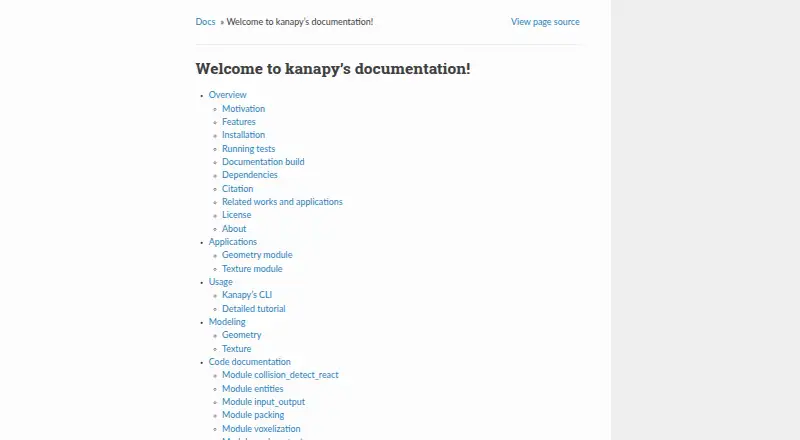
Through the modular materials data schema, Kanapy can import and export voxel structures. It can also create particle-position and radius files for Neper and input files for Abaqus.
Kanapy uses the GNU Affero General Public License version 3. Its examples, notebooks, and documentation are covered separately by CC BY-NC-SA 4.0.
Good fit
Kanapy suits researchers and industry teams that need synthetic microstructures for finite element simulations or other research work. It is also suited to users analyzing EBSD measurements and reconstructing crystallographic texture.
Watch for
The project documents installation through conda-forge or pip in a Python environment, with NumPy, SciPy, Matplotlib, orix, NetworkX, and scikit-image among the listed dependencies.
Linux and macOS installations need a working C/C++ compiler; Windows installation relies on a pre-built wheel. Texture features require MATLAB and MTEX to be installed separately.
The geometry module's performance-sensitive part is written in C++ and accessed through Python bindings, while the GUI remains under development.
Pricing
Kanapy has a free plan.
Verdict
Kanapy is suited to work involving measured grain structures, crystallographic texture, voxel meshes, or simulation inputs for Neper and Abaqus. Its command line and Python access fit technical workflows, and its multiphase support covers more than single-phase models.
Users seeking a completed graphical application, unable to install MATLAB and MTEX for texture work, or lacking a Linux or macOS compiler may prefer another option. Windows users avoid that compiler requirement through the pre-built wheel.
Our take
Kanapy is a practical choice for specialists building synthetic microstructures from EBSD measurements and texture data. It covers multiphase modeling, voxel mesh creation, and export paths into Neper and Abaqus. The main tradeoff is setup: it needs several scientific Python packages, separately installed MATLAB and MTEX for texture functionality, and its graphical interface is unfinished. Teams comfortable with command-line or Python workflows should find the package a closer fit than users seeking a polished visual modeling tool.
- Free plan available
- Supports multiphase microstructures
- Creates voxel-based hexahedral meshes
- Produces Neper and Abaqus integration files
- Provides Python API and command-line tools
- Alpha GUI remains under development
- MATLAB and MTEX are separate requirements for texture features
- Linux and macOS require a C/C++ compiler
- Requires several Python scientific dependencies
- Pick it ifResearchers analyzing EBSD maps; Finite element microstructure workflows; Teams using Python, Neper, or Abaqus
- Skip it ifYou require a completed graphical interface; MATLAB and MTEX cannot be installed for texture work; A compiler cannot be provided on Linux or macOS
Pricing
Kanapy has a free plan.
Questions
Is Kanapy free?
Yes. A free plan is available for Kanapy.
Which operating systems support Kanapy?
Documentation covers Linux, macOS, and Windows. Linux and macOS need a working C/C++ compiler, while Windows uses a pre-built wheel.
Does Kanapy have an API?
Yes. It includes Python and command-line interfaces; the graphical interface is still an alpha version under development.
Can Kanapy analyze EBSD maps?
Yes. The package can inspect experimental EBSD maps for microstructure morphology and texture, then assign orientations from measured misorientation distributions.
Can it create simulation files?
It can generate particle position and radius files that Neper reads, Abaqus input files, and voxel-based hexahedral meshes.
What does Kanapy require for texture features?
Texture functionality uses MATLAB and MTEX, and both must be installed separately.
What license does Kanapy use?
Kanapy is distributed under the GNU Affero General Public License version 3. Its examples, notebooks, and documentation are licensed separately under CC BY-NC-SA 4.0.