KodeKloud review: DevOps, cloud and AI training
kodekloud.com · checked 15 Oct 2026
How it plugs in
Signal on Cloud Training Platforms6.6#2 of 25
KodeKloud is an online school for DevOps, cloud and AI. Its browser service and Android and iOS apps provide access, while subscribers can use KodeKey to experiment with multiple AI providers in one workspace and through an OpenAI-compatible endpoint.
Review
In a line
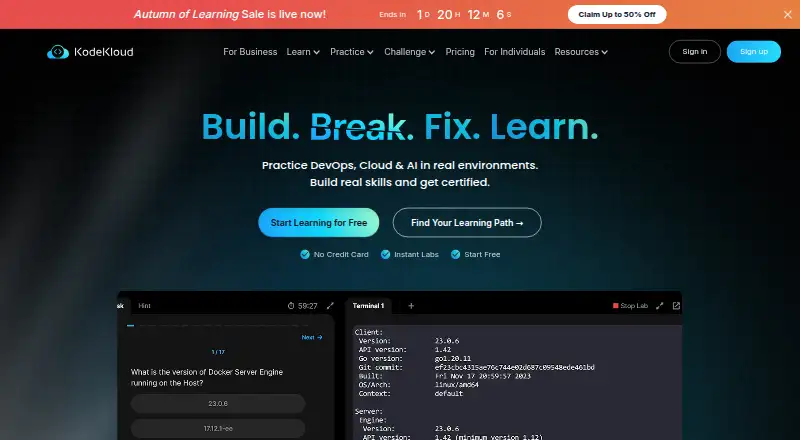
The service combines self-paced DevOps, cloud and AI lessons with a learner community and temporary practice environments.
What it does
Learners progress through on-demand material at their own pace. Depending on the course, they may encounter video lectures, written lessons, quizzes, interactive labs or mock exams. Role- and subject-based routes include DevOps Engineer, Kubernetes, AWS, Azure, Linux and AI.
When that window closes, the session expires and captured information is destroyed. Cloud playgrounds have separate resource limits.
The syllabus covers Kubernetes, Docker, Linux, Terraform, AWS, Azure, Google Cloud, Python, CI/CD and MLOps. Courses also prepare learners for CKA, CKAD, CKS, AWS and Microsoft Azure certifications. KodeKey lets subscribers test models from Anthropic, Google and DeepSeek.
How it connects
KodeKloud runs as a hosted platform reachable through the web, Android and iOS. The mobile apps stream lessons, allow offline downloads and sync progress, whereas labs, playgrounds, AI playgrounds and quizzes currently require the web.
Subscription users can send requests to KodeKey through its OpenAI-compatible endpoint; documentation demonstrates Python, JavaScript and cURL with the OpenAI client format. The endpoint is intended for study and short experiments, not production applications or enterprise AI gateway workloads.
The learning platform is proprietary, not open source. KodeKloud nevertheless maintains a public GitHub organization containing course notes, challenges, examples and other learning repositories. A community forum and Discord provide additional learner support.
Good fit
KodeKloud says its courses serve beginners through experienced professionals at different career stages. Structured routes, certification work and disposable practice environments let learners build skills without setting up local systems.
Depending on the package, teams get dashboards, learning tracking, reports, assignments, centralized billing and webinars. Enterprise plans add SSO/SAML, guided team onboarding, a dedicated learning consultant, an account manager and custom reports and charts.
Watch for
A lab ends when its allotted time runs out, and data captured during that session is not retained.
Labs may need a compatible browser configuration. KodeKloud recommends Google Chrome and notes that JavaScript, WebSockets, hardware acceleration and a stable connection can be required. Cloud playground resources also have caps.
The mobile apps omit labs, playgrounds, AI playgrounds and quizzes. KodeKey token allowances renew on the first of every month, and its models are for educational experimentation rather than large or production projects.
Email help is offered Monday through Friday from 10 a.m. to 10 p.m. India Standard Time.
Pricing
KodeKloud has a Free plan, a seven-day trial and paid options. Free access includes free courses, selected labs and playgrounds, free videos, basic KodeKloud Engineer, plus community and Discord access.
The $30-per-user monthly Pro plan adds Pro courses, over 60 DevOps playgrounds, three cloud playgrounds and KodeKloud Engineer Pro. At $46 per user each month, AI adds AI-assisted labs, a personalized AI tutor and multilingual AI.
For Business costs $330 per user annually and includes team dashboards, learning reports, license transfer, webinars, Pro and Standard courses and AI features. Teams is shown at $360 per user per year for two to five users, with courses, labs, DevOps and cloud playgrounds, AI playgrounds including KodeKey, administration, billing and assignments.
The Business tier uses a custom quote, requires at least two seats and bills annually. It includes AI features, team tracking and reports, priority and dedicated support, and technical webinars.
Verdict
KodeKloud suits people seeking organized DevOps, cloud or AI learning alongside short-lived practice environments and certification work. The free option offers an entry point, while paid levels add playgrounds, AI tools and team administration.
Review browser, connectivity and session limits before subscribing. KodeKey is suited to brief educational testing rather than production AI systems. Organizations wanting SSO, reporting or dedicated help should compare the business tiers.
Our take
KodeKloud fits learners who prefer structured routes and disposable environments instead of permanent infrastructure. Its broad coverage and certification tracks span multiple career stages, and the free option lowers the initial cost. Trade-offs include expiring labs, browser and network prerequisites, and web-only practical features. Teams should weigh administration and support against their number of seats. KodeKey should be treated as a study utility because its stated limits exclude production workloads.
- Self-paced instruction spans DevOps, cloud and AI topics
- A no-cost plan and seven-day trial are available
- Tracks cover CKA, CKAD, CKS, AWS and Azure exam preparation
- Subscribers receive KodeKey access through an OpenAI-compatible endpoint
- Labs and playgrounds depend on a suitable browser and reliable connection
- The phone apps leave out labs, playgrounds, AI playgrounds and quizzes
- KodeKey is limited to learning and experimentation, not large or production projects
- Pick it ifPeople developing DevOps, cloud or AI capabilities; Certification learners who want temporary practice environments; Teams seeking reports, tracking and assignment controls
- Skip it ifYou require self-hosted or open-source training software; Your workload needs a production-ready AI API; You expect labs and quizzes to run within a mobile app
Pricing
A free option and seven-day trial are available before payment. Team offerings charge per user each year, while Business uses a tailored quotation.
- FreeFree courses · selected labs/playgrounds · free videos · basic KodeKloud Engineer · community and Discord accessFree
- Standardper user/month · Standard courses · hands-on labs$15/mo
- Proper user/month · Standard and Pro courses · 60+ DevOps playgrounds · 3 cloud playgrounds · KodeKloud Engineer Pro$30/mo
- AIper user/month · Pro features · AI-assisted labs · personalized AI tutor · multilingual AI$46/mo
- For Businessper user/year · Team dashboard · learning reports · license transfer · webinars · Pro and Standard courses · AI features$330/yr
- TeamsUSD 360 /user/year; page also displays USD 24.85 · Recommended for 2–5 users · courses, labs, DevOps and Cloud playgrounds, AI playgrounds including KodeKey · admin dashboard · centralized billing · course assignments$360/yr
- BusinessCustom quote; 2 seats minimum and billed annually · Everything in AI · team dashboard · learning tracker and reports · priority and dedicated support · technical webinarsOn request
As support.kodekloud.com lists them, checked 15 Oct 2026.
Questions
Is there a free KodeKloud option?
Yes. The Free plan provides free courses, selected labs and playgrounds, free videos, basic KodeKloud Engineer, and community and Discord access. A seven-day trial is also available.
Can KodeKloud lessons be used on a phone?
Android and iOS apps stream courses, download lessons for offline use and synchronize progress. Labs, playgrounds, AI playgrounds and quizzes are restricted to the web.
Does KodeKloud provide an API?
Subscribers can use KodeKey's OpenAI-compatible endpoint. Its guides show Python, JavaScript and cURL examples, and position the service for learning and short tests rather than production.
Is the KodeKloud platform open source?
No. KodeKloud calls the platform proprietary, while its public GitHub organization hosts notes, challenges, examples and related learning repositories.
Which subjects are covered?
Coverage includes Kubernetes, Docker, Linux, Terraform, AWS, Azure, Google Cloud, Python, CI/CD and MLOps, arranged into role and topic pathways.
Near it
All alternatives →- AS
 AWS Skill Builder#1 on this board
- SCSimplilearn Cloud Computing#3 on this board
- E
 ExamPro#4 on this board
- AA
 AWS Academy#5 on this board
- C
 CloudLabs#6 on this board
- P
 Pluralsight#7 on this board
- ACAlibaba Cloud Academy#8 on this board
- TD
 Tutorials Dojo#9 on this board
- IInstruqt#10 on this board
- OUOracle University#11 on this board